
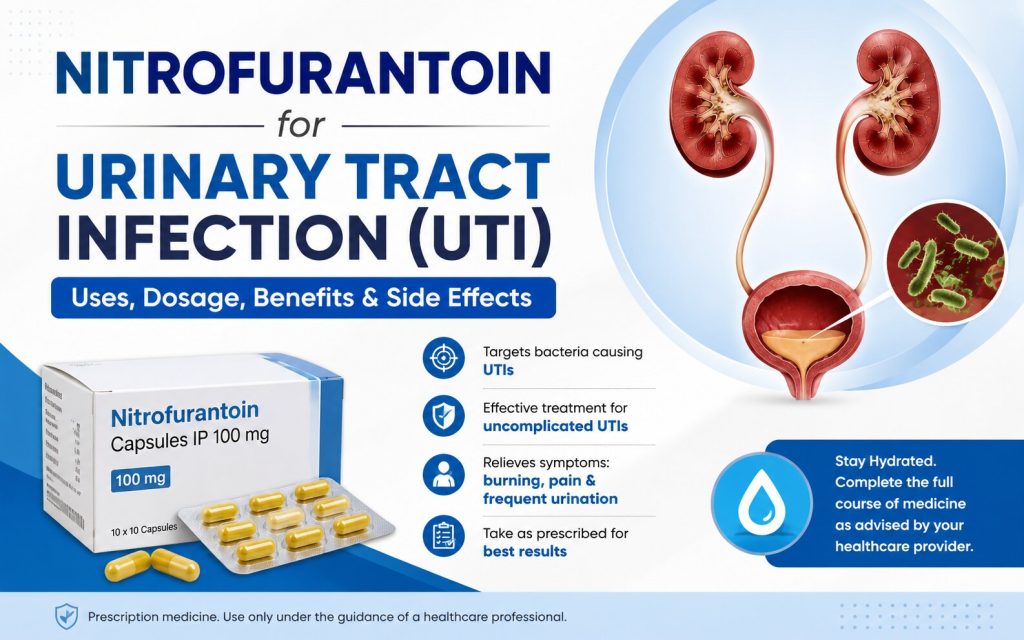
Urinary tract infections (UTIs) are among the most common bacterial infections worldwide, affecting millions of people — particularly women — every year. Among the many antibiotics available to treat this uncomfortable condition, nitrofurantoin stands out as a first-line treatment recommended by major health organisations, including the CDC and NICE guidelines in the UK. This guide explores what nitrofurantoin is, how it works, who it’s suitable for, and what you need to know before taking it. Nitrofurantoin for Urinary Tract Infection
What Is Nitrofurantoin?
Nitrofurantoin is a synthetic antimicrobial medication belonging to the nitrofuran class of antibiotics. It has been used since the 1950s to treat urinary tract infections and remains one of the most trusted options today, largely because bacteria have been slow to develop resistance to it — a growing concern with many other antibiotic classes.
Unlike broad-spectrum antibiotics that circulate throughout the entire body and treat infections in multiple organ systems, nitrofurantoin 100mg is unique in that it concentrates almost exclusively in the urine and bladder. This targeted action is precisely what makes it so effective for treating lower urinary tract infections, while also limiting its usefulness for infections elsewhere in the body, such as the kidneys or bloodstream.
Nitrofurantoin for Urinary Tract Infection is available under various brand names and generic formulations, including modified-release (MR) capsules designed to release the medication more gradually, reducing gastrointestinal side effects compared to older standard-release tablets.
How Does Nitrofurantoin Work?
Understanding the mechanism of action helps explain why nitrofurantoin is so effective against certain bacteria while being gentler on the body compared to other antibiotics.
Once nitrofurantoin enters a bacterial cell, an enzyme called nitrofuran reductase rapidly converts it into highly reactive intermediate compounds. These reactive molecules attack multiple essential bacterial processes simultaneously, including:
- Bacterial DNA — causing direct damage that prevents replication
- Ribosomal proteins — disrupting the bacteria’s ability to produce essential proteins
- Pyruvate metabolism — interfering with the bacteria’s energy production
- Cell respiration — impairing the bacteria’s ability to generate energy
Because nitrofurantoin attacks so many different bacterial targets at once, it’s much harder for bacteria to develop resistance through a single genetic mutation, unlike antibiotics that target only one specific pathway. This multi-target mechanism is a major reason nitrofurantoin has remained effective for decades, even as resistance to other UTI antibiotics has increased.
Importantly, bacterial cells activate nitrofurantoin far more quickly than human cells do, which is why the drug is much more toxic to bacteria than to the person taking it — resulting in a favourable safety profile when used correctly.
What Is Nitrofurantoin Used For?
Nitrofurantoin is specifically indicated for:
- Treatment of acute uncomplicated lower UTIs (cystitis) — bladder infections that haven’t spread to the kidneys
- Prevention of recurrent UTIs — used as a low-dose, long-term preventive therapy in people who experience frequent urinary tract infections
It is important to note what nitrofurantoin is not used for. Because it concentrates in the urine rather than spreading through the bloodstream, it does not reach adequate concentrations in kidney tissue. This means it is not effective for treating kidney infections (pyelonephritis) or any infection outside the urinary tract, such as respiratory infections, skin infections, or bloodstream infections. Using nitrofurantoin for these conditions risks treatment failure and allowing the infection to worsen.
Who Should Take Nitrofurantoin for Urinary Tract Infection?
Nitrofurantoin is generally prescribed for:
- Women with uncomplicated cystitis (the most common scenario)
- Men with uncomplicated lower UTIs, though they typically require a longer treatment course
- Individuals with recurrent UTIs who may benefit from long-term low-dose preventive therapy
However, nitrofurantoin isn’t suitable for everyone. It should generally be avoided in people with:
- Significantly reduced kidney function (typically an eGFR below 45 mL/min/1.73m²), since the drug cannot reach effective concentrations in the urine when kidney function is impaired
- Known hypersensitivity or allergy to nitrofurantoin or related compounds
- Glucose-6-phosphate dehydrogenase (G6PD) deficiency — a rare inherited enzyme deficiency that can lead to red blood cell breakdown when exposed to nitrofurantoin
- Late pregnancy (at or near term), due to a small risk of a specific type of newborn blood cell breakdown
- Newborn infants, as their enzyme systems are not yet mature enough to safely process the drug
Dosage and How to Take Nitrofurantoin for Urinary Tract Infection
The standard adult dosing for treating an active UTI typically involves:
- 100mg taken twice daily with food, usually for a 5-day course in women
- A 7-day course is often recommended for men, as they carry a higher risk of the infection spreading to the upper urinary tract
For individuals experiencing frequent, recurrent UTIs, doctors may prescribe a lower preventive dose — often 50–100mg taken once daily — over a longer period to reduce the frequency of future infections.
A few practical tips for taking nitrofurantoin correctly:
- Always take it with food or milk. This significantly improves absorption and increases the concentration of the drug reaching the urine, while also reducing the likelihood of nausea — the most commonly reported side effect.
- Swallow modified-release capsules whole. Do not crush or chew them, as this can affect how the medication is released into the body.
- Complete the full course, even if symptoms improve after a day or two. Stopping early increases the risk of the infection returning or bacteria developing resistance.
- Take doses at the same time each day to maintain consistent levels in the urine and help you remember your regimen.
- If you miss a dose, take it as soon as you remember, unless it’s almost time for your next dose — in that case, skip the missed dose rather than doubling up.
Common Side Effects of Nitrofurantoin for Urinary Tract Infection
Like all medications, nitrofurantoin can cause side effects, though most are mild and temporary. Commonly reported effects include:
- Nausea (the most frequent side effect, reduced significantly by taking the drug with food)
- Headache
- Dizziness
- Loss of appetite
- Harmless darkening of the urine to a yellow-brown colour — a normal effect of the drug being excreted, not a cause for concern
- Mild skin rash
Serious Side Effects to Watch For Nitrofurantoin for Urinary Tract Infection
While uncommon, particularly with short 5–7 day courses, certain side effects require prompt medical attention:
- Signs of a severe allergic reaction — hives, facial or throat swelling, difficulty breathing
- Pulmonary toxicity — a persistent new cough, breathlessness, or chest pain, which can occur with prolonged use
- Peripheral neuropathy — tingling, numbness, or weakness in the hands or feet, generally associated with long-term use
- Jaundice — yellowing of the skin or eyes, which may indicate liver involvement
- Vision changes, tinnitus, or seizures — rare but serious neurological effects
If any of these symptoms develop while taking nitrofurantoin, contact a healthcare provider immediately.
Nitrofurantoin During Pregnancy and Breastfeeding
Nitrofurantoin is generally considered one of the safer antibiotic options for treating UTIs during pregnancy, particularly in the second trimester. However:
- It is typically avoided during the first trimester where alternative options exist
- It must not be used at or near term (the final weeks of pregnancy), due to the risk of hemolytic anaemia in the newborn
For breastfeeding mothers, nitrofurantoin passes into breast milk in small amounts. It is generally considered compatible with breastfeeding healthy, full-term infants older than one month, but should be avoided when breastfeeding newborns under one month old or premature infants, whose enzyme systems are less developed.
Anyone who is pregnant or breastfeeding should always discuss antibiotic options with their doctor before starting treatment.
Nitrofurantoin for Urinary Tract Infection vs. Other UTI Antibiotics
Nitrofurantoin is often compared to other commonly prescribed UTI antibiotics, such as ciprofloxacin, trimethoprim, and fosfomycin. A few key distinctions:
- Lower resistance rates: Compared to fluoroquinolones like ciprofloxacin, nitrofurantoin has maintained comparatively low resistance rates among common UTI-causing bacteria such as E. coli.
- Gentler on gut bacteria: Nitrofurantoin has a narrower effect on the broader gut microbiome compared to broad-spectrum antibiotics, helping preserve the balance of beneficial gut bacteria.
- Reserved use of stronger antibiotics: Using nitrofurantoin as a first-line treatment helps preserve more powerful antibiotics, like fluoroquinolones, for cases where they’re truly necessary — such as complicated infections or kidney infections.
This is part of a broader antimicrobial stewardship strategy that aims to slow the global spread of antibiotic resistance by reserving stronger antibiotics for situations where first-line options aren’t appropriate.
Drug Interactions to Be Aware Of
Certain medications can interact with nitrofurantoin, potentially reducing its effectiveness or increasing side effects:
- Magnesium trisilicate antacids can significantly reduce absorption — these should not be taken together
- Probenecid and sulfinpyrazone (often used for gout) can reduce the concentration of nitrofurantoin reaching the urine, making it less effective
- Quinolone antibiotics may antagonise nitrofurantoin’s action and are generally not combined with it
Always provide your doctor or pharmacist with a complete list of medications and supplements you’re taking before starting nitrofurantoin.
Lifestyle Tips to Support Recovery
Alongside taking your prescribed antibiotic course, a few simple habits can support faster recovery and reduce discomfort:
- Stay well hydrated. Drinking plenty of water helps flush bacteria out of the bladder and supports the antibiotic’s action.
- Avoid alcohol during treatment. Alcohol can irritate the bladder lining, worsening symptoms like burning and frequent urination, and its dehydrating effect works against recovery.
- Urinate frequently and don’t hold it in. Regular urination helps clear bacteria from the urinary tract more quickly.
- Avoid bladder irritants, such as caffeine and spicy foods, until symptoms resolve.
When to See a Doctor
While nitrofurantoin is highly effective for uncomplicated UTIs, certain symptoms suggest a more serious infection that requires different treatment:
- Fever, chills, or back/flank pain (possible signs of a kidney infection)
- Symptoms that don’t improve within 2–3 days of starting treatment
- Blood in the urine that doesn’t resolve
- Recurrent infections occurring more than a few times per year
These situations may require further evaluation, a different antibiotic, or additional testing to rule out underlying causes.
Final Thoughts
Nitrofurantoin 100mg remains a cornerstone treatment for uncomplicated urinary tract infections due to its targeted mechanism, low resistance rates, and generally favourable safety profile. Its unique way of concentrating in the urine makes it especially effective for bladder infections while limiting its use for more complex infections elsewhere in the body.
As with any antibiotic, it’s essential to take nitrofurantoin exactly as prescribed, complete the full course, and consult a healthcare provider with any questions about suitability, dosage, or side effects — particularly if you are pregnant, breastfeeding, or have underlying kidney or blood-related conditions.
This article is intended for general informational purposes only and should not replace professional medical advice. Always consult a licensed healthcare provider before starting, stopping, or changing any medication.


Latest posts by Marie (see all)
- Semaglutide for PCOS: Can It Help with Weight Loss, Insulin Resistance & Irregular Periods? - October 17, 2026
- Semaglutide Side Effects: Common Symptoms, Serious Risks & Safety Tips - October 16, 2026
- How to control high cholesterol: self-care at home? - October 15, 2026


