




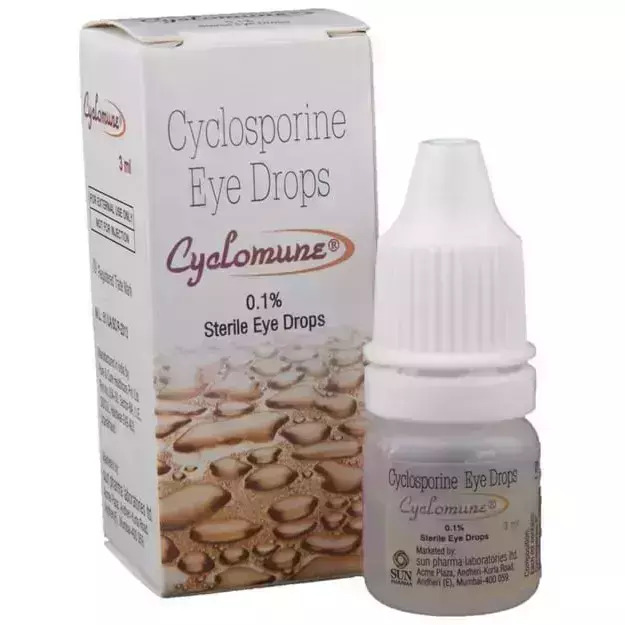
Cyclomune 0.1% (3 ml)
Available Dosages
| SKU | 2719 |
|---|---|
| Generic For | Cyclosporine |
| Manufacturer | Sun Pharma, India |
| Active Ingredient | Cyclosporine |


| Pack Size | Qty | Price Per Pill or Unit | Price | Cart | |
|---|---|---|---|---|---|
| 1 Eye Drop/s | US$ 15.00 | US$ 15.00 | |||
|
|||||
| 3 Eye Drop/s | US$ 13.00 | US$ 39.0013%US$ 45.00 | |||
|
|||||
| 5 Eye Drop/s | US$ 13.00 | US$ 65.0013%US$ 75.00 | |||
|
|||||

Cyclomune 0.1% (Cyclosporine)
Cyclomune 0.1% is an ophthalmic medicine used to treat moderate to moderately severe aqueous-deficient dry eye disease. This disease affects certain patients whose eyes are not producing sufficient tears to keep them moist and comfortable. The active ingredient of the medicine is Cyclosporine, which allows for increased tear production by reducing inflammation (swelling) in the eye. This helps to maintain the lubrication and reduces discomfort associated with it.
Before you use Cyclomune eye drops, talk to your healthcare professional if any of the following applies to you:
- History of herpes keratitis. The use of cyclosporine emulsion has not been studied in people with this condition.
- Dry eyes can result from Vitamin A deficiency or scarring. Cyclosporine eye drops have not been tested in people with these causes of dry eyes.
- The ophthalmic emulsion may cause blurring of vision immediately after you instil the eye drops. Wait for a few minutes until your vision clears before you attempt to drive or operate a complex machine.
- You are breastfeeding a baby. The effect of the medicine on breast milk is unknown.
- You are pregnant or planning to become pregnant. While there are no side effects associated with the medicine in human pregnancy. There is very little information available regarding the use of this medicine in pregnant women. Additionally, you should consult with your healthcare expert to determine the best course of action.
- You should not touch the tip of the ampoule to the eye or any surface, as this may contaminate the ophthalmic product, or touching the eye may cause injury.
- No drug interaction has been reported with Cyclomune 0.1% eye drops. However, concomitant use with eye formulations should be discussed with your healthcare provider.
- The safety and effectiveness of this product have not been demonstrated in children below the age of 16.
- Ocular burning is commonly associated with the use of Cyclomune 0.1%. Other common side effects include headache, irritation, a foreign body sensation in the eye, eye-stinging, eye pain, eye discharge, conjunctival hyperaemia, eye pruritus, dry eye, photophobia, and blurred vision. These effects usually improve on their own as your eyes become used to treatment with this medicine.
- There is a risk of developing an allergic reaction to this antibiotic. Reactions include swelling of the face, tongue, and throat, an itchy skin rash, and shortness of breath. If an allergic reaction occurs, discontinue treatment immediately and contact your healthcare provider.
This is not the complete list of side effects. For any unexpected side effects while using Cyclomune 0.1%, talk to your healthcare provider.
How to use Cyclosporine ophthalmic solution
The usual suggested dose is one drop into each affected eye, used twice daily, about 12 hours apart. Before using the product, gently shake the ampule by tipping it up and down a few times until the emulsion is uniform throughout. The medicine may be used along with artificial tears. Wait for at least fifteen minutes between using the medicine and the artificial tear product. Avoid using it when you wear contact lenses. If you must wear contact lenses, ensure that you remove them before using this medication. You should wait at least fifteen minutes before putting your contact lenses back in. Do not use the eye drop if the seal is broken before you use it for the first time. It may take several weeks before you notice an improvement in your dry eyes. Keep using it as prescribed by your healthcare specialist.
Steps to use Cyclomune 0.1% eye drops:
- Wash your hands before using the medicine. Get ready, tilt your head and look at the roof.
- Gently pull down the lower eyelid to form a small pocket.
- Turn the vial down and squeeze a drop into the eyelid pocket.
- Close your eyes for thirty seconds.
- Repeat the steps for the other eye if both eyes require treatment.
What is Cyclosporine and what condition does it treat?
Cyclosporine is an immunosuppressive medication available in ophthalmic formulations like Cyclomune 0.1% eye drops. This immunomodulator primarily treats chronic dry eye disease, also known as keratoconjunctivitis sicca. The condition occurs when eyes don't produce enough tears or tears evaporate too quickly, causing discomfort, redness, and blurred vision. Cyclosporine ophthalmic emulsion works by reducing inflammation on the eye surface, helping restore natural tear production. Cyclomune 0.1% is specifically formulated to manage moderate to severe dry eye symptoms that haven't responded adequately to artificial tears or lubricating eye drops alone.
How does Cyclosporine work in the body to relieve dry eyes?
Cyclosporine functions as an immunomodulating agent that targets inflammatory processes causing dry eye disease. When applied as Cyclomune 0.1% eye drops, the active ingredient suppresses T-lymphocyte activity on the ocular surface, reducing immune-mediated inflammation that damages tear-producing glands. This anti-inflammatory action allows lacrimal glands to recover and resume normal tear secretion. Unlike simple lubricating drops that provide temporary moisture, this calcineurin inhibitor addresses the underlying inflammatory cycle, promoting long-term improvement in tear quality and quantity. The topical ophthalmic formula delivers cyclosporine directly to affected eye tissues with minimal systemic absorption.
How long does Cyclomune 0.1% take to start working for dry eyes?
Cyclomune 0.1% containing cyclosporine typically requires consistent use for noticeable improvement in dry eye symptoms. Most patients begin experiencing reduced eye discomfort and increased tear production within three to six months of regular application. Some individuals notice gradual benefits earlier, around six to eight weeks, while maximum therapeutic effect may take up to six months. This extended timeline reflects how the immunomodulator works—addressing underlying inflammation rather than providing instant symptom masking. Patience during initial treatment is essential, as the ophthalmic emulsion rebuilds natural tear function progressively. Continuous twice-daily application ensures optimal results for chronic dry eye relief.
When and how should I use Cyclomune 0.1% eye drops correctly?
Apply Cyclomune 0.1% exactly as prescribed, typically one drop in each affected eye twice daily, approximately twelve hours apart. Before application, wash hands thoroughly and remove contact lenses, waiting at least fifteen minutes before reinserting them. Tilt your head back, pull down the lower eyelid to create a pocket, and instill one drop without touching the dropper tip to your eye or any surface. Close your eye gently for one to two minutes to prevent drainage. If using multiple eye medications, wait at least five minutes between different drops. Your ophthalmologist will provide personalized dosing instructions based on your dry eye severity.
Is Cyclomune 0.1% safe for long-term use in chronic dry eye?
Cyclomune 0.1% with cyclosporine is generally considered safe for extended use in managing chronic dry eye disease. Clinical studies demonstrate favorable long-term safety profiles when the ophthalmic emulsion is used continuously over months or years. Unlike corticosteroid eye drops that may cause elevated intraocular pressure or cataracts with prolonged use, this immunomodulating medication has not shown such complications. The topical formulation minimizes systemic absorption, reducing risk of side effects associated with oral cyclosporine. Many patients use this dry eye treatment indefinitely to maintain symptom control, with regular ophthalmologic monitoring ensuring continued appropriateness and effectiveness.
Can I use Cyclomune 0.1% with other eye drops or medications?
Cyclomune 0.1% containing cyclosporine can typically be used alongside other ophthalmic products for comprehensive dry eye management. Many patients combine this immunomodulating eye drop with preservative-free artificial tears, which can be applied as needed throughout the day for additional lubrication. If you're using multiple prescription eye medications, maintain at least a five-minute interval between different drops to prevent dilution and ensure proper absorption. The ophthalmic emulsion is generally compatible with systemic medications, though you should inform your healthcare provider about all prescription and over-the-counter drugs you're taking to identify any potential interactions.
How does Cyclomune 0.1% compare to other dry eye treatments?
Cyclomune 0.1% stands among prescription-strength immunomodulators for chronic dry eye, comparable to medications like Restasis and Cequa that also contain cyclosporine. What distinguishes this ophthalmic emulsion is its formulation delivering 0.1% cyclosporine concentration effectively. Unlike simple lubricating drops or artificial tears that offer temporary moisture, Cyclomune addresses inflammatory causes of tear deficiency. Compared to lifitegrast-based alternatives like Xiidra, which block different inflammatory pathways, cyclosporine has longer clinical history and established safety data. Many ophthalmologists prefer this immunosuppressive approach for moderate to severe keratoconjunctivitis sicca, particularly when artificial tears alone provide insufficient relief.
Is generic Cyclosporine as effective as branded dry eye medications?
Generic cyclosporine formulations like Cyclomune 0.1% contain the same active ingredient and concentration as branded versions, delivering equivalent therapeutic benefits for dry eye disease. Regulatory authorities require generic ophthalmic medications to meet stringent bioequivalence standards, ensuring comparable efficacy, safety, and quality. The immunomodulating properties of the cyclosporine molecule remain identical regardless of brand versus generic status. Many ophthalmologists prescribe generic alternatives because they provide the same anti-inflammatory action and tear production improvement at more accessible prices. Clinical outcomes for chronic keratoconjunctivitis sicca treatment show no meaningful difference between branded and quality generic cyclosporine eye drops when properly manufactured.
Why do patients choose PremiumRxDrugs for Cyclomune 0.1%?
Patients select PremiumRxDrugs for Cyclomune 0.1% cyclosporine eye drops because as a licensed pharmacy combines affordability with authenticity. The platform offers manufacturer-sourced ophthalmic medications at competitive prices, making long-term dry eye treatment more accessible than many local pharmacies. Customers appreciate discreet worldwide shipping with free delivery options, eliminating privacy concerns and reducing costs. The pharmacy's streamlined prescription management simplifies reordering for chronic keratoconjunctivitis sicca patients requiring continuous immunomodulating therapy. With over ten years serving international customers across the USA, UK, Australia, and Canada, PremiumRxDrugs has established reliability in delivering genuine cyclosporine formulations with professional service and customer support.
What are the common side effects of Cyclosporine eye drops?
Cyclosporine ophthalmic emulsion commonly causes mild burning or stinging sensation immediately after application, affecting many users initially. This eye discomfort typically decreases with continued use as eyes adapt to the immunomodulating medication. Other frequent side effects include temporary eye redness, discharge, watery eyes, blurred vision, and feeling like something is in your eye. Some patients experience itching or pain at the application site. These reactions are generally mild and transient, resolving without intervention. Serious adverse effects are rare with topical cyclosporine for dry eye treatment. If burning persists severely or you develop eye infections or vision changes, contact your ophthalmologist promptly.
Who should not use Cyclosporine eye drops for dry eyes?
Cyclosporine ophthalmic formulations are contraindicated for individuals with known hypersensitivity or allergic reactions to cyclosporine or any excipients in the emulsion. Patients with active eye infections, including viral, bacterial, or fungal keratitis, should not use this immunosuppressive medication until the infection clears, as it may worsen infectious conditions. Pregnant or breastfeeding women should discuss risks and benefits with their healthcare provider before starting cyclosporine eye drops. Children under sixteen typically lack established safety data for this dry eye treatment. People with compromised immune systems require careful evaluation before using immunomodulating ophthalmic medications. Always disclose your complete medical history to your ophthalmologist before beginning cyclosporine therapy.
Login
Sign Up
Login
Sign Up