




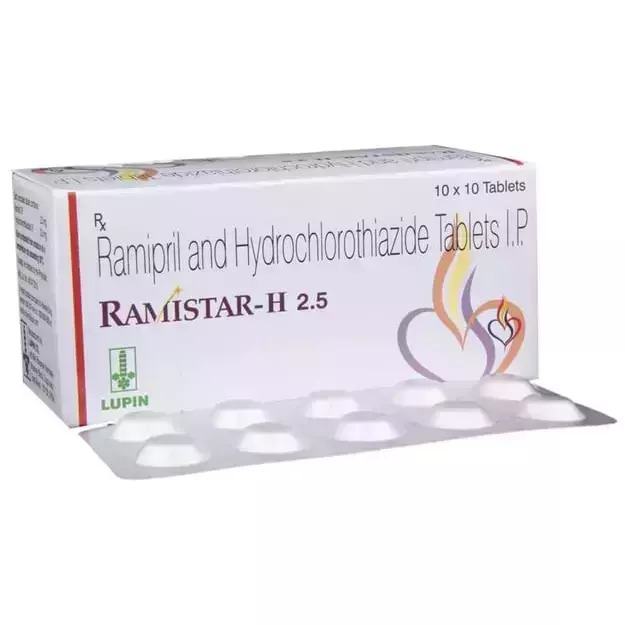
Ramistar H 2.5/12.5 mg
| SKU | 1444 |
|---|---|
| Generic For | Altace HCT |
| Manufacturer | Lupin, India |
| Active Ingredient | Ramipril and HCTZ |


| Pack Size | Qty | Price Per Pill or Unit | Price | Cart | |
|---|---|---|---|---|---|
| 30 Tablet/s | US$ 0.47 | US$ 14.00 | |||
|
|||||
| 60 Tablet/s | US$ 0.38 | US$ 22.5020%US$ 28.00 | |||
|
|||||
| 90 Tablet/s | US$ 0.34 | US$ 30.5027%US$ 42.00 | |||
|
|||||

Ramistar H 2.5/12.5 mg (Ramipril and HCTZ) – Altace HCT Alternative
Ramistar H 2.5/12.5 mg is a prescription medicine for adults to treat essential hypertension (high blood pressure). It is a combination of two medicines: Ramipril and Hydrochlorothiazide. Ramipril widens blood vessels, reduces blood pressure, and ultimately lowers blood pressure. Hydrochlorothiazide is a water pill that improves urine output, removing excess salt and water from the body. These medications work together to lower high blood pressure. Also, Ramistar H helps to reduce the risk of developing any future heart attack or stroke.
You must not use Ramistar H 2.5/12.5 mg if you have had an allergic reaction to Ramipril, Hydrochlorothiazide, thiazide diuretics, or any of the ingredients in the medicine.
Moreover, do not use this medication in case any of the following applies to you:
- Personal or family history of angioedema
- Pregnancy
- Breastfeeding
- Narrowing of the arteries to one or both kidneys (renal artery stenosis)
- Hypotension (low blood pressure)
- Anuria (problem urinating or producing no urine)
- Low-density lipoprotein apheresis with dextran sulfate
- Taking medicine that contains aliskiren
- Electrolyte imbalance
Some medicines may have a negative effect on Ramistar H 2.5/12.5 mg, or Ramistar H may have a negative effect on other medications.
If you are currently taking a medicine, whether on prescription or otherwise, inform your healthcare provider. Medicines that may interact with Ramistar include lithium salts, antidiabetics, agents, potassium retaining diuretics, antihypertensive agents, anaesthetics, corticosteroids, Non-steroidal anti-inflammatory drugs (NSAIDs), Digitalis preparation and certain decongestants, cold/cough medicines.
Along with its beneficial effects, Ramistar H 2.5/12.5 mg may cause unexpected side effects. After you have started taking this medicine, you must inform your healthcare specialist about any unexplained symptoms you might experience. Examples of occasional adverse effects include headache, chest pain, dizziness, mouth ulcers, dry cough, tongue pain, problems with sleeping, unusual tiredness/weakness, palpitations, tachycardia, nervousness, confusion, restlessness, and loss of sense of taste and smell.
If you do not feel well after you have started taking this medicine or notice anything unwanted or unusual, let your healthcare professional or seek immediate medical advice.
Rare but serious side effects associated with the medicine include:
- Abdominal pain,
- Hypotension, fainting when the blood pressure is too low, Allergic reactions (swelling of -lips/face/neck accompanied by trouble breathing, speaking or swallowing.
- Liver disease: vomiting, loss of appetite, nausea, upper abdominal stomach pain, Jaundice (yellowing of the skin and eyes).
If you suspect you have these side effects, you must get medical attention from your healthcare specialist.
You must take this medicine exactly as your healthcare specialist prescribes it to you. In general, it is advised that the daily dose be taken in the morning. Swallow the pills with an adequate amount of water before, during or after a meal. Avoid crushing or chewing the tablet. If a dose of this medicine has been missed, make sure you take it as soon as possible. However, when it is almost time to take the next dose, skip the missed dose or go back to the regular dosing schedule. Ramistar H is not for initial therapy. You must be stabilized on Ramistar and Hydrochlorothiazide before taking this medicine. Your healthcare specialist will decide on the length and dosage of the medicine. They may usually begin the treatment with a low dose and slowly adjust the dosage as required. If Ramistar H causes stomach problems, prefer to take it with food or milk.
The recommended daily dose is 2.5/12.5 mg of Ramistar H. The maximum dose should not exceed the dose of 10 mg /50 mg of Ramipril and Hydrochlorothiazide. Special attention should be given to dialysis patients.
In elderly patients, the initial doses would be lower and further dose adjustments should be more gradual because of a greater chance of unwanted effects, especially in elderly patients and frail patients.
In patients dealing with mild to moderate liver insufficiency, treatment with Ramipril/Hydrochlorothiazide must be begun only under the close supervision of a healthcare provider.
In those who have been treated with a diuretic, consideration must be given to stopping the diuretic depending on the duration of action of the diuretic before starting the Ramistar 2.5/12.5 mg.
What is Ramistar H 2.5/12.5 mg and what condition does it treat?
Ramistar H 2.5/12.5 mg is a combination antihypertensive medication containing ramipril, an ACE inhibitor, and hydrochlorothiazide (HCTZ), a thiazide diuretic. This dual-action blood pressure tablet treats hypertension in adults when single-agent therapy hasn't achieved adequate control. Ramipril works by relaxing blood vessels, while HCTZ reduces fluid retention by increasing urine output. Together, these active ingredients provide enhanced blood pressure reduction compared to either component alone. The 2.5/12.5 mg strength offers a lower-dose option suitable for patients requiring gentle yet effective hypertension management or those transitioning from monotherapy to combination treatment.
How does Ramistar H work to lower blood pressure?
Ramistar H 2.5/12.5 mg employs a complementary dual mechanism to control hypertension. Ramipril blocks angiotensin-converting enzyme, preventing the formation of angiotensin II, a hormone that narrows blood vessels. This vasodilation reduces the resistance your heart faces when pumping blood. Simultaneously, hydrochlorothiazide acts on kidney tubules to eliminate excess sodium and water through urination, decreasing overall blood volume. This diuretic effect further lowers the pressure within your cardiovascular system. By combining an ACE inhibitor with a thiazide diuretic, this antihypertensive medicine addresses blood pressure elevation through two distinct pathways, often achieving better results than either drug class used independently.
How long does Ramistar H 2.5/12.5 mg take to start working?
Ramistar H 2.5/12.5 mg typically begins lowering blood pressure within one to two hours after your first dose, though you won't physically feel this change. The hydrochlorothiazide component produces noticeable diuretic effects within two hours, increasing urination frequency. However, achieving optimal blood pressure control with this combination medication usually requires two to four weeks of consistent daily use. The ramipril component needs time to fully adjust your body's angiotensin system, while the HCTZ gradually normalizes fluid balance. Maximum antihypertensive benefits often appear after four to six weeks of regular treatment. Never stop taking this medicine abruptly, even if readings improve early.
When is the best time to take Ramistar H 2.5/12.5 mg?
Take Ramistar H 2.5/12.5 mg once daily at the same time each morning, preferably with breakfast. Morning administration is recommended because the hydrochlorothiazide diuretic increases urination, which could disrupt sleep if taken late in the day. Swallow the tablet whole with water—don't crush, chew, or split it. You may take this blood pressure medicine with or without food, though consistent timing helps maintain stable ramipril and HCTZ levels. If you miss a dose, take it as soon as you remember unless it's almost time for your next scheduled dose. Your doctor will prescribe the appropriate strength based on your individual hypertension control needs and response to treatment.
Is Ramistar H 2.5/12.5 mg safe for long-term use?
Ramistar H 2.5/12.5 mg is designed for long-term hypertension management when prescribed appropriately. Clinical studies demonstrate that the ramipril and hydrochlorothiazide combination maintains safety and effectiveness over extended periods in most patients. This antihypertensive medication requires ongoing monitoring including periodic blood tests to check kidney function, electrolyte levels (particularly potassium), and overall cardiovascular health. Many patients take this ACE inhibitor-diuretic combination for years or even decades to maintain blood pressure control and reduce risks of stroke, heart attack, and kidney damage associated with uncontrolled hypertension. Long-term benefits typically outweigh risks when properly supervised, though individual tolerance varies based on age, kidney function, and coexisting conditions.
Can I take Ramistar H 2.5/12.5 mg with other medications?
Ramistar H 2.5/12.5 mg can interact with numerous medications, requiring careful management. Potassium supplements, potassium-sparing diuretics, and salt substitutes containing potassium may cause dangerous hyperkalemia when combined with ramipril. NSAIDs like ibuprofen can reduce this blood pressure medicine's effectiveness and worsen kidney function. Lithium levels may increase when taken with HCTZ, requiring dosage adjustments. Diabetes medications may need modification as hydrochlorothiazide can affect blood sugar. This ACE inhibitor-diuretic combination may also interact with other antihypertensives, causing excessive blood pressure drops. Always provide your healthcare provider with a complete medication list including vitamins, supplements, and over-the-counter products before starting this hypertension treatment.
How does Ramistar H 2.5/12.5 mg compare to other combination blood pressure medications?
Ramistar H 2.5/12.5 mg belongs to the ACE inhibitor-diuretic class, which differs from angiotensin receptor blocker (ARB) combinations or calcium channel blocker pairings. Compared to ARB-diuretic combinations like losartan-HCTZ, ramipril-based therapy produces similar blood pressure reductions but may cause more dry cough in some patients, while ARBs rarely do. Compared to amlodipine-based combinations, this medication causes less ankle swelling but may require more electrolyte monitoring due to the hydrochlorothiazide component. The 2.5/12.5 mg strength represents a lower-dose option ideal for initial combination therapy or patients sensitive to higher concentrations. Many physicians prefer ramipril combinations due to extensive cardiovascular outcome studies demonstrating long-term protective benefits beyond simple pressure reduction.
Is generic ramipril and hydrochlorothiazide as effective as branded versions?
Generic ramipril and hydrochlorothiazide combinations are therapeutically equivalent to branded versions like Ramistar H 2.5/12.5 mg. Regulatory authorities in the USA, UK, Canada, and Australia require generic antihypertensive medications to demonstrate bioequivalence, meaning they deliver the same active ingredient amounts to your bloodstream at comparable rates as brand-name products. Generic blood pressure tablets contain identical active pharmaceutical ingredients in the same strengths, meeting the same manufacturing quality standards. The primary difference lies in inactive ingredients, packaging, and cost rather than therapeutic efficacy. Choosing generic ramipril-HCTZ offers substantial savings while providing the same hypertension control and cardiovascular protection, making it a practical option for long-term treatment adherence.
Why do patients choose PremiumRxDrugs for their Ramistar H prescription?
Patients consistently select PremiumRxDrugs for Ramistar H 2.5/12.5 mg due to the combination of affordability, authenticity, and convenience. As a licensed international pharmacy, PremiumRxDrugs offers manufacturer-sourced ramipril and HCTZ medications at competitive prices, making long-term hypertension management more affordable than many local pharmacies. The easy reorder functionality helps patients maintain consistent blood pressure control without prescription lapses. Discreet worldwide shipping reaches customers in multiple countries with free delivery options available. Over ten years of pharmacy experience has built customer trust, with reliable service for chronic condition medications. The pharmacy's commitment to authentic antihypertensive medicines ensures patients receive quality treatment, while their streamlined ordering system saves time compared to traditional pharmacy visits.
What are the common side effects of ramipril and HCTZ?
Ramipril and HCTZ commonly cause dizziness or lightheadedness, especially when standing quickly, due to blood pressure reduction. Many patients experience increased urination from the hydrochlorothiazide diuretic component. A persistent dry cough affects approximately 10% of people taking ramipril-based medications. Some individuals notice fatigue, headache, or nausea during initial treatment weeks. The HCTZ component may cause electrolyte imbalances, including low potassium levels that can lead to muscle weakness or cramps. Less common effects include elevated blood sugar, increased sun sensitivity causing easier sunburn, and gastrointestinal discomfort. Most side effects diminish as your body adjusts to this antihypertensive combination. Severe reactions like angioedema, though rare, require immediate medical attention.
Who should not take ramipril and HCTZ?
Ramipril and HCTZ is contraindicated in pregnant women as ACE inhibitors can cause serious fetal harm, particularly during second and third trimesters. Breastfeeding mothers should avoid this combination as both components transfer into breast milk. Individuals with anuria (inability to produce urine) or severe kidney impairment cannot safely use this medication. Those with a history of angioedema from previous ACE inhibitor use face heightened reaction risks. Patients with severe liver disease require alternative treatments due to metabolism concerns. People allergic to sulfonamide-derived drugs may react to hydrochlorothiazide. Those with untreated electrolyte imbalances, particularly low sodium or potassium, need correction before starting this antihypertensive therapy. Hereditary or idiopathic angioedema also represents an absolute contraindication.
Login
Sign Up
Login
Sign Up