




A Ret Gel .025%
Available Dosages
| SKU | 1151 |
|---|---|
| Generic For | Retin A |
| Strength | 20gm |
| Manufacturer | AKUMS DRUGS & PHARMACEUTICALS LTD |
| Active Ingredient | Tretinoin Gel USP |


| Pack Size | Qty | Price Per Pill or Unit | Price | Cart | |
|---|---|---|---|---|---|
| 1 Tube/s | US$ 6.00 | US$ 6.00 | |||
|
|||||
| 3 Tube/s | US$ 5.33 | US$ 16.0011%US$ 18.00 | |||
|
|||||
| 6 Tube/s | US$ 5.17 | US$ 31.0014%US$ 36.00 | |||
|
|||||

A Ret Gel .025% – Affordable Retin A Alternative
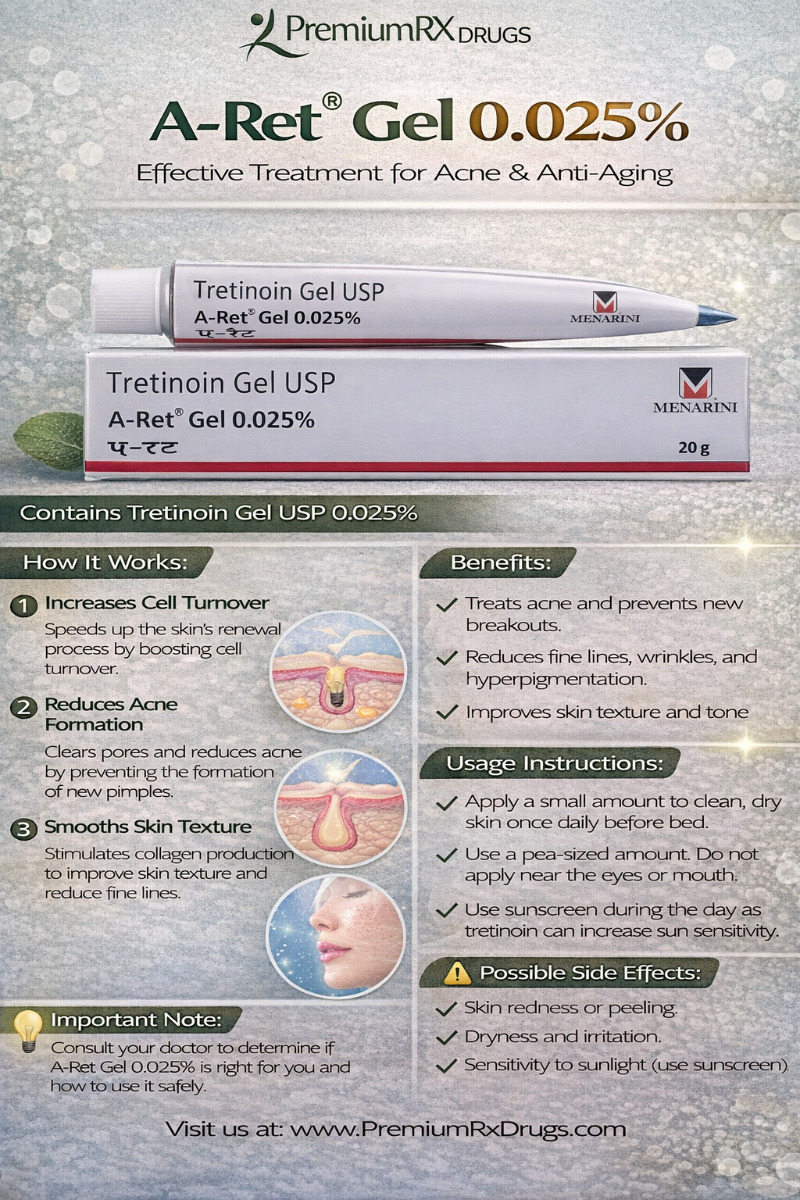
A-Ret gel 0.025% is a clinically trusted topical formulation for treating acne and improving overall skin texture. Powered by tretinoin, a derivative of Vitamin A, this dermatologically recommended gel works at a cellular level to accelerate skin renewal, unclog pores, and reduce the formation of acne lesions. It is widely used by individuals seeking clearer, smoother, and more youthful-looking skin without invasive procedures. A-Ret gel 0.025% is primarily manufactured by Akums Drugs & Pharmaceuticals Ltd, India, a well-known pharmaceutical company that produces a range of dermatological medications. Learn more about where to buy A-Ret gel 0.025% online and what to expect from this medicine.
What is A-Ret gel 0.025%?
A-Ret gel 0.025% is a topical retinoid medication formulated with tretinoin at a concentration of 0.025%. It is primarily prescribed for mild to moderate acne but is also highly effective in addressing early signs of ageing, uneven skin tone, and rough skin texture. The gel-based formulation allows for easy absorption into the skin, making it suitable for oily and acne-prone skin types.
Initial breakout phase (Retinization): When starting A-Ret gel, some users may experience a temporary worsening of acne, often called the "purging phase." This occurs because tretinoin accelerates the turnover of skin cells, bringing underlying clogged pores to the surface. This phase typically lasts for 2–4 weeks and is a normal part of the treatment process. Continued use leads to clearer skin over time. In weeks 1–2, mild irritation and dryness may occur, while in weeks 3–4, initial breakouts may appear as pores begin to clear. By the time you reach weeks 5–8, you will notice a noticeable reduction in acne and smoother skin. Then by week 8–12, improved skin tone, reduced scars, and a clearer complexion. Consistency is key when using tretinoin-based products, as results develop gradually.
Tretinoin and its working mechanism
Tretinoin, the active ingredient, belongs to a class of medications known as retinoids. These are used primarily for acne and skin renewal. It works by binding to nuclear retinoic acid receptors in skin cells, thereby regulating gene expression and accelerating cell turnover. This process helps shed dead skin cells, preventing clogged pores and reducing the formation of comedones. Tretinoin also decreases inflammation and promotes collagen synthesis, improving skin texture and reducing fine lines. By normalising keratinisation and enhancing epidermal renewal, it effectively treats acne while improving overall skin clarity and tone.
Tretinoin - Brand vs generic
Various companies manufacture acne products that contain tretinoin as the main active ingredient. Retin-A is the brand drug, and A Ret gel is the generic version. Both medicines work similarly when used per regimen, as both contain the main active ingredient, treatinon.
How does A-Ret gel 0.025% works?
A-Ret gel 0.025% targets the root causes of acne and skin irregularities. These compounds are known for their ability to regulate skin cell turnover and prevent pore blockage, which are key factors in acne development. It penetrates deep into the skin layers and stimulates the natural process of cell turnover. This helps in shedding dead skin cells more efficiently, preventing them from clogging pores. Additionally, tretinoin reduces the formation of microcomedones, which are the earliest form of acne lesions. By keeping pores clear, it minimises the occurrence of blackheads, whiteheads, and inflammatory acne. It also enhances collagen production over time, improving skin elasticity and reducing the appearance of fine lines. The gel also helps normalise keratinisation, a process that can otherwise lead to the buildup of dead cells inside hair follicles. By maintaining a healthy skin renewal cycle, A-Ret gel helps achieve smoother, clearer skin with consistent use.
A-Ret gel 0.025% vs higher strengths
A-Ret gel is available in strengths of 0.05% and 0.1%. The 0.025% variant is ideal for beginners or individuals with sensitive skin. 0.025% is gentle, suitable for new users; A-Ret gel 0.05% is moderate strength for persistent acne; and A-Ret gel 0.1% is a strong formulation for severe cases. Starting with a lower concentration reduces the risk of irritation while still delivering effective results.
A-Ret gel vs other acne treatments
Unlike over-the-counter acne treatments that only target surface-level symptoms, A-Ret gel works at a deeper level to address the root causes of acne. It not only treats existing breakouts but also prevents future ones by regulating skin cell turnover. Compared with benzoyl peroxide or salicylic acid, tretinoin offers long-term benefits, including improved skin texture and reduced signs of ageing.
Key benefits of A-Ret gel 0.025%
- Effective acne treatment: A-Ret gel is widely recognised for treating acne at its source. It reduces both inflammatory and non-inflammatory acne, helping to clear existing breakouts while preventing new ones.
- Unclogs pores: The gel penetrates deep into pores to remove impurities, excess oil, and dead skin cells. This prevents blockages that can lead to acne.
- Improves skin texture: Regular use results in smoother, softer skin by promoting the growth of new, healthy skin cells.
- Reduces fine lines and wrinkles: Tretinoin boosts collagen production, helping minimise early signs of ageing.
- Fades hyperpigmentation: Helps lighten dark spots, acne scars, and uneven skin tone, giving the skin a more radiant, uniform appearance.
- Enhances skin radiance: By accelerating cell turnover, A-Ret gel reveals fresher skin layers, improving overall brightness and glow.
Precautions and warnings with tretinoin gel
A-Ret gel is not recommended for use during pregnancy or breastfeeding. Avoid excessive sun exposure while using this product. Do not apply to broken or irritated skin. Consult a healthcare professional before use if you have sensitive skin or existing skin conditions.
Side effects of tretinoin gel
While A-Ret gel 0.025% is highly effective, some users may experience mild side effects, especially during the initial weeks of use. Common side effects include redness, dryness, peeling, mild irritation, and increased sensitivity to sunlight. These effects are generally temporary and subside as the skin adjusts to the treatment. Using a moisturiser and sunscreen can help minimise discomfort.
Usage instructions for tretinoin gel
Tretinoin A-Ret gel 0.025% is suitable for individuals dealing with:
- Mild to moderate acne
- Blackheads and whiteheads
- Oily and acne-prone skin
- Uneven skin tone
- Early signs of ageing
- Rough or dull skin texture
It is often recommended for first-time tretinoin users because its lower concentration allows the skin to gradually adapt to the treatment. For optimal results, A-Ret gel should be used as part of a consistent nighttime skincare routine. Cleanse your face with a mild, non-comedogenic cleanser and pat dry. Wait for 20–30 minutes to ensure the skin is completely dry. Apply a pea-sized amount of the gel evenly across the affected areas. Avoid sensitive areas such as the eyes, lips, and corners of the nose. Follow with a gentle moisturiser if needed. It is recommended to start using the gel 2–3 times a week and gradually increase frequency as the skin builds tolerance.
Important usage tips: Always apply A-Ret gel at night, as tretinoin is sensitive to sunlight. Use sunscreen during the day to protect your skin from UV damage. Avoid combining with harsh exfoliants or alcohol-based products. Be consistent with usage for best results.
Storage instructions: Store in a cool, dry place away from direct sunlight. Keep the tube tightly closed when not in use. Keep out of reach of children. Proper storage ensures the medication's effectiveness and stability.
What is A Ret 0.025% Gel used for?
A Ret 0.025% Gel contains tretinoin 0.025% in a gel vehicle — the lowest-strength standard tretinoin formulation in gel form. Indications: mild acne vulgaris; early photoaging; post-inflammatory hyperpigmentation; and as the introductory concentration for tretinoin-naive patients. The 0.025% gel concentration provides gentle retinoid activity with a favourable tolerability profile — minimal purging, dryness, and irritation compared to higher concentrations. The gel vehicle makes it suitable for oily and combination skin types. A Ret 0.025% gel is particularly appropriate for younger acne patients (teenagers with oily skin), patients with mild acne or early photoaging requiring a first retinoid, and as long-term maintenance therapy after achieving remission at higher concentrations.
How does A Ret 0.025% Gel compare to Retino A 0.025% Cream?
A Ret 0.025% Gel and Retino A 0.025% Cream both contain tretinoin 0.025% but in different vehicles. Gel vehicle: lighter, oil-free, faster-drying, leaves no greasy residue — cosmetically preferred for oily and acne-prone skin; may be slightly more drying due to alcohol content. Cream vehicle: emollient base provides moisture and reduces irritation — better for dry or sensitive skin. Efficacy: both deliver identical tretinoin concentration — comparable clinical outcomes at equal concentrations. Choice: for oily/combination acne-prone skin → A Ret 0.025% gel; for dry/sensitive/mature skin → Retino A 0.025% cream. Teenagers with oily acne-prone skin typically prefer the gel; adults with drier skin for photoaging prefer the cream.
Is A Ret 0.025% Gel suitable as a maintenance therapy after acne clearing?
A Ret 0.025% Gel is an excellent maintenance option after achieving acne remission with higher-concentration tretinoin: downgrade from 0.05% nightly to 0.025% 3×weekly as maintenance when acne is well-controlled to reduce cumulative irritation while maintaining comedolytic benefit. Alternatively, 0.025% nightly is a sustainable maintenance regimen for patients who fully cleared with 0.05% and want to continue long-term treatment with minimal side effects. A Ret 0.025% gel maintains: prevention of new microcomedone formation; continued sebum regulation; low-level pigmentation fading; and early photoaging prevention. If acne relapses during 0.025% maintenance: increase frequency to nightly or upgrade back to 0.05%.
What drug interactions apply to A Ret 0.025% Gel?
Same local precautions as higher-strength tretinoin gels — systemic interactions are not expected. Local interactions at 0.025%: the same incompatibilities with benzoyl peroxide (apply separately), salicylic acid (avoid simultaneous), and alcohol-based toners apply — though the potential for irritation is less severe at this lower concentration. Photosensitisation applies (SPF 30+ required daily) but is least pronounced at this concentration. Tretinoin gel 0.025% is compatible with most non-irritating skincare actives: niacinamide (apply first and allow to dry, then A Ret); hyaluronic acid serum; ceramide moisturiser. Avoid simultaneous benzoyl peroxide — use morning only.
Is A Ret 0.025% Gel equivalent to Retin-A 0.025% Gel?
Yes. A Ret 0.025% Gel and branded Retin-A 0.025% Gel both contain tretinoin 0.025% in equivalent gel formulations. A Ret is the generic alternative providing the same gentle-strength topical retinoid therapy at significantly lower cost. PremiumRxDrugs.com stocks authentic manufacturer-sourced A Ret 0.025% Gel verified for quality and bioequivalence.
Can I order A Ret 0.025% Gel from PremiumRxDrugs for international delivery?
Yes. PremiumRxDrugs.com ships A Ret 0.025% Gel to the USA, UK, Australia, and many other countries. Our genuine manufacturer-verified tretinoin products, competitive pricing, and free worldwide shipping on qualifying orders makes us a reliable international source for starter and maintenance retinoid gel.
What side effects does A Ret 0.025% Gel cause?
A Ret 0.025% Gel causes the mildest side effect profile of standard tretinoin concentrations. Common but mild: slight dryness; minimal peeling; mild erythema (redness); purging (typically mild and brief — 2–4 weeks vs. 4–8 weeks at higher concentrations). Photosensitisation applies but is least pronounced at this concentration — morning SPF 30+ is still required. Burning or stinging on application is generally mild. The alcohol-based gel vehicle may cause transient stinging on application to irritated or dry skin. True allergic contact dermatitis to tretinoin is uncommon. Most patients tolerate 0.025% nightly from the outset without needing to use every other night — though starting every other night for 2 weeks is still recommended for very sensitive skin.
How long until A Ret 0.025% Gel shows results for acne?
A Ret 0.025% Gel timeline: purging (if it occurs) is typically mild and brief (2–4 weeks); initial acne improvement at 6–8 weeks; significant lesion reduction at 12–16 weeks; maximum benefit at 4–6 months with continued nightly use. The lower concentration means slower onset than 0.05% but substantially better tolerability — particularly important for adherence (the most critical factor in tretinoin outcomes). For maintenance use after higher-strength tretinoin: 0.025% gel prevents microcomedone formation effectively when used consistently 3–5× weekly. For photoaging: visible improvements in texture and pigmentation at 4–6 months with nightly use — less dramatic than higher concentrations but with minimal irritation, making long-term maintenance sustainable.
Can A Ret 0.025% Gel be used by teenagers for the first time with acne?
A Ret 0.025% Gel is well-suited as the first-line topical retinoid for teenage acne — particularly for teenagers with oily or combination skin and predominantly comedonal or mild inflammatory acne. Application for teenagers: start every other night for 2 weeks to establish tolerance; progress to nightly if well tolerated. Patient education for teenagers is critical: explain the purging phase (do not stop treatment when acne temporarily worsens); emphasise daily SPF application (non-negotiable — use a lightweight, non-comedogenic SPF 30–50+ formulation); explain that results take 2–3 months. For teenagers with severe inflammatory acne: combination therapy (topical retinoid + topical antibiotic, or referral for oral antibiotic consideration) is more appropriate than retinoid monotherapy alone.
How should A Ret 0.025% Gel be stored properly?
Store A Ret 0.025% Gel at room temperature (15–25°C) away from direct sunlight, UV light, and heat — tretinoin is degraded by light and heat, reducing potency. An exposed gel may turn yellow-brown (oxidised tretinoin). Do not freeze — cold temperatures may affect gel consistency and stability. Keep tightly capped when not in use to prevent air oxidation. Keep out of reach of children. Check expiry date before each use — expired tretinoin gel has reduced potency. An opened tube should be used within 12 months per the product label. The alcohol-based vehicle is flammable — keep away from open flames and heat sources. Store in the original packaging (tube provides light protection).
Can A Ret 0.025% Gel be used during summer months with high sun exposure?
A Ret 0.025% Gel can be used year-round including summer — but sun protection becomes even more critical during high UV months. Key precautions in summer: apply broad-spectrum SPF 50+ sunscreen every morning (reapply every 2 hours if outdoors); avoid prolonged direct sun exposure between 10am–4pm; wear protective clothing and a hat. Some patients choose to reduce tretinoin frequency in summer (from nightly to 3–4× weekly) if sunburn or increased sensitivity is an issue — this is a practical compromise. A Ret 0.025% causes the least photosensitisation of any tretinoin concentration — making it the most summer-friendly formulation. The evening-only application ensures no direct sun exposure to freshly applied tretinoin. Continue SPF use year-round — not just in summer — for optimal acne and anti-aging results.
Login
Sign Up
Login
Sign Up