




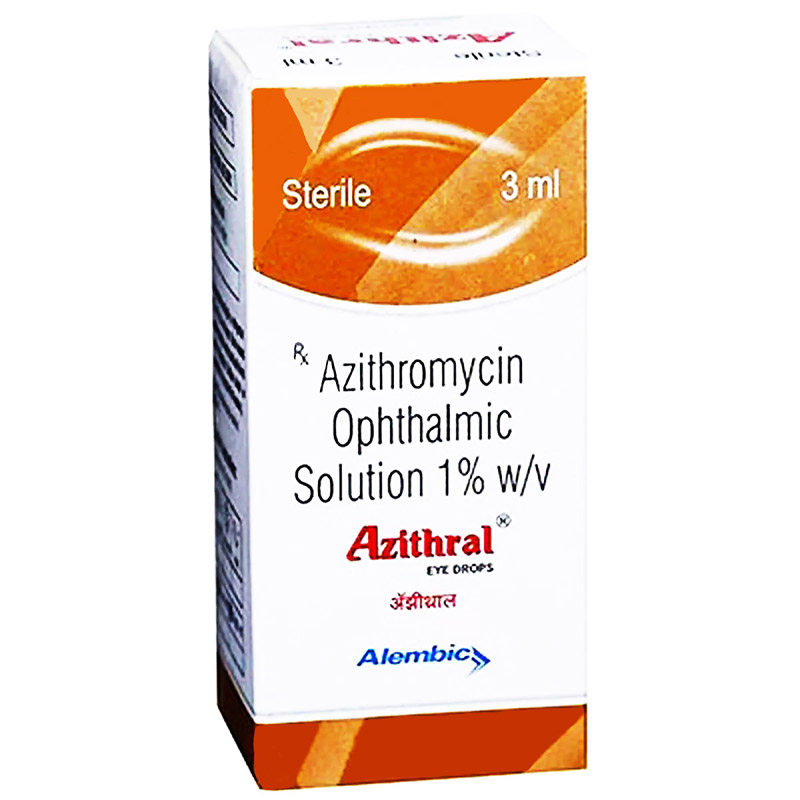
Azithral Eye Drops 0.1% (3ml)
Available Dosages
| SKU | 91 |
|---|---|
| Generic For | Azasite |
| Strength | 3 ml |
| Manufacturer | Alembic |
| Active Ingredient | Azithromycin |


Out Of Stock

Azithral Eye Drops 0.1% (Azithromycin) – Affordable Azasite Alternative
Azithral Eye Drops 0.1% (3ml)
The Azithral eye drop is composed of an active therapeutic agent called Azithromycin, a second generation macrolide prescribed for the treatment of various bacterial infections. Azithromycin is derived from erythromycin and is more potent against certain bacterial species than erythromycin. The eye drop has been proposed as a novel treatment for the treatment of blepharitis (a common eyelid inflammation). It’s benefits lies in a wide spectrum anti-inflammatory and anti-bacterial properties. The product has proven to be effective and safe in treating bacterial conjunctivitis with good patient tolerance. The anti-bacterial activity of the drug is directed against many gram-negative and gram positive bacteria, in addition to atypical bacteria.
Azithromycin ophthalmic solution general information
What is Azithromycin opthalmic solution used for?
Azithromycin is prescribed by the physicians to treat bacterial conjunctivitis caused by Staphylococcus aureus, Streptococcus pneumonia, CDC coryneform group G, Haemophilus influenza, and Streptococcus mitis group.
How does Azithromycin opthalmic solution work?
Azithromycin is the active component of the Azithral eye drop. It functions by adhering to the 50 S subunit of the bacterias and interferes with microbial protein synthesis.
Where to buy Azithromycin opthalmic solution online?
Azithromycin ophthalmic solution is available to our clients in 3 ml strength. Buy Azithromycin ophthalmic solution-3 ml online from premiumrxdrugs.com far cheaper than your other local pharmacies.
What does Azithromycin opthalmic solution contain?
The eye solution contains Azithromycin, a macrolide antibiotic as an active ingredient. Each drop of the ophthalmic solution delivers 1 % of Azithromycin to the patient.
What are the side effects of Azithromycin ophthalmic solution?
Eye irritation is the most commonly reported side effect of Azithromycin ophthalmic solution-3 ml.
Some other adverse effects related to the usage of this eye preparation include:
- Eye pain
- Itching in the eye
- A feeling of discomfort or that something is in your eye
- Eye burns
- Irritation and stinging when the drop hits the eye
- Irritation around your eye
- Eyelid irritation
- Changes in your taste
- Swelling around your eye
- Blurred vision
- Stuffy nose
- Sinus infection
- Appearance of rashes on the skin
- Hives
- Changes in the surface of the eye
Tell your physician about any unwanted effect that bothers you or does not disappear in a few days.
What medications interact with Azithromycin ophthalmic solution?
Tell your physician about the following medications:
- Arsenic trioxide
- Coumadin
- Sotalol
- Antithrombin-Alfa
- Quinidine
- Escitalopram
- Halofantrine
- Bivalirudin
- Argatroban
- Disopyramide
- Procainamide
- Amiodarone
- Chloroquine
- Flecainide
- Afatinib
- Argatroban
- BCG vaccine live
- Amiodarone
- Citalopram
- Escitalopram
- Warfarin
When should Azithromycin opthalmic solution not be used?
- The 3 ml eye drop should not be used in patients with known hypersensitivity to Azithromycin or other ingredients of the formulation.
- The safety and efficacy of the solution has not been established in the pediatric population under 1 year of age.
- Don’t use this medicine for a condition for which it is not prescribed.
How should Azithromycin opthalmic solution be used?
Use the eye drop exactly as your physician tells you to use it.
If you are using it for the first time, then place one drop of Azithromycin ophthalmic solution in your eye twice daily in the morning and in the evening. It is recommended to wait for at least 8 to 12 hours after using morning dose. For next five days, one drop once daily in the morning or in the evening.
Always remember, do not wear contact lenses while using the eye drop.
How long should you use Azithromycin opthalmic solution?
Continue using Azithromycin ophthalmic solution for as long as recommended by your physician. Use it regularly to take the most benefits out of it.
Missed dose of Azithromycin ophthalmic solution
If you miss a dose of Azithromycin opthalmic solution take that dose as soon you remember, but if the time of another dose is near just leave that missed dose and take your another dose on time. Try not to miss any dose of the drug as skipping doses can increase the chance that your medicine will not work properly.
How should Azithromycin opthalmic solution be stored?
- Store Azithromycin opthalmic solution at room temperature
- Keep all your medications out of the reach of children and pets
- Keep it in a dry place away from the direct sunlight and heat
What is Azithral Eye Drops 0.1% used for?
Azithral Eye Drops 0.1% contains azithromycin 0.1% as an ophthalmic solution indicated for treating bacterial conjunctivitis (pink eye) caused by susceptible organisms including Haemophilus influenzae, Streptococcus pneumoniae, and Staphylococcus aureus. It is used in adults and children aged 1 year and older. Azithromycin eye drops provide targeted antibiotic treatment directly to the eye, achieving high local tissue concentrations with minimal systemic absorption and side effects.
How should Azithral Eye Drops 0.1% be instilled?
Instill one drop of Azithral 0.1% into the affected eye(s) twice daily (morning and evening) for the first 2 days, then once daily on days 3–7. Tilt your head back, pull down the lower eyelid gently, and apply the drop into the lower conjunctival sac. Avoid touching the dropper tip to the eye or any surface to prevent contamination. Blink gently after instillation. If using other eye drops, wait at least 5 minutes between applications. Always wash hands before and after use.
How long does a course of Azithral Eye Drops last?
The standard treatment course for bacterial conjunctivitis with Azithral Eye Drops 0.1% is 7 days: twice daily (morning and evening) on days 1 and 2, then once daily on days 3 through 7. This short, convenient regimen is one of azithromycin eye drops' advantages over older ophthalmic antibiotics that require 3–4 times daily instillation. Completing the full 7-day course is important even if symptoms resolve earlier to ensure complete bacterial eradication and prevent recurrence.
Is Azithral 0.1% safe for children?
Azithral Eye Drops 0.1% is approved for use in children aged 1 year and older for the treatment of bacterial conjunctivitis. It is not recommended for infants under 1 year without specialist assessment. For children, the instillation technique requires a calm approach — asking a second adult to gently hold the child's head may help. Since systemic absorption from eye drops is minimal, the overall safety profile for children is favorable. Always confirm appropriate use with a paediatrician or ophthalmologist for young children.
Can Azithral Eye Drops treat viral conjunctivitis?
No, Azithral Eye Drops 0.1% is an antibiotic and is only effective against bacterial conjunctivitis. Viral conjunctivitis — the most common form, often caused by adenoviruses — does not respond to antibiotic eye drops. Viral conjunctivitis typically resolves on its own within 1–2 weeks. Using antibiotic eye drops for viral conjunctivitis is inappropriate, wastes medication, and contributes to antibiotic resistance. If you are unsure whether your conjunctivitis is bacterial or viral, consult an eye doctor or GP for a proper diagnosis.
How does Azithral Eye Drops compare to tobramycin or ciprofloxacin eye drops?
Azithral 0.1%, tobramycin, and ciprofloxacin eye drops are all used for bacterial conjunctivitis but differ in dosing frequency and spectrum. Azithromycin eye drops require only twice-daily dosing for the first 2 days and once daily thereafter — fewer applications than tobramycin (3–4 times daily) or ciprofloxacin (2 times daily). Azithromycin also concentrates well in conjunctival tissue due to its macrolide properties. For cases not responding to azithromycin, culture-guided therapy with fluoroquinolone drops may be considered.
What are the side effects of Azithral Eye Drops 0.1%?
Azithral Eye Drops are generally well-tolerated. The most common side effects include mild, transient eye irritation, burning or stinging upon instillation, blurred vision immediately after application, and eye discharge. These effects are typically brief and self-limiting. Allergic reactions to azithromycin eye drops are rare. Systemic side effects are extremely unlikely given the minimal amount absorbed through the eye. Discontinue use and consult your ophthalmologist if significant pain, worsening redness, or visual changes occur during treatment.
Can Azithral Eye Drops be used with contact lenses?
Contact lenses should be removed before instilling Azithral Eye Drops and should not be reinserted for at least 15 minutes after application. Additionally, during active bacterial conjunctivitis, wearing contact lenses is generally discouraged, as lenses can harbour bacteria, slow healing, and worsen infection. Dispose of any contact lenses worn during the infection period, along with their cases. Use spectacles until the infection has fully resolved and your eye doctor confirms it is safe to resume lens wear.
Do Azithral Eye Drops treat trachoma?
Azithromycin (systemic) is the recommended treatment for trachoma — a chronic bacterial eye infection caused by Chlamydia trachomatis that is a leading cause of preventable blindness worldwide. The WHO-endorsed treatment for trachoma is a single oral dose of azithromycin (20mg/kg, maximum 1g). Topical azithromycin eye drops may have a supplementary role, but oral treatment is the standard. Azithral Eye Drops 0.1% is intended for acute bacterial conjunctivitis, not trachoma treatment or prevention programs.
How should Azithral Eye Drops be stored?
Store Azithral Eye Drops 0.1% at room temperature between 15°C and 25°C (59°F–77°F). Do not refrigerate or freeze. Keep the bottle tightly closed when not in use. Protect from direct sunlight and heat. Discard the bottle 28 days after opening, regardless of how much remains, to reduce contamination risk. Do not use beyond the printed expiry date. Keep out of reach of children. Contaminated eye drops can cause secondary eye infections, so proper storage and disposal practices are essential.
Can I buy Azithral Eye Drops 0.1% online from PremiumRxDrugs?
Yes, Azithral Eye Drops 0.1% (azithromycin ophthalmic solution) are available at PremiumRxDrugs.com. PremiumRxDrugs is a licensed pharmacy with over 10 years of experience supplying authentic, manufacturer-sourced ophthalmic and other medications worldwide. Products are quality-verified for safety and efficacy. Discreet packaging, worldwide shipping, and free shipping on qualifying orders make it easy to get the eye care medication you need delivered directly to your door conveniently and reliably.
What happens if Azithral Eye Drops are accidentally ingested?
Accidental oral ingestion of a small amount of Azithral Eye Drops 0.1% is unlikely to cause serious harm given the very low azithromycin concentration (0.1%) and small bottle volume. However, any accidental ingestion — especially in children — should be reported to a poison control center or doctor immediately for guidance. Symptoms of azithromycin ingestion at low quantities are typically mild but should be medically assessed. Keep all eye drop bottles secured and away from children to prevent accidental ingestion.
Login
Sign Up
Login
Sign Up