




Persol Gel 2.5%
| SKU | 115 |
|---|---|
| Generic For | Benzagel |
| Strength | 2.5% (30 gm) |
| Active Ingredient | Benzoyl Peroxide |


| Pack Size | Qty | Price Per Pill or Unit | Price | Cart | |
|---|---|---|---|---|---|
| 1 Tube/s | US$ 6.00 | US$ 6.00 | |||
|
|||||
| 3 Tube/s | US$ 5.00 | US$ 15.0017%US$ 18.00 | |||
|
|||||
| 6 Tube/s | US$ 4.00 | US$ 24.0033%US$ 36.00 | |||
|
|||||

Persol Gel 2.5% (Benzoyl Peroxide) – Affordable Benzagel Alternative
Persol gel 2.5% is a topical medication used to treat acne vulgaris. It is a commonly used topical treatment for mild acne. It contains the active ingredient Benzoyl peroxide, an antiseptic that reduces the number of bacteria on the skin surface. Benzoyl peroxide is a topical antibacterial medication. It has a mild drying effect that helps remove excess oil and dirt from the skin.
Benzoyl peroxide is a bactericidal agent effective against acne-causing bacteria. The antibacterial action is believed to be responsible for its beneficial effects in acne. The medicine can reach the bacteria causing the problem and destroy them, with a low risk of irritation. This significantly reduces the formation of pimples and blackheads, helping keep your skin clearer over time. The topical medication may be used alone for mild to moderate cases or as an adjunct to an acne treatment plan that includes retinoid products, antibiotics, or salicylic acid-containing formulations. Benzoyl peroxide is considered the most effective topical antibacterial for treating acne.
Precautions and warnings Persol Gel 2.5%
Patients with known sensitivity to Benzoyl Peroxide or any other components of the medication should not use Persol 2.5% gel. If you experience redness, burning, itching, swelling, or excessive dryness, discontinue treatment. The product is for external use only and not for ophthalmic use. Keep the topical formulation away from the eyes and mucous membranes. Those with very fair skin should start with a single application at bedtime to allow overnight absorption of the medication. The gel formulation may bleach colored fabrics. It is not known if benzoyl peroxide can cause fetal harm when used by a pregnant woman or may affect reproductive capacity.
The topical formulation should be used by a pregnant woman only if clearly needed. Also, it is still unknown whether the medication is excreted in breast milk; caution should be exercised when the benzoyl peroxide formulation is given to a nursing woman. Avoid using this gel if you are breastfeeding unless your physician has told you otherwise. If your dermatologist has recommended this gel while you are breastfeeding, you must not apply it to your chest, as this would expose your baby to this medicine. The safety and effectiveness in paediatric patients under 12 years of age have not been established. Never use Benzoyl peroxide gel while using tretinoin gel. Using both medications together may cause severe skin irritation. Do not use the drug on cuts, sunburned skin, or abrasions. The drug named Tretinoin can interact with the topical medication Persol 2.5% gel. There may be other drugs that could affect the potency and effectiveness of this gel formulation. Make sure you consult your dermatologist first before using any other medication.
Side effects Persol Gel 2.5%
Almost every medication causes some side effects. Persol 2.5% gel has some side effects too. Irritation and contact dermatitis are the most common side effects of benzoyl peroxide. Tell your dermatologist immediately the moment you realise these symptoms occur:
- Dryness or peeling of skin
- Feeling of warmth
- Tingling
- Slight stinging
- Burning, blistering, redness, or swelling of the treated area
- Rash
If you experience any of the following side effects, then stop using the medicine and immediately get emergency medical help:
- Hives
- Itching
- Throat tightness
- Difficulty breathing
- Feeling faint
- Swelling of the eyes, face, lips, and tongue.
How to use Persol gel 1%?
Persol gel 1% should be applied twice daily (once in the morning and once in the evening) to the affected areas of the skin. Clean the area before applying the gel to the affected skin. Apply the gel after you gently wash your face with a mild, non-medicated soap, rinse with warm water, and pat dry. Wash your hands properly after using the medicine. First, start with once daily to see how your skin reacts to the medication. Then follow the instructions properly to see the exact usage information. Try to use it exactly as directed. Do not use more or less of it or use it more often than directed by your dermatologist.
Consult your dermatologist immediately if you realise that a large amount of Persol gel has been used by mistake. Generally, improvement is seen as early as two weeks, although the medication may be used for up to ten weeks to achieve the best results. Use Persol gel 2.5% as prescribed; do not stop treatment in between, as it may take 4 to 6 weeks to see the effects of this medication. If the acne still does not improve after this time, call your physician.
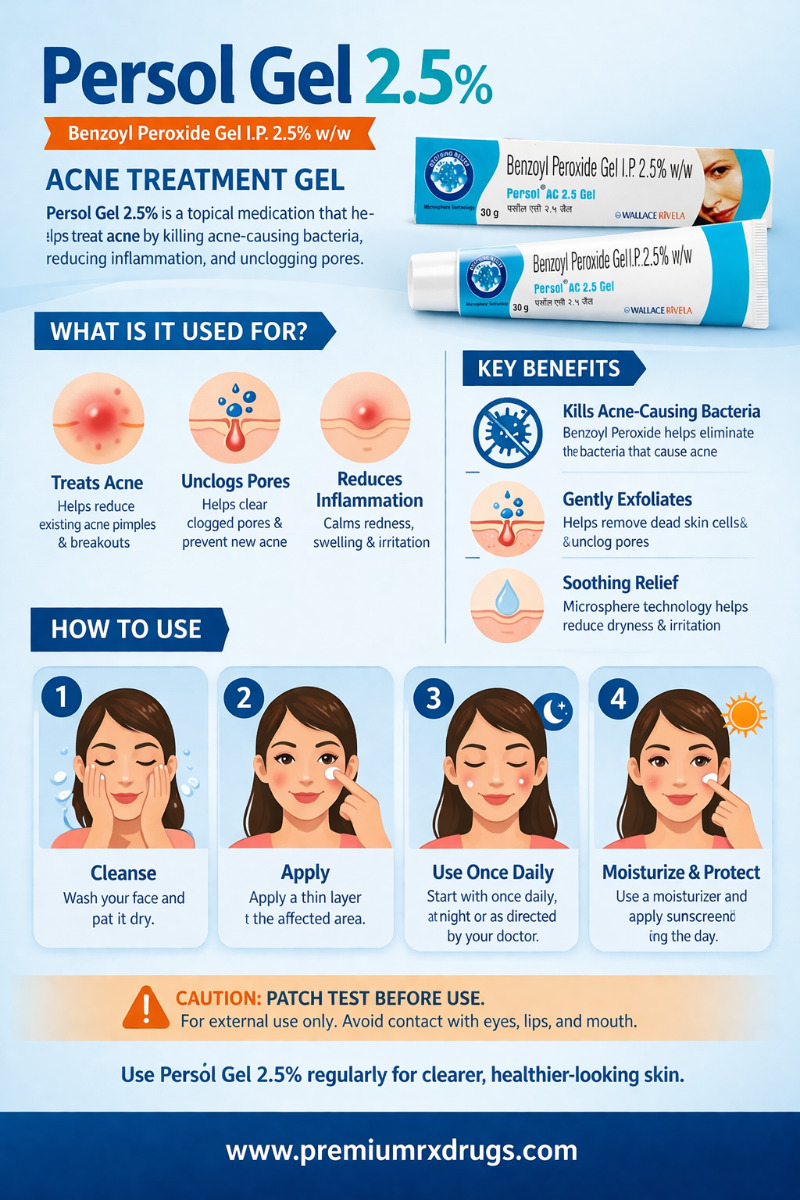
What is Persol 2.5% Gel used for?
Persol 2.5% Gel contains benzoyl peroxide 2.5% — the lowest standard clinical concentration of this topical acne bactericide. It is used for mild-to-moderate acne vulgaris — particularly suitable for sensitive skin, dry skin, or patients initiating benzoyl peroxide therapy for the first time. Clinical evidence shows that 2.5% benzoyl peroxide achieves comparable acne reduction to 5% and 10% concentrations with significantly less skin irritation, dryness, and redness — making it the preferred starting concentration in clinical guidelines. It kills P. acnes via bactericidal oxidative mechanism without inducing resistance, reduces comedone formation, and has mild anti-inflammatory properties.
Why choose Persol 2.5% over Persol 5% for acne?
Clinical trials directly comparing benzoyl peroxide concentrations find 2.5% achieves equivalent or nearly equivalent acne lesion count reduction to Benzoyl Peroxide 5% and 10%, with significantly better skin tolerability — less dryness, irritation, and peeling. The dermatology consensus supports starting at 2.5% for most patients: adequate bactericidal efficacy; substantially better skin tolerance; better long-term adherence (patients who are not excessively irritated continue treatment consistently). Upgrade to 5% only if 2.5% provides insufficient acne control after 8–12 weeks of consistent use. 2.5% is particularly appropriate for: sensitive, dry, or combination skin; patients using concurrent retinoids (reducing total irritation burden); teenagers with moderate acne new to treatment; patients with easily irritated skin.
Can Persol 2.5% be used alongside topical clindamycin for acne?
Yes — benzoyl peroxide 2.5% combined with topical clindamycin 1% is a first-line acne combination recommended in multiple international guidelines. The combination addresses bacterial overgrowth (clindamycin) and prevents antibiotic resistance (benzoyl peroxide kills resistant bacteria). Application: use benzoyl peroxide in the morning and clindamycin in the evening (or morning if preferred by the patient). Pre-formulated combination products (benzoyl peroxide + clindamycin in a single gel) are available for convenience. When using both separately: apply one, allow to absorb, then apply the other — or apply at different times of day. Do not apply benzoyl peroxide simultaneously with tretinoin in the same application (retinoid degradation).
Is Persol 2.5% suitable for sensitive skin and rosacea?
Persol 2.5% is the most tolerable benzoyl peroxide concentration for sensitive skin — but benzoyl peroxide is generally avoided in rosacea patients because it can irritate rosacea-affected skin and worsen erythema. For pure sensitive skin acne without rosacea: Persol 2.5% is appropriate — start with every-other-day application and progress to daily as tolerated. For acne co-existing with rosacea: azelaic acid 15–20% is strongly preferred — it treats both acne (anti-inflammatory, antibacterial) and rosacea (anti-inflammatory, anti-Demodex). Benzoyl peroxide (even 2.5%) in active rosacea can trigger flushing and worsen erythema. Discuss with a dermatologist for acne-rosacea coexistence.
What drug interactions apply to Persol 2.5% Gel?
Same as Persol 5% — benzoyl peroxide degrades tretinoin on contact (apply separately at different times); compatible with topical antibiotics (clindamycin, erythromycin — use together but ideally at different times of day); bleaches coloured fabrics (physical interaction — not a pharmacological drug interaction). At 2.5%: bleaching risk is present but potentially slightly less intense than at 5% (lower peroxide concentration). Avoid mixing with topical vitamin C serums in the same application session. Do not use with other oxidising agents simultaneously. Systemic drug interactions are not expected from topical 2.5% benzoyl peroxide.
Is Persol 2.5% Gel equivalent to PanOxyl 2.5% or Benzac AC 2.5%?
Yes. Persol 2.5% Gel and branded PanOxyl 2.5% / Benzac AC 2.5% both contain benzoyl peroxide 2.5% in equivalent gel formulations. Persol is the generic alternative providing the same gentle-strength acne bactericide at significantly lower cost. PremiumRxDrugs.com stocks authentic manufacturer-sourced Persol 2.5% Gel verified for quality and bioequivalence.
Can I order Persol 2.5% Gel from PremiumRxDrugs for international delivery?
Yes. PremiumRxDrugs.com ships Persol 2.5% Gel to the USA, UK, Australia, and many other countries. Our genuine manufacturer-verified benzoyl peroxide products, competitive pricing, and free worldwide shipping on qualifying orders make us a reliable international source for sensitive-skin acne therapy.
What side effects does Persol 2.5% Gel cause?
Persol 2.5% Gel has the best tolerability profile of all benzoyl peroxide concentrations. Common (but mild): mild skin dryness; slight peeling; occasional mild redness on first use. Bleaching: same bleaching of coloured fabrics applies — manage with white towels and pillowcases. Allergic contact dermatitis (approximately 1–2% of users): intense redness, itching, and swelling that worsens rather than improving — distinct from expected mild irritant effects; stop immediately if suspected. Photosensitivity is minimal at this concentration. Most patients tolerate Persol 2.5% with minimal side effects — making it ideal for long-term use in combination acne regimens.
Is Persol 2.5% safe in pregnancy?
Benzoyl peroxide 2.5% has essentially the same pregnancy safety profile as 5% — FDA Category C with minimal systemic absorption (traces in urine). At the lower 2.5% concentration, total benzoyl peroxide exposure is half that of 5% — making it slightly preferable from a theoretical safety standpoint. For mild acne in pregnancy: azelaic acid cream remains the most evidence-supported safe topical option. Persol 2.5% used for limited areas, briefly, for moderate acne is generally considered acceptable — discuss with your obstetrician. The 2.5% concentration is also less irritating — reducing the skin barrier disruption that could theoretically increase systemic absorption in pregnancy.
How does the bactericidal mechanism of Persol 2.5% reduce antibiotic resistance?
Benzoyl peroxide prevents antibiotic resistance by a mechanism fundamentally different from antibiotics. It generates free oxygen radicals within the follicle — bacteria are killed directly by oxidative damage to bacterial lipids, proteins, and DNA. This oxidative killing mechanism cannot be overcome by bacteria through mutation — unlike the enzyme production, membrane changes, or efflux pumps that confer antibiotic resistance. When combined with topical clindamycin or erythromycin: benzoyl peroxide kills clindamycin-resistant P. acnes strains that the antibiotic cannot affect — preventing their selective proliferation. This is why current guidelines mandate combining any topical antibiotic with benzoyl peroxide: the combination maintains long-term antibiotic efficacy by preventing resistant strain dominance on the skin surface.
How long should Persol 2.5% Gel be used continuously for acne?
Benzoyl peroxide can be used indefinitely for acne — unlike antibiotics, there is no time limit based on resistance risk. For acne management: use daily as part of a morning routine alongside other acne treatments (retinoid in evening, benzoyl peroxide in morning). For maintenance after acne is cleared: continue Persol 2.5% application (daily or alternate days) to maintain bacterial suppression and prevent recurrence. If using alongside oral antibiotics: after completing the antibiotic course (3–6 months), continue benzoyl peroxide indefinitely as maintenance monotherapy (or with topical retinoid). Annual skincare review: assess whether continued benzoyl peroxide is still needed (some patients achieve long-term remission and can trial stopping with retinoid-only maintenance).
Login
Sign Up
Login
Sign Up