




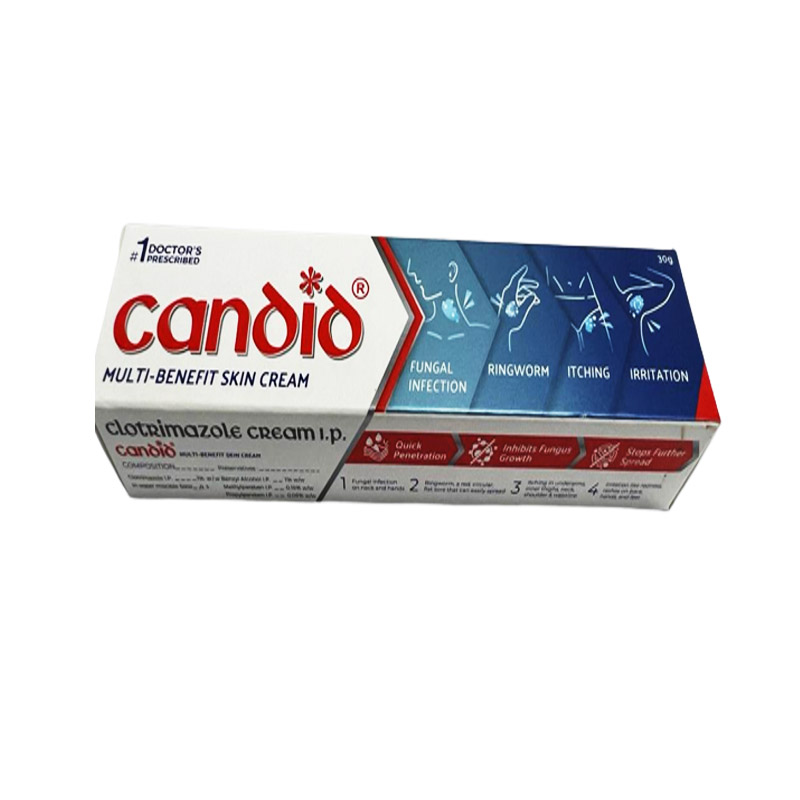
Candid Cream 30gm
Available Dosages
| SKU | 272 |
|---|---|
| Generic For | Candid Cream |
| Strength | 30gm |
| Manufacturer | Glenmark |
| Active Ingredient | Clotrimazole |


| Pack Size | Qty | Price Per Pill or Unit | Price | Cart | |
|---|---|---|---|---|---|
| 1 Tube/s | US$ 8.00 | US$ 8.00 | |||
|
|||||
| 3 Tube/s | US$ 5.00 | US$ 15.0037%US$ 24.00 | |||
|
|||||
| 6 Tube/s | US$ 5.00 | US$ 30.0037%US$ 48.00 | |||
|
|||||

Candid Cream (Clotrimazole) for Yeast & Fungal Infections
Candid cream 30 g is a prescription treatment for fungal skin infections such as ringworm, nappy rash, fungal sweat rash, and athlete's foot. It is also used to get rid of irritation of the vulva or the end of the penis, which may be related to thrush. When the cream is applied to the skin, it destroys the fungus or yeast, triggering the infection. The active ingredient of Candid cream is Clotrimazole, which is categorized under the class of medicines called imidazoles and is an antifungal medication that fights the cause of fungal skin infections. When Candid cream is applied to the infected area of the skin, it destroys the fungus or yeast, which gives rise to infection.
Precautions (Things to remember, allergies, and warnings) Candid Cream
Do not put Clotrimazole cream in your mouth or swallow it. If you accidentally swallowed the cream, get immediate medical help. If the cream enters your eyes or mouth, rinse immediately with water.
Although the infected area will itch, do not scratch. Scratching will only damage the skin's surface and cause the infection to spread further. Make sure you clean the affected area of the skin. Keep a close eye on if the product is drying, but avoid excessive rubbing. Do not share bedding, towels, bathmats, etc., with others; you could spread the infection in them. Also, rinse your hands after application to prevent the spreading of infection.
If you apply Clotrimazole to the athlete's foot, thoroughly dry the skin between the toes. Wash your socks, tights, and stockings in hot water so that the fungal spores shed (if any).
Side effects of Clotrimazole cream- Candid cream
Clotrimazole Candid cream can cause side effects; however, not everyone experiences them. Some people may be allergic to the cream. If you or your baby are allergic, a reaction will develop soon after you use it. If you or your baby develop an allergic reaction, discontinue topical therapy and inform your dermatologist immediately. Signs of an allergic reaction may include swallowing or breathing problems, swelling of the face, lips, throat, or tongue, weakness, feeling dizzy or faint, and nausea. After applying Clotrimazole, you might experience itching, rash, burning, discomfort, irritation, redness, pins and needles, or skin peeling. This may mean that you are allergic to Clotrimazole. Talk to your dermatologist if you and your baby get any side effects. This includes any possible side effects that may not mentioned in this guide.
How to use Candid cream ?
Take a small amount of cream on the fingertips and apply a thin layer to the affected skin area. Do not let the medication get into your eyes, nose, and mouth. In case of accidental contact with these areas, rinse with water thoroughly. Don't forget to wash your hands before and after using the cream if your hands are not in the affected area to prevent the spread of infection.
Before using Clotrimazole, carefully read these instructions:
- If the feet are infected, make sure you wash them properly and dry them
- The medicine should be applied thinly and evenly over the affected areas twice or thrice daily, and the cream should be rubbed gently into the skin.
- The treatment duration depends upon the type of infection. Use Clotrimazole for at least two weeks for candida infections or at least a month for other infections.
- If you are suffering from an athlete's foot, using an antifungal dusting powder may be helpful. You can discuss this with your dermatologist related to its recommendation.
The symptoms associated with skin infection, such as itching or soreness, should improve within a few days of tropical treatment. However, signs such as redness and scaling may take longer to resolve. If symptoms persist, speak to your dermatologist.
What is Candid Cream 30gm used for?
Candid Cream 30gm contains clotrimazole 1% — a broad-spectrum topical imidazole antifungal. Indications: tinea corporis (ringworm), tinea cruris (jock itch/groin ringworm), tinea pedis (athlete's foot), tinea versicolor (Malassezia pityriasis versicolor — patchy skin discolouration), cutaneous candidiasis (Candida skin folds infection), and paronychia (nail fold candida infection). Clotrimazole disrupts fungal cell membrane ergosterol synthesis, causing membrane permeability changes and fungal cell death. It covers both dermatophytes (Trichophyton, Microsporum, Epidermophyton) and yeasts (Candida species, Malassezia) — making it one of the most versatile topical antifungals available.
How should Candid Cream be applied for tinea and skin fungal infections?
Apply a thin layer of Candid Cream 1% to the affected area and approximately 2–3cm of surrounding skin. Rub in gently. Frequency and duration: tinea corporis/cruris — twice daily for 3–4 weeks; tinea pedis — twice daily for 4–6 weeks (longer for athlete's foot due to hyperkeratotic environment); tinea versicolor — once or twice daily for 2–3 weeks; cutaneous candidiasis — twice daily for 2–4 weeks. Wash hands after applying unless treating hand infection. Avoid eyes and mucous membranes. Continue treatment for the full duration — stopping early when symptoms resolve leads to recurrence because residual fungi remain. For tinea pedis: apply between toes and to surrounding plantar skin; keep feet dry.
Is Candid Cream 1% effective for vaginal thrush?
Clotrimazole 1% cream (as in Candid Cream) is not the formulation used for vaginal candidiasis — vaginal thrush treatment uses higher concentration intravaginal formulations (clotrimazole 2% cream with applicator, or clotrimazole pessaries 100mg, 200mg, 500mg). However, Candid 1% cream can be applied to the external vulval area for symptomatic itch and inflammation accompanying vaginal thrush — to soothe the external skin irritation. Internal vaginal treatment requires the appropriate intravaginal formulation. If you need a combined internal and external treatment, Canesten Combi or equivalent (clotrimazole pessary + external cream) is appropriate.
What drug interactions apply to Candid Cream 1%?
Topical clotrimazole 1% cream has minimal systemic absorption — clinically significant systemic drug interactions are not expected. No systemic drug monitoring is required. Locally: do not apply simultaneously with other topical antifungals on the same area (additive benefit is not established, and mixing creams may alter delivery); do not apply under occlusive dressings unless clinically directed (increases absorption and local effects). Clotrimazole cream is compatible with general moisturisers applied at different times. For concurrent tinea and eczema: topical corticosteroid can be applied separately to the affected area, or a clotrimazole + corticosteroid combination cream (Candid B) may be more convenient if both antifungal and anti-inflammatory effects are needed.
How does Candid Cream compare to Lamisil (terbinafine) cream for ringworm?
Clotrimazole 1% cream and terbinafine 1% cream (Lamisil) both treat dermatophyte ringworm effectively. Terbinafine's advantages: fungicidal (kills dermatophytes); significantly shorter treatment durations (1–2 weeks for tinea corporis vs. 3–4 weeks for clotrimazole); superior cure rates in comparative trials for dermatophyte tinea. Clotrimazole's advantages: broader spectrum (effective against Candida and Malassezia — not covered by terbinafine); lower cost; OTC availability. For pure dermatophyte tinea (ringworm, athlete's foot), terbinafine is more effective with shorter treatment. For tinea versicolor or candida skin infection: clotrimazole is appropriate — terbinafine is not effective against Malassezia. Candid Cream is preferred for mixed or uncertain aetiology infections.
Is Candid Cream 1% equivalent to Canesten Cream?
Yes. Candid Cream 1% and branded Canesten Cream 1% both contain clotrimazole 1% in equivalent topical formulations. Candid is the generic alternative providing the same broad-spectrum antifungal therapy for tinea and candida skin infections at significantly lower cost. PremiumRxDrugs.com stocks authentic manufacturer-sourced Candid Cream verified for quality and bioequivalence.
Can I order Candid Cream from PremiumRxDrugs for international delivery?
Yes. PremiumRxDrugs.com ships Candid Cream 30gm to the USA, UK, Australia, and many other countries. Our genuine manufacturer-verified antifungal products, competitive pricing, and free worldwide shipping on qualifying orders make us a reliable international source for clotrimazole cream.
What side effects does Candid Cream cause?
Candid Cream 1% is generally very well tolerated. Local effects: mild burning or stinging on application (transient — typically seconds), mild itching at the application site (especially initially), and occasional skin redness. Allergic contact dermatitis to clotrimazole is rare but possible — persistent worsening redness, itching, or new blistering after initial improvement suggests allergy; stop and seek dermatology review. Systemic side effects are negligible given minimal absorption. If the treated area does not improve after 4 weeks of twice-daily application, reassessment for alternative diagnoses (psoriasis, eczema, atopic dermatitis) or resistant organisms is warranted.
Can Candid Cream be used in skin folds for intertrigo?
Clotrimazole 1% cream is suitable for candidal intertrigo — candida overgrowth in warm, moist skin folds (groin, axillae, under breasts, abdominal folds). Apply a thin layer to the affected skin fold twice daily. Additionally: keep skin folds dry and ventilated (absorbent powder — not the cream — can help maintain dryness between applications); use breathable clothing/underwear; manage contributing factors (diabetes, obesity, excessive sweating). Candida intertrigo often responds within 1–2 weeks of treatment. Recurrence is common if the underlying moisture and warmth environment persists — address contributing factors to reduce recurrence frequency.
Is Candid Cream safe for use on children with tinea?
Clotrimazole 1% cream is safe for use in children for tinea corporis, tinea cruris, tinea pedis, and candida skin infections — there are no specific age restrictions for topical use given minimal systemic absorption. Apply a thin layer to the affected area twice daily for the recommended duration; wash hands after. For tinea capitis (scalp ringworm) in children, topical clotrimazole cream is insufficient — systemic oral antifungal treatment is required. For infants with candida diaper rash: clotrimazole 1% cream applied after each nappy change for 1–2 weeks is effective — allow the cream to dry briefly before applying nappy. Use with gentle nappy rash barrier cream on surrounding healthy skin.
How should Candid Cream 30gm be stored?
Store Candid Cream at room temperature (15–30°C) away from direct sunlight and excessive heat. Do not freeze. Keep the tube cap tightly closed after each use to prevent drying and contamination. Keep out of reach of children. Check the expiry date before use. An opened tube should be used within 12 months (check product label for specific guidance). If the cream changes colour, separates, or develops an unusual texture or smell, replace with a fresh tube. Store in the original packaging to protect from light.
Login
Sign Up
Login
Sign Up