




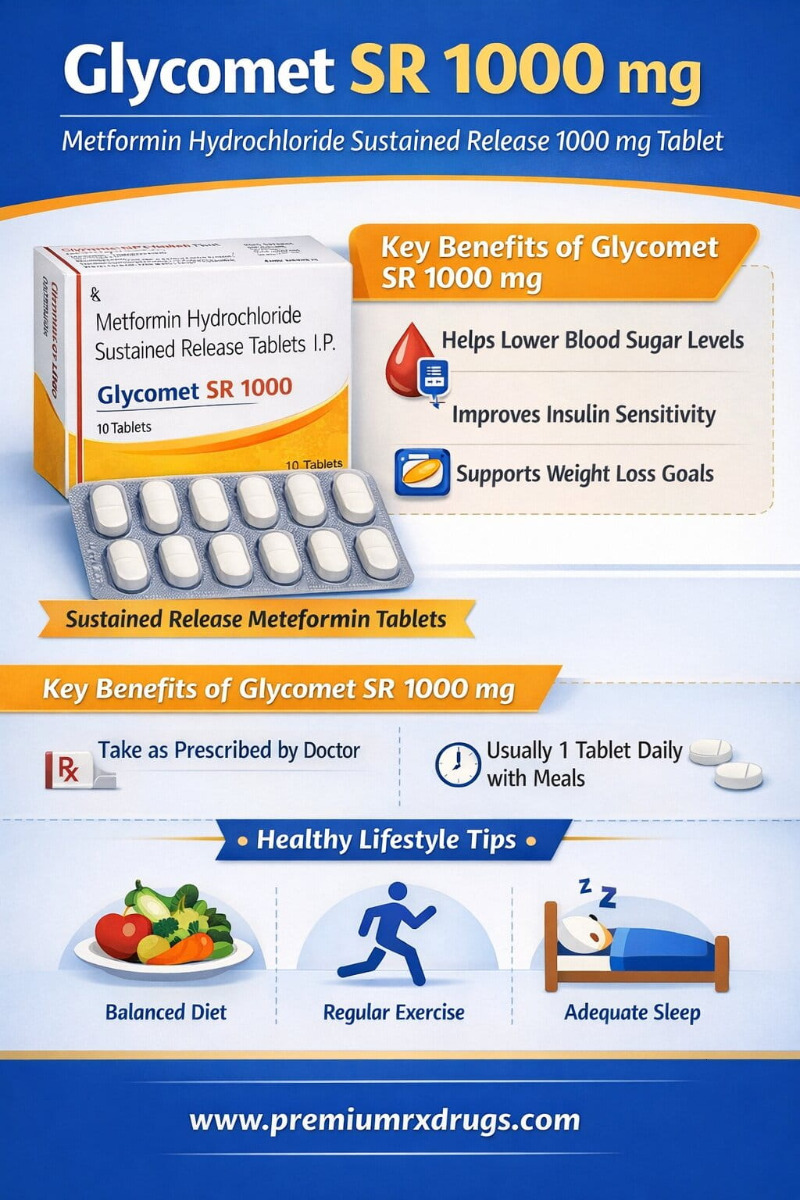
Glycomet SR 1000 mg
Available Dosages
| SKU | 658 |
|---|---|
| Generic For | Glucophage |
| Strength | 1000mg |
| Manufacturer | USV Ltd. |
| Active Ingredient | Metformin Hcl |


| Pack Size | Qty | Price Per Pill or Unit | Price | Cart | |
|---|---|---|---|---|---|
| 30 Tablet/s | US$ 0.20 | US$ 6.00 | |||
|
|||||
| 60 Tablet/s | US$ 0.15 | US$ 9.0025%US$ 12.00 | |||
|
|||||
| 90 Tablet/s | US$ 0.13 | US$ 12.0033%US$ 18.00 | |||
|
|||||

Glycomet SR 1000 mg – Affordable Glucophage Alternative for Type 2 Diabetes
Glycomet SR 1000mg is an extended-release oral diabetes medication in India and available online. It is a sustained-release matrix that delivers the drug gradually over several hours, significantly reducing the gastrointestinal side effects commonly associated with immediate-release Metformin. Glycomet SR is recommended as a first-line pharmacological treatment for type 2 diabetes mellitus in major international guidelines.
What is Glycomet SR 1000mg?
Glycomet SR 1000mg is a sustained-release oral tablet containing 1000mg of metformin hydrochloride, a biguanide-class antidiabetic agent. The SR formulation is designed to slowly release Metformin from a hydrophilic polymer matrix, maintaining more stable blood levels throughout the day and reducing peak drug concentrations that can cause gastrointestinal intolerance. It is prescribed for adults with type 2 diabetes mellitus, either as monotherapy when lifestyle interventions are insufficient, or in combination with other antidiabetic agents or insulin. In some clinical settings, it is also used adjunctively in type 1 diabetes and for polycystic ovary syndrome.
Manufacturer: USV LTD, India, manufactures the diabetes medicine Glycomet SR 1000mg, along with some other strengths.
Metformin hydrochloride: Ingredient profile and its mechanism
The active ingredient is metformin hydrochloride. Metformin works through three complementary mechanisms: it reduces hepatic glucose output by inhibiting gluconeogenesis (the liver's production of new glucose from non-carbohydrate sources) and glycogenolysis (breakdown of stored glycogen); it increases peripheral insulin sensitivity in skeletal muscle and adipose tissue, enhancing glucose uptake and utilisation; and it modestly reduces intestinal glucose absorption. Importantly, Metformin does not stimulate pancreatic insulin secretion, so it does not cause hypoglycaemia when used as monotherapy. It also activates AMP-activated protein kinase (AMPK), a master metabolic regulator, contributing to its broader metabolic benefits, including modest weight loss or weight neutrality.
Clinical uses of Metformin Glycoment
Glycomet SR 1000mg is indicated as a first-line treatment for type 2 diabetes mellitus in adults, monotherapy or in combination with sulphonylureas, DPP-4 inhibitors, SGLT-2 inhibitors, GLP-1 receptor agonists, or insulin. It is also prescribed for polycystic ovary syndrome (PCOS) to improve insulin resistance and restore ovulatory function, for prediabetes to delay progression to type 2 diabetes, and adjunctively in type 1 diabetes to reduce total insulin requirements. Among antidiabetic agents, Metformin has unique evidence of cardiovascular benefit, reducing major cardiovascular events and mortality in overweight type 2 diabetes patients.
Key benefits of using Glycoment
The SR formulation of Glycomet 1000mg offers superior gastrointestinal tolerability compared to immediate-release Metformin, making it the preferred option for patients who experience nausea or diarrhoea on standard tablets. Once-daily dosing improves adherence for long-term therapy. Metformin is weight-neutral or associated with modest weight loss, which is a meaningful advantage over insulin and sulphonylureas. It carries essentially no hypoglycaemia risk as monotherapy. The UKPDS landmark study established Metformin's cardioprotective benefits, making it particularly valuable in patients at elevated cardiovascular risk.
Comparing Glycomet SR 1000mg with Glucophage
Glycomet SR 1000mg is the generic equivalent of Glucophage SR 1000mg by Merck. Both use an extended-release delivery mechanism and contain the same concentration of the active ingredient. Bioequivalence studies confirm equivalent drug delivery to the bloodstream. The primary difference is cost: Glucophage SR is considerably more expensive, while Glycomet SR is available online at a fraction of the price, with no compromise in therapeutic efficacy. There are no clinically meaningful differences in treatment outcomes between the two formulations.
Related strengths and products: In addition to Glycomet SR 1000mg, Glycomet 250mg, and Glycomet 850mg, allowing doctors to customise diabetes treatment according to blood sugar control needs. Related products include Glycomet GP combinations, such as Glycomet GP 500+1mg and Glycomet GP 500+2mg, which combine Metformin with glimepiride (Glypride 1mg) to enhance glucose management. Other alternative metformin-based products include Bigomet 500mg, and many more.
Precautionary advice and drug interactions of metformin hcl tabs
Glycomet SR 1000mg or Glucophage is contraindicated in patients with severe renal impairment (eGFR below 30 mL/min/1.73m²), as Metformin accumulates under these conditions, increasing the risk of lactic acidosis — a rare but potentially fatal complication. Renal function must be assessed before initiating therapy and monitored at least annually. Metformin must be withheld for 48 hours before and after iodinated contrast imaging procedures and resumed only when renal function is stable. Significant hepatic impairment, congestive heart failure, chronic excessive alcohol consumption, and conditions causing dehydration or hypoxia are additional contraindications or caution flags. Interactions are possible with contrast agents, topiramate, vancomycin, cationic drugs (such as cimetidine) that compete for renal tubular secretion, and loop diuretics. Long-term use may reduce vitamin B12 absorption; periodic monitoring of B12 levels is advisable. Pregnant and breastfeeding women should discuss use with their doctor.
Side effects of metformin hcl tabs
Glycomet SR 1000mg or Glucophage is generally well tolerated, particularly compared to immediate-release Metformin. The most common side effects are gastrointestinal, including nausea, vomiting, diarrhoea, abdominal discomfort, and metallic taste, and the sustained-release formulation substantially reduces these. Starting at a lower dose and taking the tablet with the evening meal further minimises these effects. The most serious adverse effect of Metformin is lactic acidosis, which is extremely rare in patients with normal renal function but requires immediate medical attention if suspected. Symptoms include unusual muscle pain, difficulty breathing, stomach discomfort, dizziness, and slow or irregular heartbeat. Long-term use may cause vitamin B12 deficiency; regular monitoring is recommended. Hypoglycaemia is not a feature of metformin monotherapy.
Benefits of buying Glycomet SR 1000mg online
For patients managing type 2 diabetes, a chronic condition requiring lifelong daily medication, the cost savings from purchasing type 2 diabetes treatment online, like Glycomet SR 1000mg through PremiumRxDrugs, are substantial and accumulate significantly over months and years. The online platform stocks genuine USV Ltd.-manufactured Glycomet SR, ensuring pharmaceutical quality and consistency. Large packages offer further savings, and worldwide delivery ensures patients are never without their essential daily medication. The platform's straightforward prescription upload process and customer support make ordering easy, and discreet packaging provides privacy for patients managing health conditions online.
Usage instructions and storage information for metformin hcl tabs
Glycomet SR 1000mg or Glucophage is taken once daily with the evening meal to maximise tolerability by slowing absorption further and reducing peak drug levels. Swallow the tablet whole. Do not crush, split, or chew it. Breaking an SR tablet destroys the sustained-release mechanism, releasing the full dose at once and defeating its purpose, increasing the risk of side effects. The tablet matrix may occasionally be visible in the stool after the drug has been absorbed; this is harmless and expected. Typical starting doses of Metformin are lower (500mg once or twice daily), with gradual upward titration over 4 to 8 weeks to the 1000mg dose to minimise gastrointestinal effects. The maximum recommended total daily dose is 2000–3000mg. Missed doses should be taken as soon as remembered; skip and resume normally if the next dose is imminent. Do not double-dose. Store in a cool, dry place (below 25°C), away from moisture, heat, and sunlight. Keep out of reach of children and pets.
What is Glycomet SR 1000mg used for?
Glycomet SR 1000mg contains metformin hydrochloride 1000mg in a sustained-release (SR) tablet formulation for type 2 diabetes management. The SR formulation releases metformin gradually over several hours, reducing the GI side effects (nausea, diarrhoea) common with immediate-release tablets while maintaining effective blood glucose control. At 1000mg, it is typically a maintenance dose for adults already established on metformin therapy — providing near-maximum glucose-lowering benefit.
How does metformin SR 1000mg work to control blood sugar?
Metformin reduces hepatic glucose output by inhibiting gluconeogenesis (glucose production from non-sugar substrates), the primary mechanism causing high fasting blood sugar in type 2 diabetes. It also improves peripheral insulin sensitivity in muscle and adipose tissue, reducing post-meal glucose spikes. Unlike sulfonylureas, it does not stimulate insulin secretion — so it does not cause hypoglycaemia when used alone. The SR formulation achieves more stable plasma levels, reducing peak concentration and GI side effects.
When should Glycomet SR 1000mg be taken?
Glycomet SR 1000mg is typically taken once daily with the evening meal. The sustained-release formulation works best with food — taking it during a substantial meal slows absorption further and maximises the GI tolerability benefit of the SR formulation. Some patients are prescribed twice daily dosing (morning and evening meals). Swallow the SR tablet whole — never crush, chew, or halve it, as this destroys the sustained-release mechanism and causes an immediate high-dose release.
How long does metformin SR 1000mg take to lower HbA1c?
Metformin SR 1000mg begins reducing fasting blood glucose within 1–2 weeks. Full HbA1c reduction — the true measure of glycaemic control — takes 3 months to assess. At 1000mg/day, the expected HbA1c reduction is 1.0–1.5% in patients with mild to moderate hyperglycaemia. For patients with high baseline HbA1c (>9%), the total dose may be increased to 2000mg/day (two 1000mg SR tablets). Maximum metformin dose is 2550–3000mg/day in divided doses.
What are the advantages of the SR formulation over immediate-release metformin?
Glycomet SR (sustained-release) metformin has significantly better GI tolerability than immediate-release (IR) formulations. In clinical comparisons, the SR formulation causes nausea, diarrhoea, and vomiting in fewer patients — studies show GI adverse events reduced by 30–50%. The SR formulation also allows once-daily evening dosing, improving adherence. Blood glucose control is equivalent to IR at the same total daily dose. For patients who stopped IR metformin due to GI intolerance, SR is often well tolerated.
Is Glycomet SR 1000mg safe long-term?
Metformin has the longest safety track record of any oral diabetes medication and is recommended in all major guidelines as first-line therapy. Long-term use is associated with reduced cardiovascular events (UKPDS trial). The main long-term concern is gradual vitamin B12 depletion — annual B12 monitoring and supplementation when levels fall is recommended. Metformin does not cause weight gain, hypoglycaemia, or organ toxicity when renal function is maintained within approved thresholds.
How does Glycomet SR 1000mg compare to Glycomet 500mg IR?
Glycomet SR 1000mg delivers twice the metformin dose as a single sustained-release tablet compared to Glycomet 500mg IR, with fewer GI side effects due to slower drug release. The 1000mg SR achieves higher therapeutic plasma levels maintained for longer. For patients requiring higher metformin doses, taking two 500mg IR tablets twice daily can be replaced by one 1000mg SR tablet once daily — often with better tolerability and simpler regimen.
Is Glycomet SR 1000mg the same as Glucophage XR 1000mg?
Yes. Glycomet SR 1000mg contains the same active ingredient — metformin HCl 1000mg — in an extended/sustained-release formulation as branded Glucophage XR 1000mg. Both use controlled drug release mechanisms to improve GI tolerability compared to immediate-release tablets. Glycomet SR is the generic version providing equivalent glucose-lowering efficacy at a fraction of the cost of branded Glucophage XR.
Can I order Glycomet SR 1000mg from PremiumRxDrugs for delivery to the USA?
Yes. PremiumRxDrugs.com ships Glycomet SR 1000mg and other diabetes medications to the USA, UK, Australia, and many other countries. Our genuine manufacturer-verified medicines, transparent pricing, and free worldwide shipping on qualifying orders make us a dependable source for affordable metformin therapy.
What side effects does Glycomet SR 1000mg cause?
GI side effects — nausea, diarrhoea, abdominal bloating, vomiting — are the most common, though significantly less frequent with SR than immediate-release formulations. Taking with food further reduces these effects. Metallic taste is occasionally reported. Vitamin B12 deficiency develops gradually with long-term use (monitor annually after 3 years). Lactic acidosis is the most serious but rare complication — it occurs almost exclusively in patients with contraindicated risk factors (severe renal, hepatic, or cardiac failure).
What precautions apply to Glycomet SR 1000mg users?
Never crush or chew SR tablets. Always take with food. Withhold before iodinated contrast procedures and restart 48 hours post-procedure. Monitor eGFR at least annually — reduce dose when eGFR 30–45 ml/min, stop below 30. Monitor B12 annually after 3 years of use. Avoid excess alcohol. Inform your doctor if you experience unusual muscle pain, difficulty breathing, or stomach pain — these could indicate lactic acidosis. Disclose metformin use to all healthcare providers before any procedure.
Login
Sign Up
Login
Sign Up