




Tazret Forte Cream 0.1% 20gm
Available Dosages
| SKU | 1082 |
|---|---|
| Generic For | Tazorac Cream |
| Strength | 20gm |
| Manufacturer | Glenmark |
| Active Ingredient | Tazarotene |


| Pack Size | Qty | Price Per Pill or Unit | Price | Cart | |
|---|---|---|---|---|---|
| 1 Tube/s | US$ 14.00 | US$ 14.00 | |||
|
|||||
| 3 Tube/s | US$ 13.02 | US$ 39.067%US$ 42.00 | |||
|
|||||
| 6 Tube/s | US$ 12.50 | US$ 75.0011%US$ 84.00 | |||
|
|||||

Tazret Forte Cream 0.1% – Affordable Tazorac Cream Alternative
Struggling with stubborn acne, rough skin texture, or persistent breakouts that refuse to go away? Tazret Forte cream 0.1%, powered by the potent retinoid tazarotene, is designed for individuals who need stronger, dermatologist-recommended treatment beyond basic skincare solutions. This advanced topical therapy works deep within the skin to unclog pores, reduce inflammation, and accelerate natural skin renewal. Whether you’re dealing with severe acne, psoriasis, or uneven skin tone, Tazret Forte offers a clinically trusted solution to restore smoother, clearer, and healthier-looking skin.
What is Tazret Forte cream 0.1%?
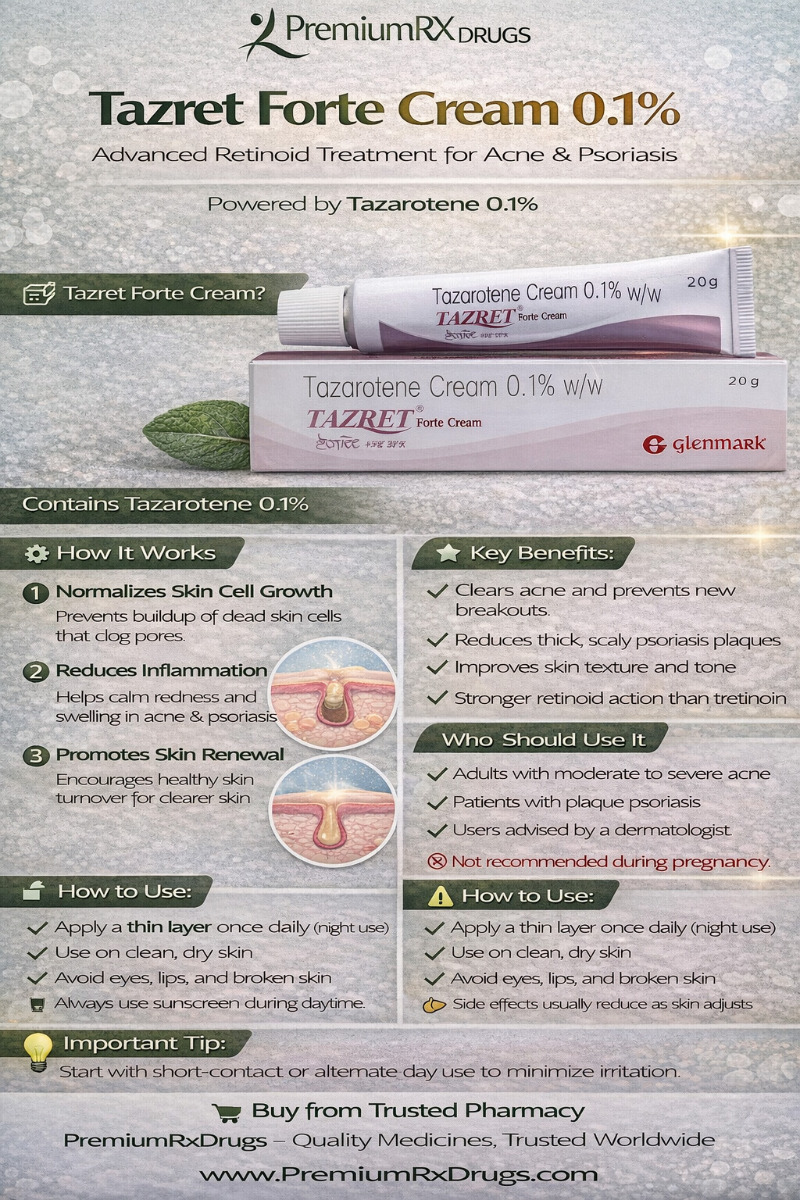
Tazret Forte cream is a prescription-strength topical retinoid formulated with tazarotene 0.1%, a vitamin A derivative known for its powerful effects on skin cell turnover. It is widely used to treat moderate to severe acne and certain skin conditions, such as plaque psoriasis. Unlike milder over-the-counter treatments, this formulation penetrates deeper into the skin, targeting the root causes of acne while improving overall skin texture and tone.
Manufacturer: Tazret Forte cream 0.1% is manufactured by Glenmark Pharmaceuticals, a well-established Indian pharmaceutical company known for producing high-quality dermatological medications.
Who should use Tazret Forte cream?
This cream is ideal for:
- Individuals with moderate to severe acne
- Those who haven’t responded to milder treatments
- People with rough, uneven skin texture
- Patients diagnosed with plaque psoriasis
- Adults seeking stronger retinoid-based skincare solutions
Active ingredient Tazarotene & its working mechanism
Tazret Forte contains tazarotene, which binds to specific receptors in the skin to regulate cell growth and differentiation. It helps normalise the shedding of dead skin cells, preventing them from clogging pores. Additionally, it reduces comedone formation (blocked pores) and minimises inflammation. Over time, this leads to clearer skin, fewer breakouts, and improved overall complexion.
Tazret Forte vs other retinoids: When compared to other retinoid treatments, Tazret Forte stands out for its potency and faster results.
Tazarotene (Tazret Forte): Strongest option, ideal for severe acne and resistant skin conditions
Tretinoin: Effective but slightly less potent, suitable for moderate acne
Adapalene: Gentler, better suited for sensitive skin or beginners
If you need faster and more noticeable results, Tazret Forte is often the preferred choice.
Comparing brand vs generic: Detailed comparison of Tazret Forte and Tazorac cream
The main distinction between generic Tazret Forte cream and brand-name Tazorac cream lies not in how they work, but in their formulations, cost, and accessibility. Both contain the same active ingredient, tazarotene, which regulates skin cell turnover and reduces inflammation, making them equally effective for treating acne and psoriasis when used correctly. However, Tazret Forte is often preferred by long-term users because it delivers the same therapeutic results at a significantly lower price, making ongoing treatment more sustainable. On the other hand, Tazorac may offer a slightly more refined formulation, which some users report is cosmetically more elegant or less irritating initially, especially for sensitive skin types.
Another subtle difference is that branded versions, such as Tazorac, typically undergo extensive clinical trials under a single manufacturer. At the same time, generics such as Tazret Forte must demonstrate bioequivalence but may differ slightly in inactive ingredients, which can affect texture, absorption, and irritation in some individuals. Ultimately, both options are medically interchangeable, but the choice often depends on budget, skin sensitivity, and personal preference rather than effectiveness.
Key benefits of Tazret Forte cream
- Targets stubborn acne at its source: Tazret Forte works by preventing clogged pores, one of the primary causes of acne. It helps reduce blackheads, whiteheads, and inflammatory breakouts.
- Accelerates skin cell turnover: By increasing the rate at which skin cells regenerate, it promotes smoother skin and reduces the appearance of acne scars and rough patches.
- Reduces inflammation and redness: Its anti-inflammatory properties help calm irritated skin, making it effective for inflamed acne lesions.
- Improves skin texture and tone: With consistent use, users often notice brighter, more even-toned skin with reduced pigmentation.
- Effective for psoriasis management: Tazret Forte is also used to treat plaque psoriasis by slowing excessive skin cell growth and reducing scaling.
Safety information and precautions of tazarotene cream
Tazret Forte or Tazorac cream is not suitable for everyone. Avoid using this cream if you are pregnant or planning to become pregnant, have highly sensitive or eczema-prone skin, are allergic to tazarotene or retinoids, or have sunburned or damaged skin. Always consult a healthcare professional before starting treatment. To ensure safe use, keep the precautionary measures suggested by yoru dermatologist in mind. Avoid excessive sun exposure; always use sunscreen. Do not apply to broken or irritated skin. Avoid combining with harsh exfoliants or alcohol-based products. Wash your hands after application. Keep away from the eyes, mouth, and sensitive areas.
Possible side effects of the tazarotene formulation
While generally well tolerated, some users may experience skin irritation or a burning sensation when using Tazret Forte or Tazorac cream. Itching and increased sensitivity to sunlight may occur. If severe irritation occurs, discontinue use and seek medical advice.
Using Tazarotene cream for the best results
For optimal effectiveness, follow the steps your dermatologist provides before using Tazret Forte or Tazorac cream. Cleanse your face with a gentle, non-medicated cleanser. Pat your skin dry completely. Apply a pea-sized amount of cream to affected areas. Use once daily, preferably at night. Follow with a moisturiser to reduce dryness. Avoid applying excessive amounts, as this may increase irritation without improving results. When starting Tazarotene, it’s normal to experience mild side effects such as dryness, redness, peeling, and slight irritation. These effects typically subside as your skin adjusts. Visible improvements usually appear within 4–8 weeks, with continued progress over time.
Storage Instructions: Store at room temperature. Keep away from direct sunlight and heat. Do not freeze. Keep out of reach of children.
What is Tazret Forte 0.1% Gel used for?
Tazret Forte 0.1% Gel contains tazarotene 0.1% — the maximum-strength topical retinoid formulation of tazarotene. FDA-approved indications: acne vulgaris (moderate-severe, resistant to lower concentrations or as initial therapy under dermatologist supervision); photoaging (FDA-approved for fine lines, dyspigmentation, and tactile roughness — one of the few topical agents with this FDA approval); and plaque psoriasis (plaques with significant thickness and scaling). Tazarotene 0.1% achieves the highest retinoid receptor activity of any approved topical retinoid — providing maximum comedolytic, anti-inflammatory, anti-proliferative, and collagen-stimulating effects, with the most pronounced initial irritation.
How does Tazret Forte 0.1% compare to tretinoin 0.1%?
Tazarotene 0.1% vs. tretinoin 0.1% are both maximum-strength topical retinoids. Comparative evidence: tazarotene 0.1% consistently shows superior reduction in both comedones and inflammatory lesions compared to tretinoin 0.1% in clinical trials; also demonstrates superior photoaging improvement in some studies. Both achieve significant collagen stimulation and epidermal normalization. Tazarotene 0.1% disadvantages: more irritating than tretinoin 0.1% — higher rates of erythema, dryness, and treatment-related discomfort; higher discontinuation rates in trials; requires very careful initiation. Patient-reported tolerability often favours tretinoin 0.1%. Dermatologist choice: tazarotene 0.1% for maximum acne or psoriasis efficacy where tolerability is manageable; tretinoin 0.1% when tolerability is the priority.
How should Tazret Forte 0.1% Gel be initiated for retinoid-experienced patients?
Tazret Forte 0.1% should only be initiated by patients already tolerating a lower-strength retinoid (tretinoin 0.05%, tazarotene 0.05%, or Supatret 0.04%) or under close dermatologist supervision. Initiation: Week 1–2: apply every other night; Week 3–4: move to nightly if well-tolerated (manageable peeling, no blistering). Supporting measures essential at 0.1%: ceramide-rich moisturiser applied after gel absorption; barrier-protective approach (some clinicians use the 'buffer' — moisturiser before and after application); strict SPF 50+ morning sunscreen. If initiated as first retinoid: begin every 3 nights for the first 2 weeks, progressing very gradually. Expect 8–12 weeks before full skin adaptation at 0.1%.
Is Tazret Forte 0.1% safe in pregnancy?
Tazarotene 0.1% is Category X — absolutely contraindicated in pregnancy. At the higher 0.1% concentration, systemic absorption (2–5%) is potentially greater than at 0.05% — the teratogenicity precaution is the same regardless of topical concentration. Women must use reliable contraception throughout tazarotene treatment and for 1 month after the last application. Perform a pregnancy test before initiating in women of reproductive age. If pregnancy occurs during treatment, stop immediately and obtain obstetric consultation. Tazarotene 0.1% is contraindicated during breastfeeding. For acne or psoriasis management during pregnancy: dermatologist consultation for alternative therapies (azelaic acid for acne; emollients, coal tar, and low-potency topical steroids for psoriasis).
What drug interactions apply to Tazret Forte 0.1% Gel?
Same local interaction precautions as tazarotene 0.05% — heightened at the higher concentration. Benzoyl peroxide: absolute separation required (use morning only — never concurrently with tazarotene application). Other retinoids: never combine. Photosensitising systemic medications (doxycycline, thiazides, quinolones, NSAIDs): increased photosensitivity — enhance sun protection to SPF 50+ minimum. Salicylic acid and glycolic acid preparations: avoid simultaneous use due to cumulative irritation. At 0.1%, topical tazarotene may theoretically have slightly higher systemic absorption — but clinically significant systemic drug interactions remain unexpected. Stop 7–10 days before any laser, chemical peel, or IPL treatment.
Is Tazret Forte equivalent to Tazorac 0.1% or Avage?
Yes. Tazret Forte 0.1% Gel and branded Tazorac 0.1% Gel (acne/psoriasis) / Avage 0.1% Cream (photoaging) all contain tazarotene 0.1% in equivalent topical formulations. Tazret Forte is the generic alternative providing the same maximum-strength tazarotene therapy at significantly lower cost. PremiumRxDrugs.com stocks authentic manufacturer-sourced Tazret Forte 0.1% Gel verified for quality and therapeutic equivalence.
Can I order Tazret Forte 0.1% Gel from PremiumRxDrugs for international delivery?
Yes. PremiumRxDrugs ships Tazret Forte 0.1% Gel to the USA, UK, Australia, and many other countries. Our genuine manufacturer-verified tazarotene products, competitive pricing, and free worldwide shipping on qualifying orders make usa reliable international pharmacy for maximum-strength topical retinoid therapy.
What side effects does Tazret Forte 0.1% cause?
Tazarotene 0.1% causes the most pronounced retinoid dermatitis of any standard topical retinoid: significant dryness and peeling; pronounced erythema; intense burning and stinging on application; pronounced purging; strong photosensitisation. Skin irritation at 0.1% is substantially more than at 0.05% and comparable to or greater than tretinoin 0.1%. Managing 0.1% tazarotene side effects: every-other-night initiation is non-negotiable; buffer method (moisturiser sandwich); ceramide-based moisturiser; SPF 50+ daily. Blistering with excessive application on sensitive or broken skin. Eyelid/lip margin irritation — maintain 0.5–1cm exclusion zone from these areas. True allergic contact dermatitis uncommon. If side effects remain severe after 8 weeks of every-other-night use, switch to tretinoin 0.1% or 0.05%.
What results can be expected from Tazret Forte 0.1% for photoaging?
Tazarotene 0.1% has strong clinical evidence for photoaging improvement — FDA-approved for this indication. Expected improvements: fine lines and wrinkles — 20–40% reduction at 6 months; mottled hyperpigmentation — 30–50% improvement at 6 months; skin roughness — significant smoothing at 3–6 months; skin tone uniformity — improved at 6–12 months. Compared to tretinoin 0.1%: some clinical trials demonstrate superior or equivalent improvements in specific photoaging parameters with tazarotene 0.1%, particularly for dyspigmentation. Both achieve significant collagen remodelling and epidermal normalisation. Long-term continued use (1–2 years): progressive and maintained improvements. The high efficacy of 0.1% tazarotene comes at the cost of the most pronounced side effect profile among topical retinoids.
Can Tazret Forte 0.1% be used for psoriasis on the scalp?
Tazarotene gel formulation can be used on scalp psoriasis, though it requires careful application. Application: part hair to expose psoriatic plaques; apply a thin layer directly to the plaque surface; avoid applying to surrounding uninvolved scalp (more irritating on non-psoriatic skin). For scalp psoriasis specifically: shampoo-based or solution-based treatments (ketoconazole, coal tar, calcipotriol) are often more practical. Tazarotene gel 0.1% for scalp psoriasis may cause significant scalp irritation — combination with a corticosteroid scalp solution in the morning helps. Response: plaque thickness reduces within 4–8 weeks; scaling and erythema improve over 8–12 weeks. Tazarotene is not the first-line for isolated scalp psoriasis — topical vitamin D analogues (calcipotriol) and corticosteroids are first-line, with tazarotene as second-line for resistant plaques.
How long should Tazret Forte 0.1% be used for acne versus psoriasis?
For acne: use nightly until full clearance (typically 6 months); then downgrade to maintenance at lower concentration (tazarotene 0.05% or tretinoin 0.025%) 2–3× weekly to avoid prolonged maximum-strength use. Indefinite 0.1% tazarotene for acne maintenance is possible but more irritating than needed for maintenance — lower concentrations maintain remission with fewer side effects. For psoriasis: use in courses of 12 weeks (as per clinical guidelines for topical retinoid psoriasis therapy); a maintenance approach of 2–3× weekly after achieving clearance; take breaks of 4–8 weeks between intensive courses if needed. Psoriasis is chronic — ongoing maintenance with tazarotene or combination therapy rotation (with topical steroids and vitamin D analogues) is the standard long-term approach. Annual dermatologist review recommended.
Login
Sign Up
Login
Sign Up