
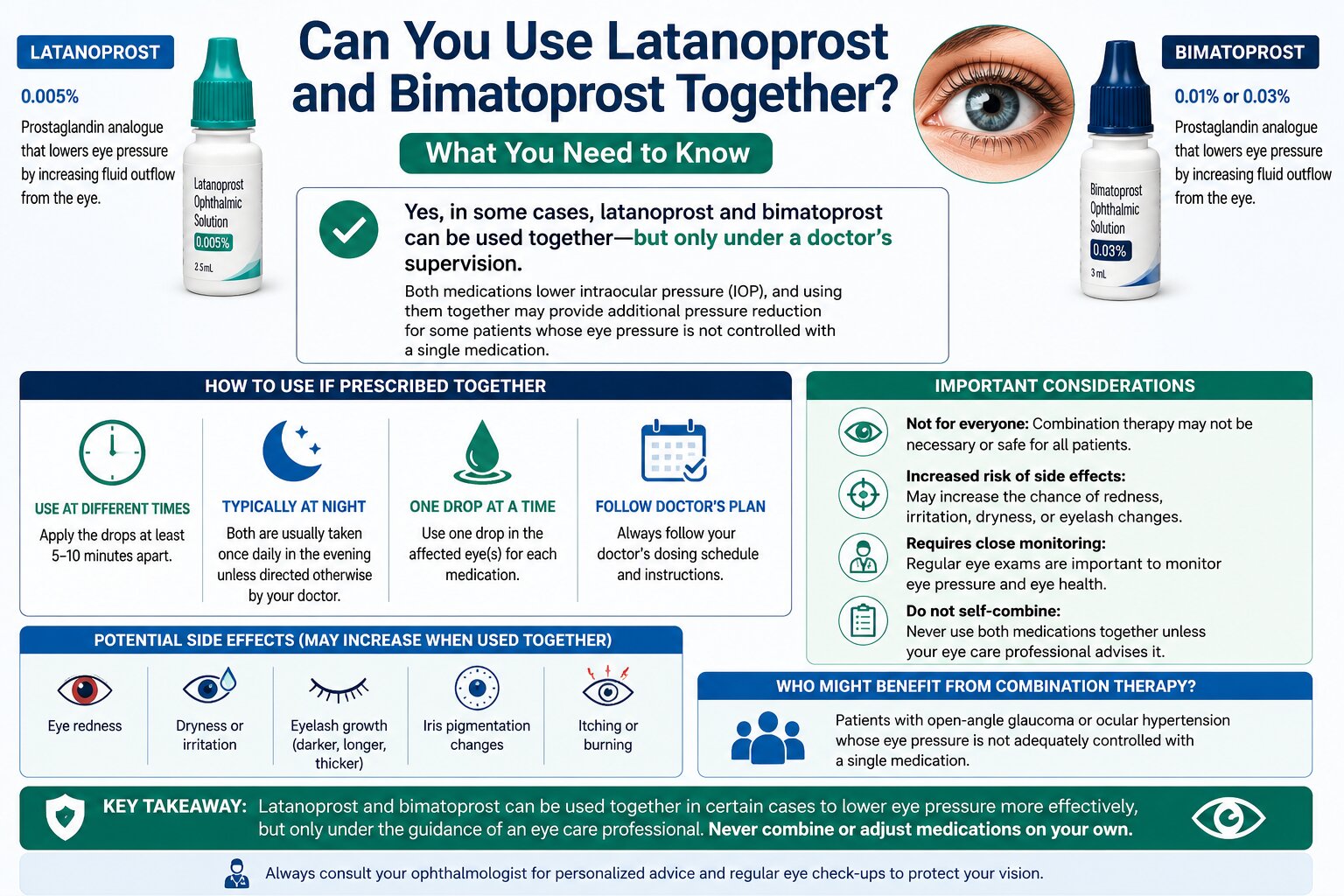
If your current glaucoma medication isn’t bringing your eye pressure down as much as your doctor would like, it’s natural to wonder whether adding a second, similar drug could help. Latanoprost and bimatoprost are both highly effective, prescribed for the same condition, and work by improving fluid drainage from the eye, so combining them seems like it should produce twice the benefit.
The research tells a more complicated story. Here’s what’s actually known about using these two medications together, why the answer isn’t as simple as “more is better,” and what your doctor is more likely to recommend instead.
A Quick Refresher: What Are Latanoprost and Bimatoprost?
Both medications are used to lower intraocular pressure (IOP) in patients with open-angle glaucoma or ocular hypertension — the most common form of glaucoma, and a major cause of progressive, irreversible vision loss when pressure inside the eye isn’t controlled.
- Latanoprost is a prostaglandin F2-alpha analogue, available at PremiumRxDrugs as the Latoprost RT Eye Drop .005%. It was the first prostaglandin analogue to reach the market and remains one of the most widely prescribed glaucoma medications worldwide.
- Bimatoprost is technically classified as a prostamide, a close chemical relative of the prostaglandin class. It’s available as Careprost (Bimatoprost) Solution.
Both are dosed once daily, and both have strong, well-documented safety records on their own.
How Do They Work — And Why Does That Matter for Combining Them?
To understand why combining these two specific drugs is different from combining other glaucoma medications, you need to understand how they lower pressure.
The eye constantly produces fluid (aqueous humour) that drains out through two main pathways: the trabecular meshwork (the “conventional” route) and the uveoscleral pathway (the “unconventional” route). Glaucoma medications work by either reducing how much fluid the eye produces or increasing how much drains out.
- Latanoprost works almost entirely by increasing outflow through the uveoscleral pathway.
- Bimatoprost also acts on the uveoscleral pathway, and research suggests it has additional effects on the trabecular meshwork.
This is the key detail: both drugs, for the most part, pull the same lever. When two medications act on the exact same drainage pathway through similar receptor mechanisms, doubling up on them doesn’t necessarily double the benefit — the pathway can only be stimulated so much before it’s essentially maxed out, regardless of how many similar drugs are pushing on it.
So, Can They Be Used Together?
This is the central question, and the honest answer is: generally, no, not as a way to get extra pressure reduction.
Clinical research comparing the combined use of latanoprost and bimatoprost solutions against either drug alone has consistently failed to demonstrate a meaningful additive benefit. In other words, patients using both medications together typically don’t end up with significantly lower eye pressure than patients using just one of them at its full effect.
More concerning, some studies and clinical reports have noted that combining the two can occasionally lead to a paradoxical increase in IOP in certain patients — meaning pressure goes up rather than down. The leading explanation is that when two drugs compete for the same or overlapping receptors along the same outflow pathway, they can interfere with each other’s effectiveness rather than reinforcing it, similar to how overlapping signals can cancel each other out rather than combine.
Because of this, combination therapy using two prostaglandin-class drugs together is not considered a recommended treatment strategy for glaucoma, despite how logical it might seem on paper.
Why This Is Different From Other Glaucoma Drug Combinations
It’s important to separate this specific combination from glaucoma combination therapy in general, which is extremely common and often very effective. The difference comes down to mechanism.
When a prostaglandin analogue (like latanoprost or bimatoprost) is combined with a drug from a different class — one that lowers pressure through a different mechanism entirely — the two medications typically work well together, because they’re not competing over the same pathway. Common, well-supported combinations include:
- Prostaglandin analogue + beta-blocker (e.g., timolol) — reduces fluid production while also increasing outflow
- Prostaglandin analogue + alpha-2 agonist (e.g., brimonidine) — reduces production and modestly increases outflow through a separate route
- Prostaglandin analogue + carbonic anhydrase inhibitor (e.g., dorzolamide) — reduces aqueous humour production through an entirely different enzymatic pathway
These combinations are commonly prescribed and well-studied because each drug addresses the problem from a different angle. Latanoprost plus bimatoprost, by contrast, attacks the problem from nearly the same angle twice, which is why it doesn’t behave the way patients might expect.
What Happens If You Use Both Anyway?
Using latanoprost and bimatoprost together isn’t typically dangerous in the way that some drug interactions are, but it carries real downsides without a clear upside:
- No reliable extra pressure reduction — you’re paying for and using two medications without solid evidence of additional benefit over one alone.
- Possible paradoxical IOP increase — in some patients, combining the two has been associated with eye pressure rising rather than falling, the opposite of the intended effect.
- Compounded side effects — both drugs share overlapping side effects (eye redness, irritation, iris darkening, eyelash growth), and using both increases your overall exposure without a proportional therapeutic gain.
- Unnecessary cost — two prescriptions instead of one, for a strategy that isn’t supported by strong clinical evidence.
What to Do Instead If One Drug Isn’t Working Well Enough
If your current medication — whether it’s latanoprost or bimatoprost — isn’t reducing your eye pressure to your target level, there are generally two better paths than combining the two:
- Switch to the other drug. Since latanoprost and bimatoprost don’t always perform identically in every patient, some people who respond poorly to one see better results on the other, meaningfully, despite their similar mechanisms. This is a common and reasonable first step.
- Add a drug from a different class. Rather than doubling up within the prostaglandin/prostamide category, your doctor may add a beta-blocker, alpha-2 agonist, or carbonic anhydrase inhibitor — one of the combinations described above — to attack IOP through a second, independent mechanism.
Both of these strategies are well-supported by research and clinical practice, unlike combining two same-class prostaglandin drugs.
Talk to Your Ophthalmologist Before Changing Anything
Glaucoma treatment decisions should always be made in partnership with an eye care professional who can measure your actual intraocular pressure, track your response to treatment over time, and weigh your specific risk factors. Never add, stop, or combine glaucoma medications on your own — even when a change seems logical, as this article demonstrates, intuition doesn’t always match what the clinical evidence shows.
Frequently Asked Questions
Is it dangerous to accidentally use both on the same day? An isolated instance is unlikely to cause serious harm, but it isn’t a treatment strategy your doctor would recommend for the future. If you’ve been prescribed both and aren’t sure why, check with your doctor or pharmacist.
Why would my doctor prescribe both if they don’t work better together? In most cases, doctors don’t intentionally prescribe both prostaglandin-class drugs simultaneously for the same eye. If you’ve been prescribed both, it may be because you’re transitioning from one to the other, or because they’re being used on different eyes for separate reasons — worth clarifying with your prescriber.
Can I combine bimatoprost or latanoprost with cosmetic eyelash products? If you’re already using one for glaucoma treatment, adding a separate cosmetic lash serum containing a similar ingredient isn’t recommended without medical guidance, for the same overlapping-mechanism reasons described above.
What’s the most effective combination therapy for glaucoma? There’s no single “best” combination for every patient — it depends on your specific pressure target, treatment response, and any other health conditions. Pairing a prostaglandin analogue with a drug from a different class (like a beta-blocker) is among the most commonly used and well-supported strategies.
Final Thoughts
It’s a reasonable instinct to think that combining two powerful glaucoma medications would lower eye pressure more than either one alone — but latanoprost and bimatoprost are simply too similar in how they work for that logic to hold up. The research points clearly toward switching between the two, or pairing one of them with a medication from a different drug class, as the more effective paths forward. As always, any changes to your glaucoma treatment plan should be made in consultation with your ophthalmologist.
This article is for informational purposes only and does not replace professional medical advice. Latanoprost and bimatoprost are prescription medications — never combine, switch, or stop glaucoma treatments without first consulting an ophthalmologist.

Latest posts by Marie (see all)
- Semaglutide for PCOS: Can It Help with Weight Loss, Insulin Resistance & Irregular Periods? - October 17, 2026
- Semaglutide Side Effects: Common Symptoms, Serious Risks & Safety Tips - October 16, 2026
- How to control high cholesterol: self-care at home? - October 15, 2026


