
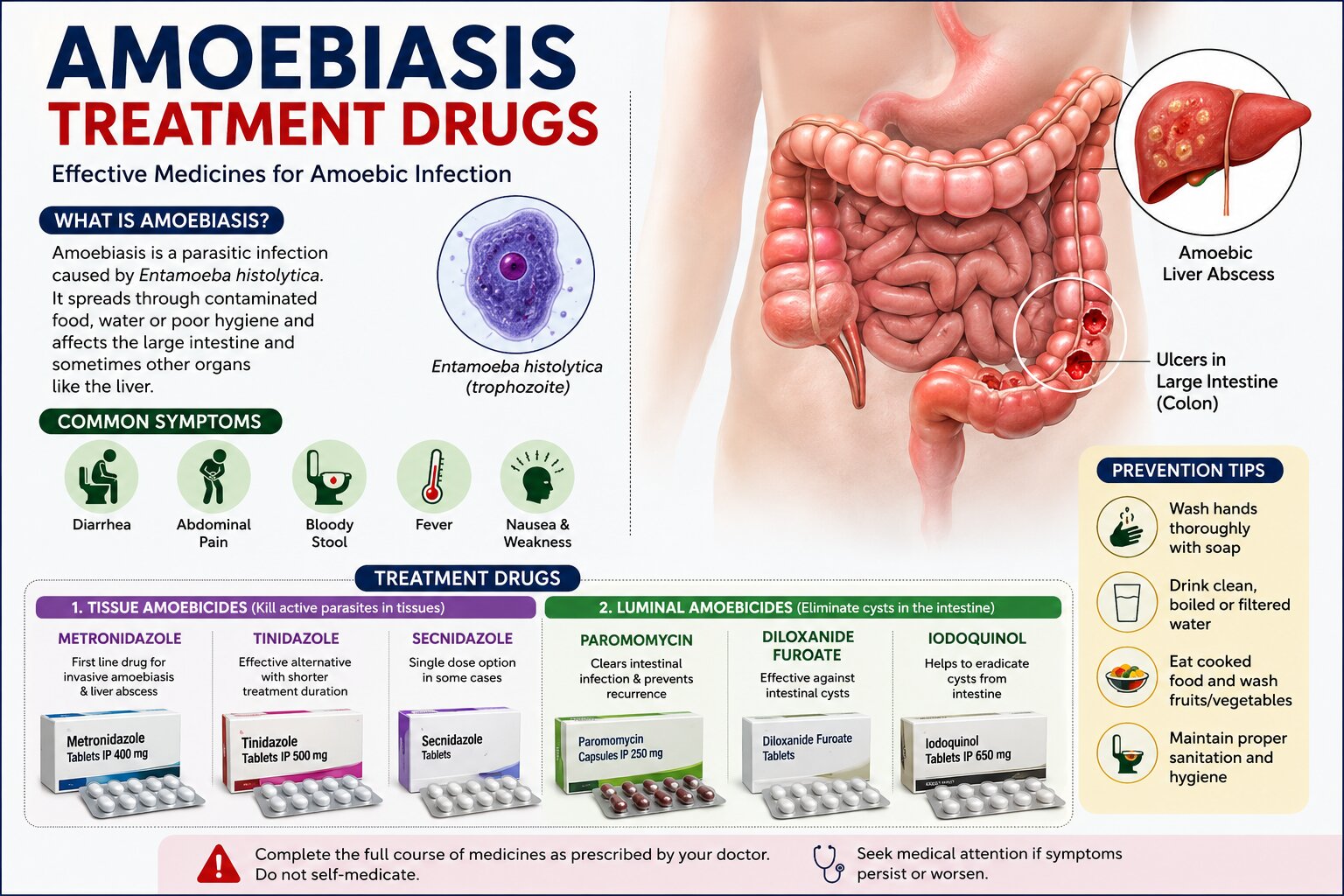
The infection is commonly spread through contaminated food and water and can range from asymptomatic colonisation to severe intestinal disease and life-threatening liver abscesses. Fortunately, effective drugs for amoebiasis are available to eliminate the parasite and prevent complications.
Amoebiasis is a parasitic infection caused by Entamoeba histolytica, a microscopic parasite that primarily affects the intestines. It remains one of the leading causes of parasitic disease worldwide, particularly in developing countries where sanitation and clean water access are limited.
In this comprehensive guide, we’ll discuss the symptoms, diagnosis, treatment options, medications, side effects, and prevention strategies for amoebiasis.
What Is Amoebiasis?
Amoebiasis is an infection caused by the protozoan parasite Entamoeba histolytica. The parasite exists in two forms:
Cyst Stage
The cyst is the infectious form of the parasite. It can survive outside the body for extended periods and is resistant to many environmental conditions. Infection occurs when a person consumes food or water contaminated with these cysts.
Trophozoite Stage
After entering the digestive tract, cysts release active parasites called trophozoites. These organisms colonise the large intestine and may invade the intestinal wall, causing tissue damage and inflammation.
In severe cases, trophozoites can enter the bloodstream and spread to organs such as the liver, lungs, and brain.
How Amoebiasis Spreads
The infection is primarily transmitted through the faecal-oral route.
Common sources include:
- Contaminated drinking water
- Improperly washed fruits and vegetables
- Poor sanitation practices
- Inadequate hand hygiene
- Food prepared by infected individuals
Travellers visiting endemic regions are at higher risk of contracting amoebiasis.
Symptoms of Amoebiasis
Many infected individuals experience no symptoms. However, when symptoms occur, they may range from mild to severe.
Common Symptoms
- Diarrhea
- Abdominal cramps
- Stomach pain
- Bloating
- Nausea
- Fatigue
- Loss of appetite
- Weight loss
Symptoms of Amoebic Dysentery
When the parasite invades the intestinal wall, patients may develop:
- Bloody diarrhea
- Mucus in stools
- Severe abdominal pain
- Tenesmus (constant urge to pass stool)
- Low-grade fever
Symptoms of Amoebic Liver Abscess
If the parasite spreads to the liver, symptoms may include:
- High fever
- Chills
- Right upper abdominal pain
- Enlarged liver
- Shoulder pain
- Excessive sweating
Prompt treatment is essential to prevent serious complications.
Diagnosis of Amoebiasis
Accurate diagnosis is crucial because Entamoeba histolytica closely resembles non-harmful amoeba species.
Stool Examination
Microscopic analysis of stool samples may reveal cysts or trophozoites.
Stool Antigen Testing
ELISA-based tests help identify Entamoeba histolytica more accurately than traditional microscopy.
PCR Testing
Polymerase Chain Reaction (PCR) testing is considered one of the most accurate methods for detecting amoebic DNA.
Blood Tests
Serological tests can detect antibodies, especially in patients with liver abscesses.
Imaging Studies
Ultrasound and CT scans are frequently used to diagnose amoebic liver abscesses.
Amoebiasis Treatment Drugs
Successful treatment generally requires two types of medications:
- Tissue Amoebicides
- Luminal Amoebicides
This dual-treatment approach ensures complete parasite eradication.
Tissue Amoebicides
These drugs kill parasites that have invaded body tissues.
1. Metronidazole
Metronidazole remains the most widely prescribed medication for invasive amoebiasis.
How It Works
It damages parasite DNA, leading to cell death.
Uses
- Amoebic dysentery
- Intestinal amoebiasis
- Amoebic liver abscess
Common Side Effects
- Metallic taste
- Nausea
- Vomiting
- Headache
- Dizziness
Important Warning
Alcohol should be avoided during treatment and for at least 72 hours afterwards because serious reactions may occur.
2. Tinidazole
Tinidazole belongs to the same drug class as Metronidazole but has a longer half-life.
Benefits
- Shorter treatment duration
- Better patient compliance
- Effective tissue penetration
Side Effects
- Metallic taste
- Nausea
- Fatigue
- Mild gastrointestinal discomfort
3. Secnidazole
Secnidazole is a newer nitroimidazole medication.
Advantages
- Single-dose treatment in some cases
- Long-lasting activity
- Improved treatment adherence
Side Effects
- Nausea
- Headache
- Abdominal discomfort
Luminal Amoebicides
These medications eliminate parasites remaining in the intestinal lumen after tissue treatment.
4. Paromomycin
Paromomycin is often prescribed following Metronidazole or Tinidazole therapy.
How It Works
It remains inside the intestine and destroys residual parasites.
Benefits
- Prevents relapse
- Eliminates cyst carriers
- Reduces transmission
Side Effects
- Abdominal cramps
- Diarrhea
- Bloating
5. Diloxanide Furoate
Diloxanide Furoate is commonly used to clear intestinal cysts.
Benefits
- Effective cyst eradication
- Well tolerated
Side Effects
- Flatulence
- Mild abdominal discomfort
- Nausea
6. Iodoquinol
Iodoquinol is another luminal agent used to eliminate intestinal amoebic cysts.
Benefits
- Effective against luminal parasites
- Reduces recurrence
Possible Side Effects
- Rash
- Nausea
- Gastrointestinal upset
Patients with thyroid disorders should use Iodoquinol cautiously.
Why Two Drugs Are Often Needed
Many patients wonder why they receive more than one medication.
The reason is simple:
- Tissue amoebicides kill parasites in body tissues.
- Luminal amoebicides remove parasites remaining inside the intestine.
Without follow-up treatment, relapse can occur because intestinal cysts may survive.
Treatment of Amoebic Liver Abscess
An amoebic liver abscess is the most common extraintestinal complication.
Standard Treatment Includes
- Metronidazole or Tinidazole
- Follow-up luminal therapy with Paromomycin or Diloxanide Furoate
When Is Drainage Required?
Doctors may recommend abscess drainage when:
- The abscess is very large
- Rupture is possible
- Symptoms fail to improve within 72 hours
- Diagnosis remains uncertain
Most patients recover successfully with prompt treatment.
Prevention of Amoebiasis
Preventing infection is often easier than treating it.
Drink Safe Water
- Boil water before drinking
- Use purified or filtered water
- Avoid untreated water sources
Follow Food Safety Practices
- Eat thoroughly cooked foods
- Wash fruits and vegetables properly
- Avoid raw foods in high-risk areas
Maintain Good Hygiene
- Wash your hands frequently
- Use soap and clean water
- Practice proper sanitation
Travel Precautions
When visiting endemic regions, remember:
“Boil it, cook it, peel it, or forget it.”
Frequently Asked Questions
What is the best treatment for amoebiasis?
Metronidazole and Tinidazole are considered first-line treatments for invasive amoebiasis. They are usually followed by a luminal amoebicide such as Paromomycin.
Can amoebiasis be cured completely?
Yes. Most cases can be completely cured with appropriate treatment.
How long does treatment take?
Treatment duration varies depending on the medication and severity of infection, but usually ranges from 3 to 14 days.
Is amoebiasis contagious?
Yes. It spreads through contaminated food, water, and poor hygiene practices.
Can amoebiasis return after treatment?
Yes. Reinfection can occur if hygiene and sanitation measures are not maintained.
Conclusion
Amoebiasis is a common yet potentially serious parasitic infection caused by Entamoeba histolytica. While many infections remain mild, untreated cases can lead to severe intestinal disease and liver abscesses.
Effective amoebiasis treatment drugs such as Metronidazole, Tinidazole, Secnidazole, Paromomycin, Diloxanide Furoate, and Iodoquinol play a vital role in eliminating the parasite and preventing recurrence.
Early diagnosis, proper treatment, safe drinking water, good hygiene practices, and food safety measures remain the most effective strategies for controlling amoebiasis and protecting public health.
This version is formatted for direct publishing on WordPress, Blogger, or a pharmacy/health website and is optimised around the keyword “Amoebiasis Treatment Drugs” for SEO.


