
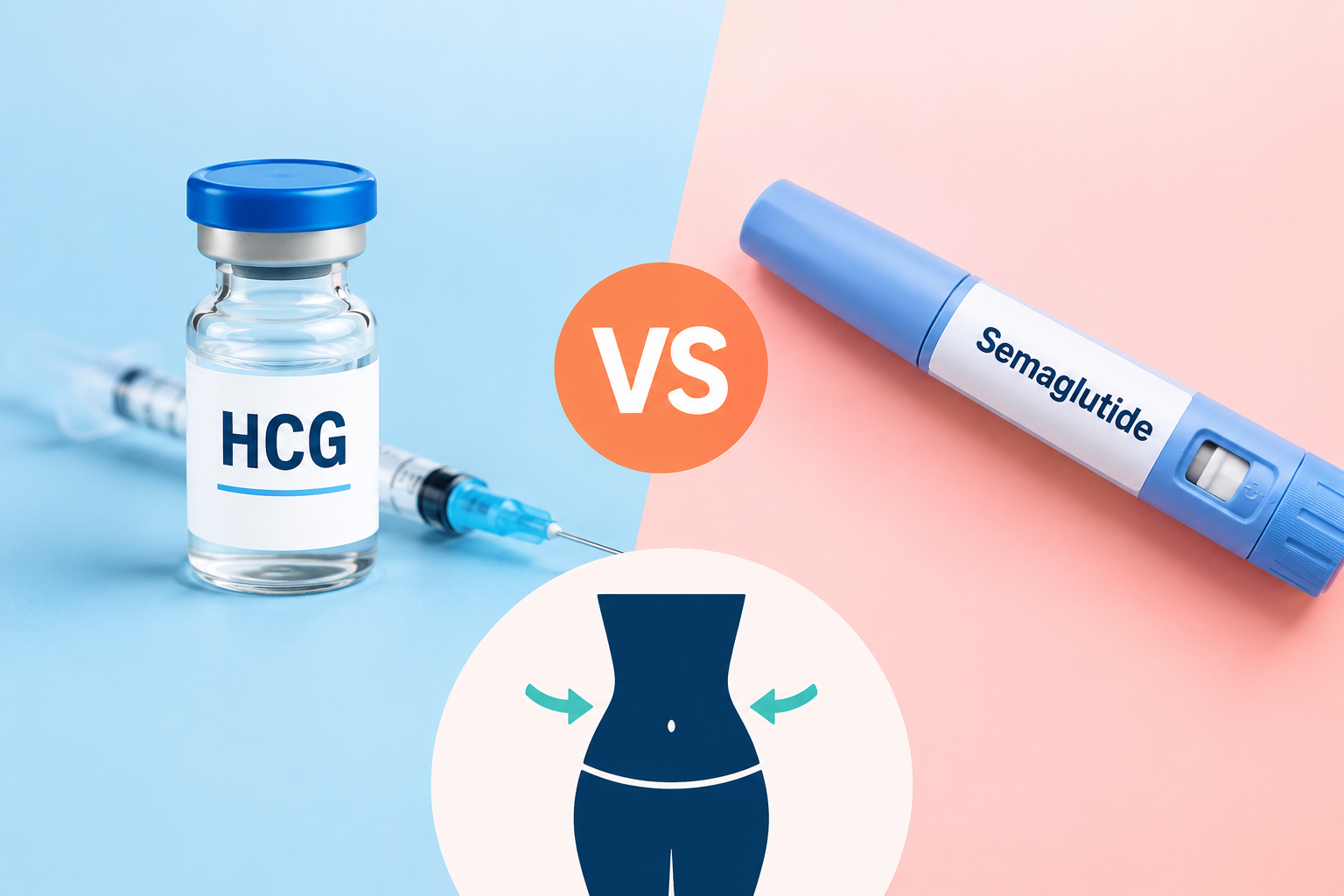
People seeking faster weight-loss results often come across many different approaches online. HCG and semaglutide often appear in these discussions, but they serve different medical roles. This raises a practical question: Can HCG and semaglutide be used together for weight loss? Currently, no evidence-based weight-loss treatment recommends combining HCG with semaglutide. HCG is not approved for treating obesity, whereas semaglutide is an evidence-supported medication used for weight management in appropriate patients. The U.S. FDA specifically states that HCG is not effective for weight loss. That difference is important when evaluating claims about using the two together.
HCG and Semaglutide are not two versions of the same treatment
First, understand that these substances belong to completely different treatment categories. HCG, or human chorionic gonadotropin, is a hormone. Prescription HCG has recognised medical applications, including certain fertility treatments and specific hormonal uses in men. Its approved uses do not include weight reduction. Semaglutide works differently. It is a GLP-1 receptor agonist that acts on pathways involved in appetite, food intake and glucose regulation. Semaglutide has been evaluated extensively for obesity management, and current clinical guidelines include it among pharmacological options for appropriate adults with obesity or qualifying overweight and related health conditions.
So, although both may appear in searches for HCG vs semaglutide for weight loss, they should not automatically be viewed as interchangeable treatments.
Why is HCG associated with weight loss?
The HCG diet became popular through programs that paired HCG with extremely restrictive calorie intake. This is where much of the confusion begins. The FDA explains that products marketed as HCG for weight loss are commonly promoted alongside very-low-calorie diets. According to the FDA, available evidence does not establish that HCG itself produces additional weight loss. In other words, seeing the scale decrease during an HCG diet does not prove HCG caused the weight loss. Very-low-calorie diets can also create nutritional and medical concerns. The FDA has specifically highlighted risks such as gallstone formation, electrolyte disturbances and abnormal heart rhythms associated with severe calorie restriction.
How Semaglutide approaches weight management
Semaglutide takes a different route.GLP-1 is a naturally occurring hormone involved in appetite and metabolic regulation. Semaglutide mimics GLP-1 activity and can help reduce appetite and food intake. This can make it easier for some patients to maintain a calorie deficit without relying on an extremely restrictive diet. That does not mean semaglutide is a standalone solution. The 2025 clinical practice guideline update on obesity pharmacotherapy recommends using obesity medications alongside health-behaviour interventions and individualising treatment according to the person’s medical needs.
The American College of Physicians’ 2026 living guideline also identifies semaglutide as one of the pharmacological options for appropriate adults with obesity and for certain adults with overweight and weight-related conditions.
Can you take HCG while using Semaglutide?
This is the central issue. No established evidence shows that adding HCG to semaglutide improves weight-loss outcomes. That means people should not assume that combining the two will produce faster or greater fat loss. There is also a practical concern with combining semaglutide treatment with the type of severe calorie restriction traditionally associated with HCG diet programs. Semaglutide can already decrease appetite and food intake. Adding a highly restrictive diet may make it difficult to obtain enough protein, calories, fluids and essential nutrients. Therefore, someone taking semaglutide should not add HCG injections, HCG drops, or an HCG diet on their own to accelerate weight loss. If HCG has been prescribed for another medical reason, the healthcare professional managing the treatment should know about the patient’s semaglutide use.
What happens if weight loss slows down on Semaglutide?
A weight-loss plateau does not automatically mean another drug should be added. Body weight naturally changes over time, and responses to obesity medication vary by individual. When progress slows, a clinician may review several factors, including:
- whether the medication is being taken correctly
- treatment duration and dose
- dietary intake
- physical activity
- sleep and lifestyle factors
- other medications
- underlying medical conditions
- treatment goals and expectations
Current obesity guidelines emphasise individualised, long-term management rather than adding medications whenever weight loss slows. This approach is particularly important because obesity is considered a chronic condition that may require ongoing treatment and follow-up.
Could HCG make semaglutide more effective?
No established clinical evidence shows that HCG enhances semaglutide’s weight-loss effect. This is an important distinction from claims sometimes made on weight-loss websites or social media. The FDA states that HCG has not been demonstrated to be an effective therapy for obesity and that there is no substantial evidence that it increases weight loss. Consequently, using HCG specifically to “boost” semaglutide should not be considered an evidence-based weight-management strategy.
What about HCG drops, pellets and “homoeopathic HCG”?
Consumers should be particularly cautious with products marketed as HCG drops, oral HCG, homoeopathic HCG or HCG weight-loss supplements. FDA-approved HCG products are prescription products, and HCG is not FDA-approved for weight loss. The FDA has also warned about unapproved HCG products marketed for this purpose. Marketing language such as “metabolism reset,” “rapid fat burning” or dramatic weight-loss promises should therefore not be confused with established clinical evidence.
Is Semaglutide safe for everyone?
Semaglutide is a prescription medication, so suitability should be assessed before treatment. For example, the current U.S. prescribing information for Wegovy states that it is contraindicated in people with a personal or family history of medullary thyroid carcinoma (MTC) or in people with multiple endocrine neoplasia syndrome type 2 (MEN 2). The prescribing information also contains warnings and precautions concerning several other potential adverse effects and medical conditions. Common digestive effects associated with semaglutide treatment can include nausea, vomiting, diarrhoea, and constipation. The prescribing clinician should determine the appropriate dose and treatment schedule. This is one reason it matters to get semaglutide from a legitimate medical source and use it as prescribed.
The bigger issue: Fast weight loss vs sustainable weight management
The desire to lose weight quickly can make combination approaches sound appealing. However, successful weight management involves more than making the scale fall as rapidly as possible. Adequate nutrition, preserving muscle mass, physical activity, managing weight-related conditions, and long-term maintenance all matter. Modern obesity guidelines increasingly describe pharmacotherapy as part of comprehensive, long-term care, rather than a short-term intervention used only until a particular number appears on the scale. This changes how we should view HCG and semaglutide. Instead of asking, “What can I add to semaglutide to lose weight faster?”, a more useful clinical question is whether the current treatment is appropriate, effective, tolerated and sustainable for the individual.
HCG vs Semaglutide: What should you know?
HCG and semaglutide differ in several fundamental ways. HCG is a naturally occurring hormone with legitimate prescription uses, but it is not FDA-approved for weight loss. Evidence does not establish HCG as an effective obesity treatment.
Semaglutide is a GLP-1 receptor agonist with clinical evidence supporting its use in weight management for appropriate patients. Current guidelines include semaglutide as an evidence-based pharmacological treatment for obesity. Therefore, the two should not be presented as equivalent weight-loss medications.
Buy authentic HCG & weight loss medications online
You can buy HCG and weight loss medications from a reliable online pharmacy like PremiumRxDrugs (PRx), which provides genuine medications at affordable rates. For readers researching HCG and semaglutide for weight loss, relevant products on PRx include Sifasi HP 10000 IU, an HCG product, and Fertigyn HP , another HCG-based treatment available in different strengths. The website also features Corion 5000 IU, which contains HCG and is used for medically indicated fertility and hormonal conditions—not as a weight-loss medicine. For readers exploring established weight-management medicines, Obelit 120mg contains orlistat, while the website also discusses semaglutide, tirzepatide and liraglutide as prescription weight-management options. Don’t pick any medicine on your own; speak with your doctor to find the best option for your goals.
Final thoughts
The online discussion around HCG vs semaglutide for weight loss can make these treatments appear more similar than they really are. HCG has recognised medical applications, but weight loss is not an FDA-approved use. Semaglutide, meanwhile, has been studied specifically for medical weight management and is included in current obesity-treatment guidelines.
Using HCG with semaglutide is not an established strategy for achieving additional weight loss. Anyone already taking semaglutide should discuss any proposed HCG treatment with a healthcare professional, particularly if the HCG is being marketed specifically for weight reduction. The more sustainable approach is to choose an evidence-based treatment plan that considers the person’s health, nutrition, lifestyle, medication response and long-term weight-maintenance goals.

Latest posts by Marie (see all)
- HCG vs Semaglutide: Can They Be Used Together for Weight Loss? - October 3, 2026
- HCG vs Semaglutide for Weight Loss: Uses, Benefits & Differences - October 1, 2026
- Budesonide Formoterol Inhaler: Uses, Dosage and How to Use It - September 28, 2026


