
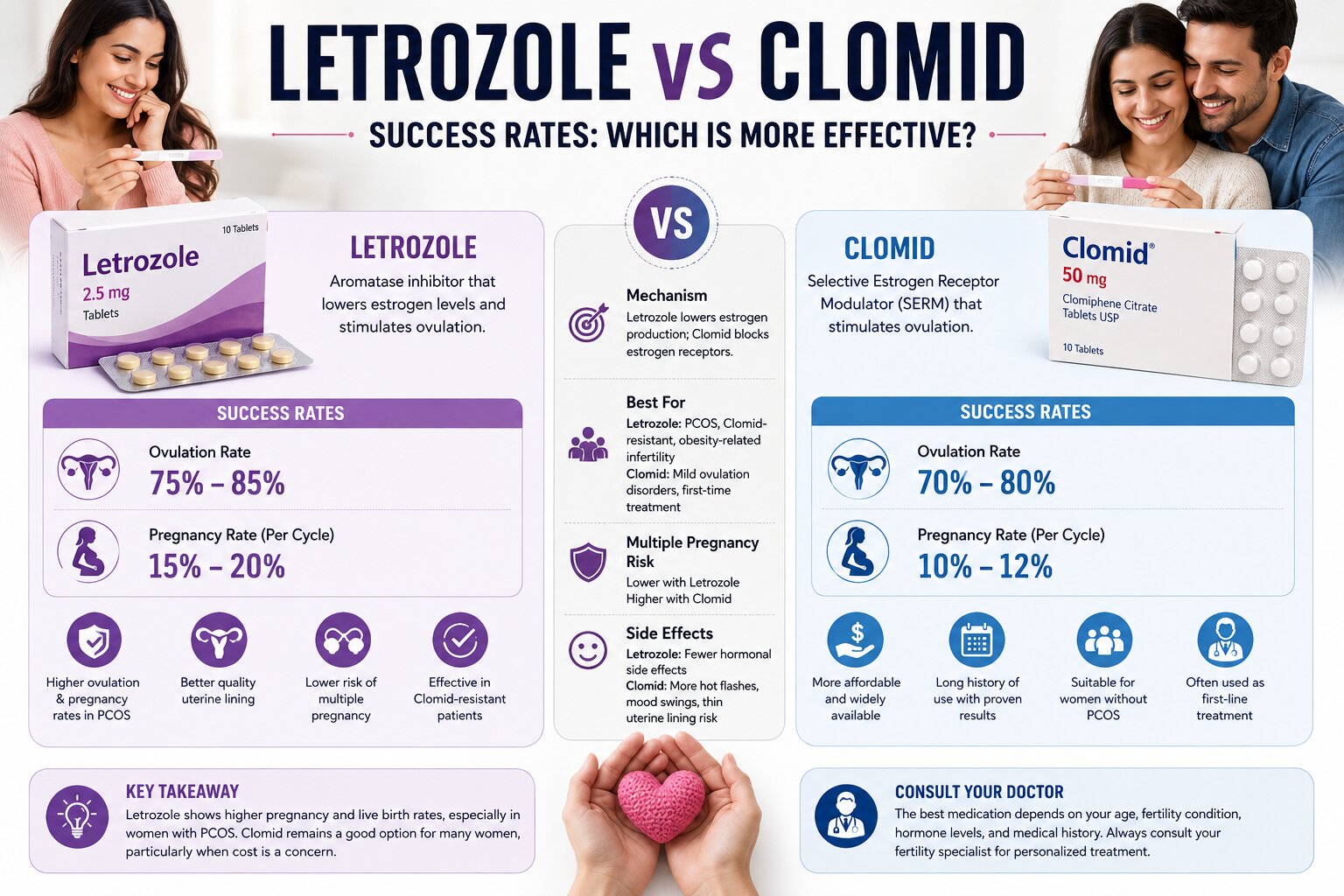
Infertility can be emotionally and physically challenging for couples trying to conceive. Fortunately, fertility medications such as Letrozole and Clomid have helped many women successfully achieve pregnancy. Both medicines are commonly prescribed to stimulate ovulation and improve conception chances, especially in women with irregular ovulation or conditions like PCOS.
However, many patients often ask: Which fertility medication is more effective — Letrozole or Clomid?
This guide explains the differences between Letrozole and Clomid, their success rates, benefits, side effects, and which treatment may work better depending on individual fertility needs.
What is Clomid?
Clomid is one of the most commonly prescribed fertility medications used for ovulation induction. Its active ingredient is Clomiphene Citrate, which stimulates the ovaries to release eggs.
Clomid belongs to a class of medicines called selective estrogen receptor modulators (SERMs). It works by blocking estrogen receptors in the brain, encouraging the body to produce more follicle-stimulating hormone (FSH) and luteinizing hormone (LH).
Common Uses of Clomid
- Ovulation induction
- PCOS-related infertility
- Irregular menstrual cycles
- Unexplained infertility
- Fertility support in women
Popular Clomid alternatives include:
- Siphene
- Clofert
- Generic Clomiphene Citrate tablets
What is Letrozole?
Letrozole is another fertility medication often prescribed for ovulation stimulation. Although originally developed to treat breast cancer, it is now widely used in fertility treatment.
Letrozole belongs to a class of drugs called aromatase inhibitors. It works by temporarily lowering estrogen levels, which signals the brain to stimulate ovulation naturally.
Common Uses of Letrozole
- PCOS infertility treatment
- Ovulation induction
- Women resistant to Clomid
- Fertility treatment before IUI
- Hormonal fertility support
Many fertility specialists now recommend Letrozole as a first-line treatment for women with PCOS.
How Letrozole and Clomid Work
Although both medications stimulate ovulation, they work differently inside the body.
Clomid Mechanism
Clomid blocks estrogen receptors in the brain, making the body think estrogen levels are low. This increases FSH and LH production, which stimulates the ovaries.
Letrozole Mechanism
Letrozole temporarily reduces estrogen production, prompting the body to increase FSH release and stimulate egg development.
The hormonal effects of Letrozole are generally shorter and more targeted than those of Clomid.
Letrozole vs Clomid Success Rates
Success rates vary depending on:
- Age
- Fertility condition
- Hormonal health
- PCOS presence
- Body weight
- Overall reproductive health
However, recent studies suggest that Letrozole may offer higher pregnancy and live birth rates in certain women, especially those with PCOS.
Clomid Success Rates
Ovulation Success
- About 70–80% of women ovulate with Clomid treatment.
Pregnancy Success
- Around 10–12% pregnancy rate per cycle.
- Approximately 30–40% pregnancy rate after multiple cycles.
Best Candidates
Clomid works well for:
- Women with irregular ovulation
- Mild ovulation disorders
- Unexplained infertility
Letrozole Success Rates
Ovulation Success
- About 75–85% ovulation rate in many patients.
Pregnancy Success
- Often shows slightly higher pregnancy rates than Clomid in women with PCOS.
- Some studies report 15–20% pregnancy rates per cycle.
Best Candidates
Letrozole is often recommended for:
- Women with PCOS
- Clomid-resistant patients
- Women with obesity-related infertility
Letrozole vs Clomid for PCOS
Polycystic Ovary Syndrome (PCOS) is one of the leading causes of infertility due to irregular ovulation.
Research has shown that Letrozole may be more effective than Clomid for women with PCOS.
Why Letrozole May Work Better for PCOS
- Higher ovulation rates
- Improved live birth rates
- Lower risk of a thin uterine lining
- Better hormonal balance
- Lower multiple pregnancy risk
Many fertility specialists now prefer Letrozole as the first treatment option for PCOS-related infertility.
Side Effects of Clomid
While Clomid is effective, some women may experience side effects.
Common Clomid Side Effects
- Hot flashes
- Mood swings
- Headaches
- Breast tenderness
- Bloating
- Ovarian enlargement
- Nausea
Possible Fertility Concerns
Clomid may sometimes:
- Thin the uterine lining
- Reduce cervical mucus quality
- Increase the risk of multiple pregnancy
These factors can occasionally reduce the chances of implantation.
Side Effects of Letrozole
Letrozole is generally well tolerated and may produce fewer estrogen-related side effects.
Common Letrozole Side Effects
- Fatigue
- Dizziness
- Mild headaches
- Joint pain
- Hot flashes
- Nausea
Unlike Clomid, Letrozole usually has less impact on cervical mucus and uterine lining.
Risk of Twins and Multiple Pregnancy
Both medications increase the possibility of multiple ovulations.
Clomid Multiple Pregnancy Risk
- Twin pregnancy risk: around 7–10%
- Higher chance of multiple follicles
Letrozole Multiple Pregnancy Risk
- Lower twin pregnancy risk compared to Clomid
- Usually stimulates fewer mature eggs
This makes Letrozole a preferred option for women concerned about multiple pregnancies.
Letrozole vs Clomid for Women Over 35
Fertility naturally declines with age, especially after 35.
Some fertility specialists prefer Letrozole for older women because:
- It may produce better egg quality support
- It has shorter hormonal effects
- It causes less thinning of the uterine lining
However, treatment depends on individual hormone testing and fertility evaluation.
Which is More Effective: Letrozole or Clomid?
The answer depends on the individual’s fertility condition.
Clomid May Be Better For:
- Mild ovulation disorders
- Women without PCOS
- First-time fertility treatment
- Cost-effective fertility support
Letrozole May Be Better For:
- PCOS patients
- Clomid-resistant women
- Women with a thin uterine lining
- Women at risk of multiple pregnancy
- Obesity-related infertility
Overall, Letrozole is increasingly considered more effective for PCOS-related infertility.
Can Men Use Clomid or Letrozole?
Yes, both medications are sometimes prescribed for male infertility.
Clomid for Men
Clomid may help:
- Increase testosterone
- Improve sperm production
- Support hormone balance
Letrozole for Men
Letrozole may help:
- Reduce excess estrogen
- Improve testosterone levels
- Enhance sperm production in selected cases
Male fertility treatment should always be monitored by a specialist.
Lifestyle Tips to Improve Fertility Success
Medication works best alongside healthy lifestyle habits.
Fertility-Friendly Tips
- Maintain a healthy body weight
- Eat a balanced diet
- Exercise regularly
- Avoid smoking and alcohol
- Reduce stress
- Sleep adequately
- Track ovulation cycles
Lifestyle improvements can significantly improve outcomes with fertility medication.
Clomiphene Citrate vs Letrozole: Key Differences
Both Clomiphene Citrate and Letrozole are widely used fertility medications that help stimulate ovulation and improve pregnancy chances. However, they work differently and may be recommended based on the patient’s fertility condition.
| Feature | Clomiphene Citrate | Letrozole |
|---|---|---|
| Drug Type | Selective Estrogen Receptor Modulator (SERM) | Aromatase Inhibitor |
| Common Brand | Clomid, Clofert, Siphene | Letroz |
| Main Use | Ovulation induction | Ovulation induction, especially for PCOS |
| Best For | Mild ovulation disorders | PCOS and Clomid-resistant patients |
| Pregnancy Rate | Moderate | Often slightly higher in PCOS |
| Risk of Twins | Higher | Lower |
| Effect on Uterine Lining | May thin lining | Usually minimal effect |
| Common Side Effects | Hot flashes, mood swings | Fatigue, dizziness |
Is Letrozole stronger than Clomid?
Not necessarily stronger, but Letrozole may work better in certain women, especially those with PCOS.
Which medication has higher pregnancy rates?
Studies suggest that Letrozole may provide slightly higher pregnancy and live birth rates for PCOS patients.
Can I switch from Clomid to Letrozole?
Yes, many women switch to Letrozole if Clomid does not produce successful ovulation or pregnancy.
Which medication causes more twins?
Clomid generally has a slightly higher multiple pregnancy risk than Letrozole.
Are these medications safe?
Both medications are widely used under medical supervision and are generally considered safe when taken correctly.
Conclusion
Both Letrozole and Clomid are effective fertility medications that help stimulate ovulation and improve conception chances. While Clomid has been used successfully for decades, Letrozole is becoming increasingly popular due to its higher success rates in women with PCOS and lower risk of side effects affecting implantation.
The best fertility medication depends on individual reproductive health, hormone levels, age, and underlying fertility conditions. Consulting a fertility specialist is essential to determine the most suitable treatment plan.
With proper medical guidance, healthy lifestyle habits, and consistent treatment, both Letrozole and Clomid can significantly improve pregnancy success rates and help couples achieve their dream of parenthood.

Latest posts by Marie (see all)
- Semaglutide for PCOS: Can It Help with Weight Loss, Insulin Resistance & Irregular Periods? - October 17, 2026
- Semaglutide Side Effects: Common Symptoms, Serious Risks & Safety Tips - October 16, 2026
- How to control high cholesterol: self-care at home? - October 15, 2026


