
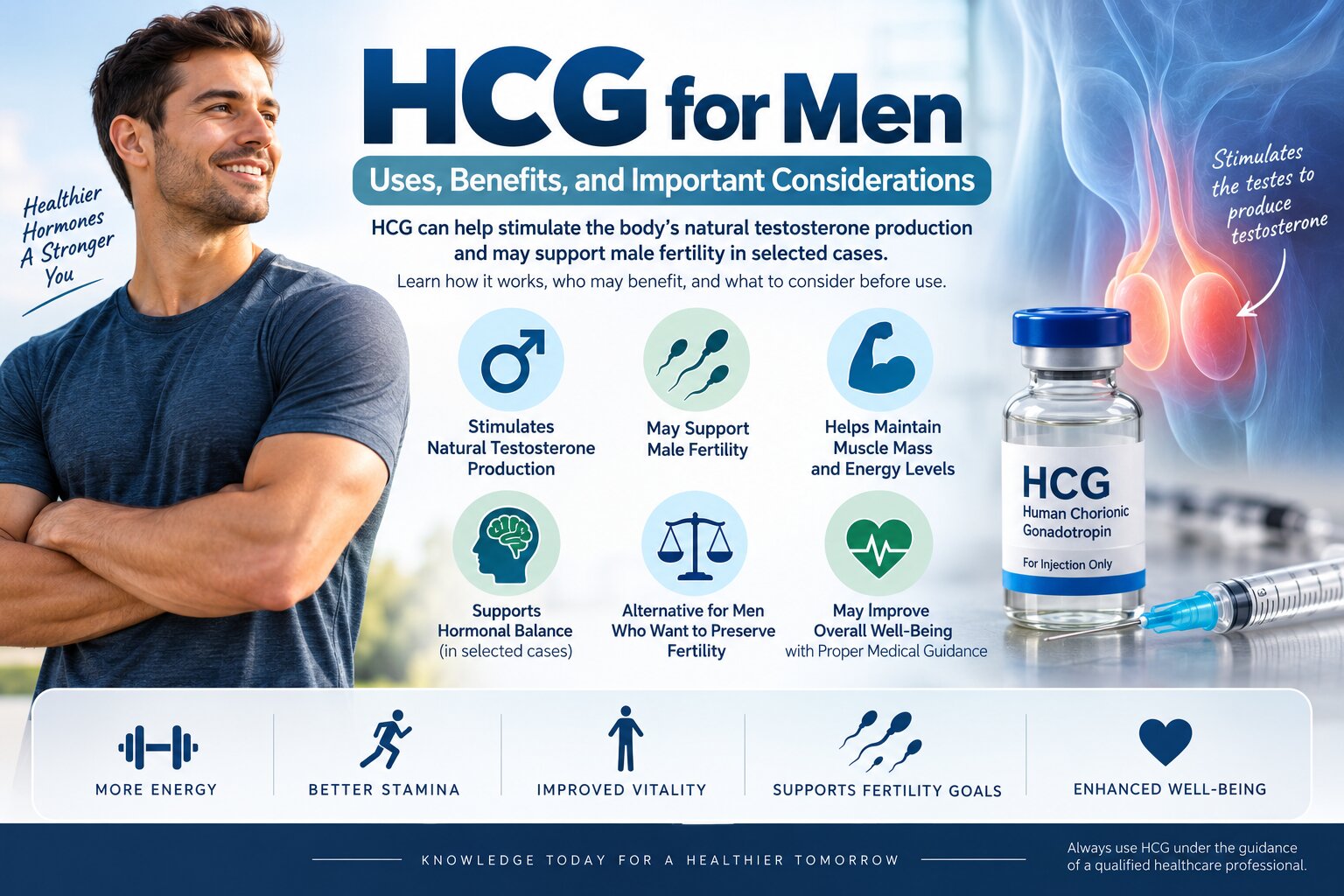
Human chorionic gonadotropin, commonly called HCG or hCG, is a hormone-based medicine that has several important applications in men’s health. Although HCG is naturally associated with pregnancy, it can also act in men in a way that resembles luteinizing hormone (LH), helping stimulate the testes to produce testosterone.
Because of this action, HCG may be considered in selected men with certain forms of testosterone deficiency, particularly when maintaining or restoring fertility is an important treatment goal. It has also been studied and used in specialist settings for male infertility and hypogonadotropic hypogonadism.
However, HCG is not a general-purpose testosterone supplement or a treatment that is appropriate for every man with low testosterone. Its use depends on the underlying cause of hormone deficiency, fertility goals, laboratory results, and medical history.
What Is HCG?
Human chorionic gonadotropin (HCG) is a naturally occurring glycoprotein hormone. In medicine, HCG can be produced from biological sources or through recombinant technology, depending on the specific product.
HCG has a biological activity similar to LH. In men, LH normally signals specialized cells in the testes called Leydig cells to produce testosterone.
HCG can provide a similar signal by binding to LH receptors in the testes. The American Urological Association (AUA) and American Society for Reproductive Medicine (ASRM) describe HCG as an injectable medication that acts as an LH analogue and stimulates testosterone production through direct action on Leydig cells.
This mechanism is particularly relevant when a man’s own LH production is insufficient.
How Does HCG Work in Men?
The male reproductive system is regulated by the hypothalamic-pituitary-gonadal (HPG) axis.
In simplified terms:
Hypothalamus → Pituitary gland → LH/FSH → Testes → Testosterone and sperm production
The pituitary gland normally releases LH and follicle-stimulating hormone (FSH). LH stimulates the Leydig cells to produce testosterone, while FSH works with testosterone inside the testes to support sperm production.
HCG can mimic the action of LH. By stimulating the Leydig cells, it can increase the testes’ production of testosterone in appropriately selected patients.
This is different from simply taking testosterone from outside the body. Exogenous testosterone can suppress the body’s production of LH and FSH and, consequently, reduce sperm production.
For this reason, HCG can have a particular role in men who have low testosterone but also want to preserve fertility.
Why Is HCG Used in Men?
HCG has several potential medical applications in men, but its use is generally limited to specific clinical situations.
The FDA labeling for HCG includes selected cases of hypogonadotropic hypogonadism, a condition in which testosterone production is low because of inadequate stimulation from the pituitary or hypothalamus.
Specialists may also consider HCG in the management of selected infertile men with low testosterone. The AUA/ASRM male infertility guideline states that clinicians may use HCG, selective estrogen receptor modulators, aromatase inhibitors, or combinations of these approaches in infertile men with low serum testosterone.
Common clinical reasons HCG may be considered include:
- Certain forms of secondary or hypogonadotropic hypogonadism
- Testosterone deficiency associated with inadequate LH stimulation
- Selected male infertility cases
- Supporting testosterone production when preservation of sperm production is important
- Fertility treatment in men whose reproductive hormone signaling is impaired
The exact role of HCG depends on the diagnosis rather than simply the presence of a low testosterone result.
HCG and Male Fertility
One of the most important reasons HCG is discussed in men’s health is its relationship with sperm production and fertility.
Testosterone production and sperm production are closely connected but are not exactly the same process.
When the pituitary releases LH and FSH, these hormones help maintain the environment required for normal testicular function. LH stimulates testosterone production within the testes, while FSH contributes to spermatogenesis.
In men with hypogonadotropic hypogonadism, LH and FSH levels can be abnormally low. This can lead to low testosterone and impaired sperm production.
The AUA/ASRM guideline explains that men with hypogonadotropic hypogonadism can have deficient LH and FSH secretion and that gonadotropin treatment can be used to initiate or restore spermatogenesis in appropriately selected patients. HCG is typically used to stimulate testosterone production, with FSH or an FSH analogue sometimes added when needed to optimize sperm production.
This means HCG should not be viewed as a universal fertility treatment. Its usefulness depends heavily on why sperm production is impaired.
HCG vs Testosterone Therapy
HCG and testosterone therapy work differently.
Testosterone replacement therapy (TRT) provides testosterone directly from an external source. It can improve testosterone levels, but external testosterone can suppress the pituitary signals that stimulate the testes.
This suppression can reduce sperm production and, in some men, may lead to very low or absent sperm in the semen.
The AUA/ASRM guideline specifically states that testosterone monotherapy should not be prescribed to men who are currently interested in fertility because of its potential effect on spermatogenesis.
HCG, by contrast, acts more like the body’s LH signal. It stimulates the testes to produce testosterone rather than simply replacing testosterone from outside the body.
That distinction can be important when evaluating treatment options for a man who has both testosterone deficiency and current or future fertility goals.
Potential Benefits of HCG for Men
When prescribed appropriately for a suitable medical condition, HCG may offer several potential benefits.
1. Stimulates Testosterone Production
Because HCG acts similarly to LH, it can stimulate Leydig cells in the testes and increase endogenous testosterone production.
2. May Support Fertility Goals
For selected men with secondary hypogonadism, HCG can help restore the hormonal stimulation needed for testicular function and may form part of a fertility treatment plan.
3. Can Be Used in Selected Men With Low Testosterone
The AUA/ASRM guideline recognises HCG as one option clinicians may consider for infertile men with low serum testosterone, depending on the individual’s hormonal profile and circumstances.
4. May Help Restore Testicular Hormonal Signalling
Unlike direct testosterone replacement, HCG provides an LH-like signal to the testes. This distinction can be relevant when the objective is to stimulate rather than replace testicular testosterone production.
Importantly, these potential benefits do not mean HCG is appropriate for everyone with low testosterone.
Who May Not Benefit From HCG?
The underlying cause of testosterone deficiency matters.
Men with primary hypogonadism, in which the testes themselves are unable to produce adequate testosterone despite appropriate hormonal stimulation, may respond differently from men whose problem originates in the hypothalamus or pituitary.
The AUA/ASRM guideline notes that men with elevated LH, consistent with primary hypogonadism, may have a limited testosterone response to medicines such as HCG because of underlying testicular dysfunction.
This is why a medical evaluation should usually establish whether low testosterone is related to primary testicular dysfunction, pituitary/hypothalamic dysfunction, medication effects, or another cause.
HCG and Weight Loss: An Important Misconception
HCG is sometimes promoted online as a weight-loss treatment, but patients should distinguish marketing claims from evidence.
FDA labelling states that HCG has not been shown to be effective as adjunctive therapy for obesity and that no substantial evidence shows it increases weight loss beyond that from caloric restriction.
Therefore, HCG should not be considered an established weight-loss medication simply because it is sometimes marketed for this purpose.
HCG Side Effects and Safety Considerations
HCG can cause adverse effects, so an appropriate healthcare professional should supervise treatment.
Possible effects can include:
- Headache
- Injection-site reactions
- Fluid retention
- Breast enlargement or tenderness
- Mood changes
- Changes in libido
- Acne
- Increased estrogen-related symptoms
Because HCG can stimulate testosterone production, hormonal changes can occur during treatment. The exact adverse-effect profile depends on the specific product, treatment regimen, and individual patient.
Always review the prescribing information for an HCG product before treatment.
People with certain medical conditions may not be appropriate candidates for HCG. For example, FDA labelling lists conditions such as androgen-dependent malignancies and previous hypersensitivity to HCG among contraindications for the referenced product.
Why Medical Testing Matters Before HCG Treatment
HCG should not be selected solely because a testosterone test is below the laboratory reference range.
A clinician may consider several factors, including:
- Testosterone levels
- LH and FSH levels
- Symptoms
- Reproductive goals
- Medical history
- Medication history
- Physical examination
- Semen analysis when fertility is a concern
- Other relevant hormone testing
The AUA/ASRM guideline recommends additional hormonal evaluation in certain infertile men, including LH testing when testosterone is low and prolactin testing in men with hypogonadotropic hypogonadism or decreased libido.
Understanding the underlying hormonal pattern helps determine whether HCG stimulation is likely to be useful.
HCG and Future Fertility
Fertility planning is an important consideration before beginning testosterone-related treatment.
A man who does not currently want children may still want to preserve fertility for the future. Because exogenous testosterone can suppress sperm production, treatment choices should be discussed with a healthcare professional before starting testosterone therapy.
The AUA/ASRM guideline notes that recovery of sperm production after testosterone-induced suppression can take months and, in rare cases, longer.
This is one reason fertility intentions should be discussed before treatment rather than after fertility problems develop.
HCG Treatment Requires Individualised Monitoring
No single HCG regimen fits every man.
Treatment depends on the diagnosis, hormone levels, fertility objectives, response to therapy, and the specific HCG injection being prescribed.
For men receiving HCG for hypogonadotropic hypogonadism or fertility-related purposes, clinicians may monitor testosterone and other reproductive parameters over time. When fertility is the goal, semen testing may also be relevant.
Patients should not change their HCG dose, frequency, injection method, or treatment duration without medical guidance.
Frequently Asked Questions
What is HCG used for in men?
HCG may be used in selected men with certain forms of hypogonadism and in some fertility-treatment settings. It acts similarly to LH and can stimulate testosterone production by the testes.
Does HCG increase testosterone?
HCG can stimulate testosterone production in the testes because it acts as an LH analogue. The response depends on the underlying cause of testosterone deficiency.
Can HCG help male fertility?
It can play a role in fertility treatment for appropriately selected men, particularly those with hypogonadotropic hypogonadism. Treatment may require additional gonadotropins depending on the individual’s condition.
Is HCG the same as testosterone?
No. HCG is a hormone that stimulates the testes to produce testosterone, while testosterone therapy provides testosterone directly.
Can men use HCG for weight loss?
HCG has not been demonstrated to provide additional weight-loss benefits beyond calorie restriction and is not an established obesity treatment according to FDA labelling.
Can HCG be used with testosterone?
In some clinical situations, specialists may use HCG alongside testosterone-related treatment, but this requires individualised medical supervision. Do not start or combine it without guidance from a qualified healthcare professional.
Final Thoughts
HCG can have an important role in selected areas of men’s reproductive and hormonal health. Its LH-like activity allows it to stimulate testosterone production by the testes, making it particularly relevant in certain cases of hypogonadotropic hypogonadism and fertility treatment.
One of the most important distinctions is between stimulating the body’s own testosterone production and replacing testosterone from outside the body. This distinction becomes especially important for men who currently want children or want to preserve future fertility.
HCG is not appropriate for every man with low testosterone, and it should not be used simply because of symptoms or a single laboratory result. Identifying the underlying cause of hormone deficiency, assessing fertility goals, and monitoring treatment response are important parts of responsible care.
Anyone considering HCG should discuss the potential benefits, risks, alternatives, and monitoring requirements with a qualified healthcare professional before treatment.

Latest posts by Marie (see all)
- HCG for Men: Uses, Benefits, and Important Considerations - September 18, 2026
- Alpha Blockers for Blood Pressure and Prostate: A Patient’s Guide to Alpha Blockers - September 17, 2026
- Allergy Medications Guide: Best Treatments for Seasonal, Skin & Food Allergies - September 17, 2026


