
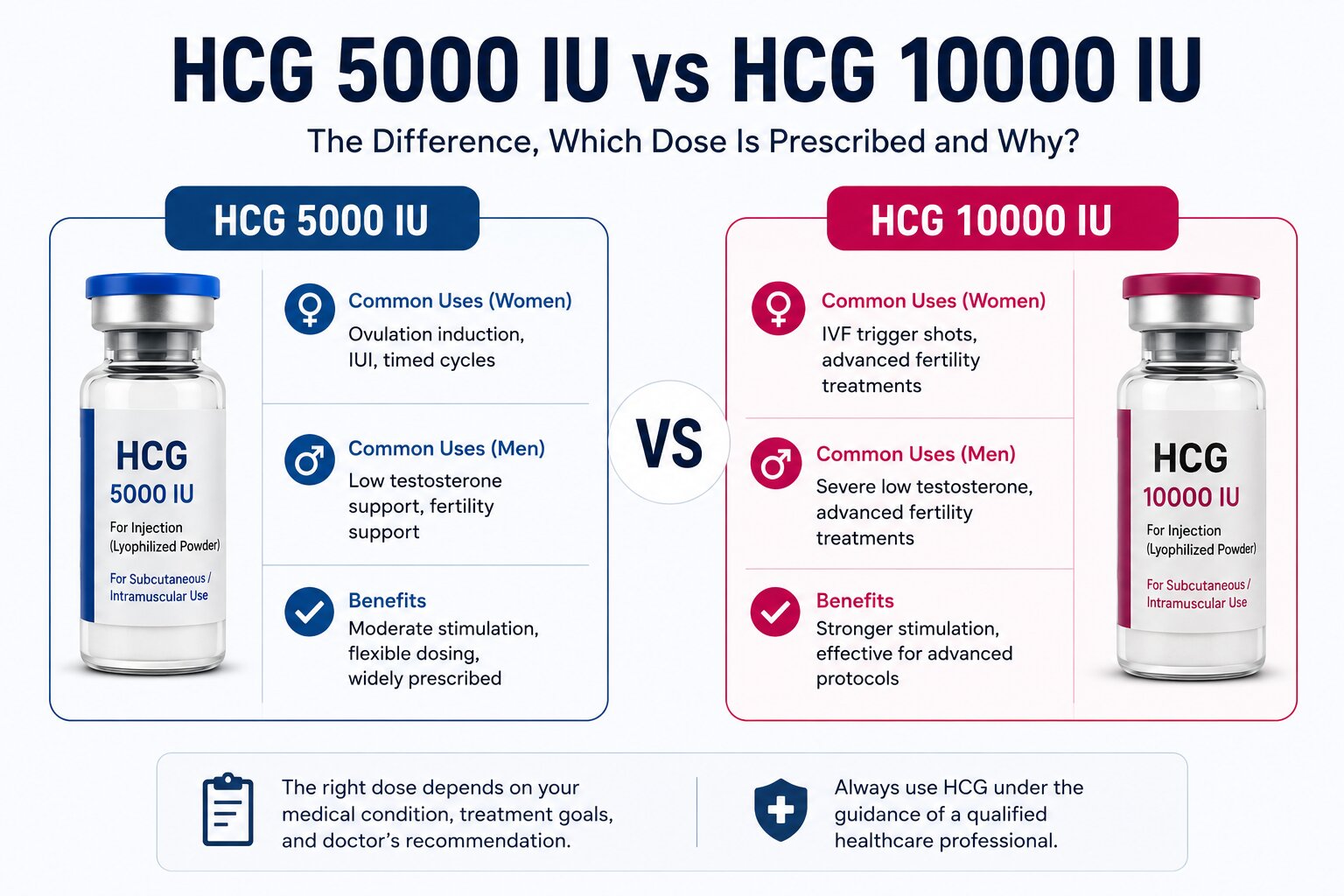
Human Chorionic Gonadotropin (HCG) is a widely prescribed hormone medication used in fertility treatments, reproductive health management, and hormone therapy. Available in various strengths, HCG 5000 IU and HCG 10000 IU are among the most commonly prescribed dosages. While both contain the same active hormone, they differ in concentration, treatment applications, and the level of hormonal stimulation they provide.
Patients often wonder whether a higher dose means better results or if one dosage is more effective than the other. The reality is that HCG dosing is carefully determined based on individual treatment goals, medical history, and physician recommendations. Understanding the differences between HCG 5000 IU and HCG 10000 IU can help patients better understand their treatment plans and expectations.
What Is HCG?
Human Chorionic Gonadotropin is a hormone naturally produced during pregnancy. In medicine, HCG is manufactured and used to mimic the action of luteinizing hormone (LH), which plays a crucial role in reproductive function.
For women, HCG helps trigger ovulation and supports fertility treatments. For men, it stimulates the testes to produce testosterone and encourages sperm production.
Common medical uses of HCG include:
- Female infertility treatment
- Ovulation induction
- In Vitro Fertilisation (IVF)
- Intrauterine Insemination (IUI)
- Male hypogonadism
- Testosterone support therapy
- Male infertility treatment
Because different medical conditions require varying levels of hormonal stimulation, HCG is available in multiple strengths, including 5000 IU and 10000 IU.
Understanding HCG Dosage Strength
The term “IU” stands for International Units, a measurement used to describe the biological activity of a hormone or medication.
HCG 5000 IU
Contains 5,000 International Units of HCG hormone.
HCG 10000 IU
Contains 10,000 International Units of HCG hormone.
Simply put, HCG 10000 IU contains twice the hormone concentration found in HCG 5000 IU.
However, this does not necessarily mean it is automatically better. The correct dosage depends entirely on the treatment objective.
HCG 5000 IU: Common Uses and Benefits
HCG 5000 IU is one of the most frequently prescribed strengths because it offers effective hormonal stimulation while allowing flexibility in treatment protocols.
For Women
HCG 5000 IU is commonly used for:
- Ovulation induction
- Fertility enhancement
- Timed intercourse cycles
- IUI treatment protocols
- Follicle maturation
When ovarian follicles reach the desired size, physicians may administer HCG 5000 IU to trigger ovulation at a predictable time.
For Men
HCG 5000 IU may be prescribed for:
- Low testosterone levels
- Male infertility
- Sperm production support
- Hypogonadism treatment
The hormone stimulates Leydig cells in the testes, encouraging natural testosterone production and supporting reproductive health.
Advantages of HCG 5000 IU
- Effective hormonal stimulation
- Widely used in fertility medicine
- Suitable for many treatment protocols
- Flexible dosing schedules
- Lower hormone exposure compared to 10000 IU
Because of its versatility, many physicians consider HCG 5000 IU a standard starting point for various reproductive treatments.
HCG 10000 IU: Common Uses and Benefits
HCG 10000 IU provides a stronger hormonal stimulus and is often used when a more robust reproductive response is required.
For Women
HCG 10000 IU is frequently prescribed for:
- IVF trigger shots
- Advanced fertility treatments
- Controlled ovarian stimulation programs
- Final follicular maturation before egg retrieval
In IVF cycles, timing is critical. HCG 10000 IU helps ensure eggs reach full maturity before retrieval procedures.
For Men
HCG 10000 IU may be used in:
- Severe testosterone deficiency
- Advanced fertility treatment plans
- Specialised endocrine disorders
- Intensive hormone therapy protocols
Advantages of HCG 10000 IU
- Strong hormonal response
- Effective ovulation triggering
- Useful for advanced fertility treatments
- Supports intensive reproductive protocols
Because of its potency, HCG 10000 IU is generally used under close medical supervision.
Key Differences Between HCG 5000 IU and HCG 10000 IU
| Feature | HCG 5000 IU | HCG 10000 IU |
|---|---|---|
| Hormone Strength | Moderate | High |
| Active Hormone Content | 5,000 IU | 10,000 IU |
| Fertility Treatment | Common | Common |
| IVF Trigger Shots | Frequently Used | Frequently Used |
| Testosterone Therapy | Common | Specialized Cases |
| Hormonal Stimulation | Moderate | Strong |
| Monitoring Requirements | Standard | Increased |
| Risk of Side Effects | Lower | Potentially Higher |
The primary difference is the amount of hormone delivered and the intensity of the physiological response.
Why Would a Doctor Choose HCG 5000 IU?
Physicians may prescribe HCG 5000 IU when:
- Moderate hormonal stimulation is sufficient
- Ovulation induction is needed
- Fertility treatment protocols require lower doses
- Testosterone support is being provided
- Patients are sensitive to hormonal fluctuations
Many fertility specialists prefer to begin with lower effective doses and adjust treatment as necessary based on patient response.
Why Would a Doctor Choose HCG 10000 IU?
HCG 10000 IU may be selected when:
- Strong follicular maturation is required
- IVF treatment protocols demand higher stimulation
- Previous lower-dose treatments were ineffective
- Advanced fertility cases require greater hormonal support
The decision is based on clinical evaluation rather than simply choosing the highest available dose.
Does a Higher Dose Mean Better Results?
One of the most common misconceptions is that HCG 10000 IU automatically produces better fertility or testosterone outcomes.
In reality:
- More hormone does not always mean greater effectiveness.
- Excessive stimulation can increase the risk of side effects.
- Treatment success depends on proper timing and individualised dosing.
The best results typically come from using the most appropriate dose rather than the largest dose.
Potential Side Effects of HCG 5000 IU and 10000 IU
Both strengths share similar side effects because they contain the same hormone.
Common Side Effects
- Injection site discomfort
- Headaches
- Fatigue
- Mood changes
- Water retention
- Breast tenderness
In Men
- Acne
- Increased estrogen levels
- Breast enlargement (rare)
- Mood fluctuations
In Women
- Abdominal bloating
- Pelvic discomfort
- Breast sensitivity
Ovarian Hyperstimulation Syndrome (OHSS)
Women undergoing fertility treatment should be aware of OHSS, a rare but potentially serious condition that may occur after HCG administration.
Symptoms may include:
- Severe abdominal pain
- Rapid weight gain
- Shortness of breath
- Nausea
Physicians monitor patients closely to reduce this risk.
Monitoring During HCG Therapy
Regardless of dosage, proper monitoring is essential.
Healthcare providers may evaluate:
For Women
- Follicle growth via ultrasound
- Hormone levels
- Ovulation timing
- Ovarian response
For Men
- Testosterone levels
- Sperm count
- Hormonal balance
- Treatment effectiveness
Monitoring helps ensure the selected dosage is both safe and effective.
Frequently Asked Questions
Is HCG 10000 IU stronger than HCG 5000 IU?
Yes. HCG 10000 IU contains twice the amount of active hormone compared to HCG 5000 IU.
Which dosage is better for fertility?
Neither dosage is universally better. The correct choice depends on the fertility protocol and individual patient needs.
Can an HCG dose of 5000 IU be used for IVF?
Yes. Many IVF programs use HCG 5000 IU, although some protocols may require HCG 10000 IU.
Is HCG 10000 IU more effective for testosterone therapy?
Not necessarily. Testosterone treatment protocols are individualised, and higher doses are not always required.
Conclusion
HCG 5000 IU and HCG 10000 IU are both valuable treatment options in fertility medicine, reproductive health, and hormone therapy. While HCG 5000 IU offers moderate stimulation and flexibility for a wide range of treatment protocols, HCG 10000 IU provides a stronger hormonal response that may be necessary for advanced fertility procedures and specialised cases.
The choice between these dosages depends on several factors, including treatment goals, medical history, fertility needs, hormone levels, and physician assessment. Rather than focusing on which dose is stronger, patients should understand that the most effective HCG treatment is tailored to their individual circumstances.
Working closely with a healthcare provider ensures that HCG therapy is administered safely and effectively, with the greatest chance of achieving the desired outcome.

Latest posts by Marie (see all)
- Semaglutide for PCOS: Can It Help with Weight Loss, Insulin Resistance & Irregular Periods? - October 17, 2026
- Semaglutide Side Effects: Common Symptoms, Serious Risks & Safety Tips - October 16, 2026
- How to control high cholesterol: self-care at home? - October 15, 2026


