
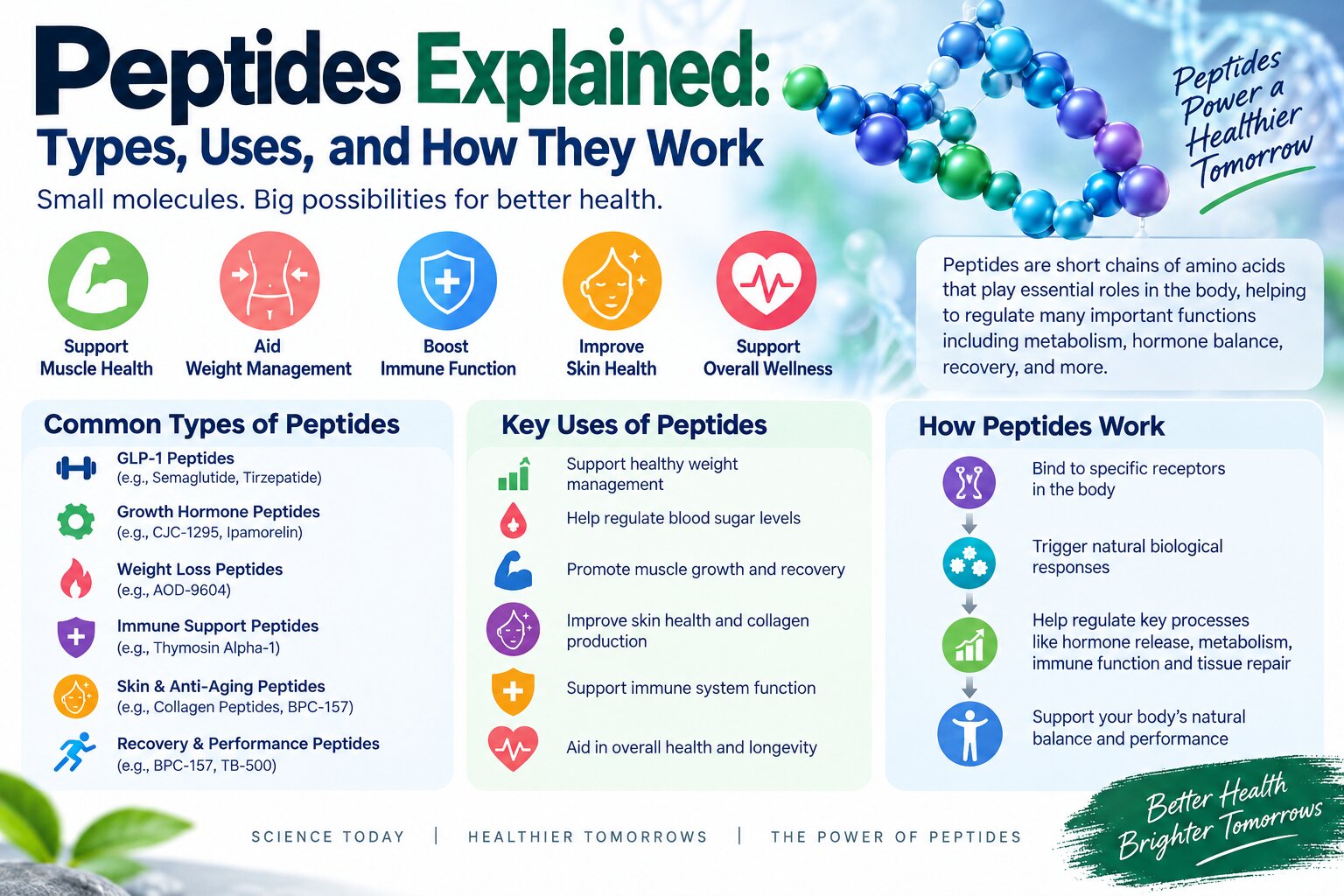
Peptides have become a major topic in modern medicine, health research, weight management, skincare, and wellness. Searches for peptides for weight loss, peptide therapy, peptide injections, GLP-1 peptides, and anti-ageing peptides have grown as more peptide-based medicines enter clinical use. But the word “peptide” covers a much broader group of substances than many online discussions suggest. Some peptides occur naturally in the human body and help regulate hormones, appetite, metabolism, immunity, and other biological processes. Others are developed in laboratories to reproduce or modify specific biological signals. Several peptide-based medicines are approved for treating particular medical conditions, while other peptides remain experimental or lack sufficient evidence for routine human use. Understanding what peptides are, how peptide medicines work, the different types of peptides, and their medical uses can help you distinguish established treatments from products promoted mainly through online marketing.
What are peptides?
Peptides are short chains of amino acids, the same building blocks that make up proteins. Their size can vary considerably, but they are generally smaller than full proteins. Many naturally occurring peptide hormones act as chemical messengers, allowing one part of the body to communicate with another. Some peptides bind to specific cell receptors and trigger biological responses. Depending on their structure and target, peptides can influence hormone signalling, blood glucose, appetite, inflammation, bone metabolism, immune activity, and other processes. This ability to interact with specific biological targets makes peptides particularly interesting in pharmaceutical research. Recent research shows that researchers are investigating peptide medicines across areas including metabolic disease, cancer, infections, endocrine disorders, and other conditions.
How do peptides work?
How a peptide works depends on its structure and biological target. No single mechanism applies to every peptide. Some peptides function naturally as hormones or signalling molecules. A therapeutic peptide may imitate one of these natural signals, strengthen or extend its effects, or interact with a particular receptor to produce a desired response. For example, medicines based on GLP-1 signalling can influence appetite and blood glucose regulation. Other peptide medicines act on pathways involved in bone formation, hormone replacement, blood sugar control, or other physiological processes. Because peptides can be designed to interact with specific targets, researchers are interested in their potential for developing more targeted therapies. However, a peptide’s biological activity does not automatically mean every version sold online is safe or medically effective.
Major types of peptides
Peptides can be classified in many ways. For consumers researching different types of peptides, the most useful approach is to consider their biological role and medical application.
- Hormonal peptides: Some naturally occurring hormones are peptides. These molecules help coordinate important body functions such as metabolism, reproduction, growth, and fluid balance. Insulin is a well-known peptide hormone that regulates blood glucose. Other peptide hormones include glucagon, oxytocin, and vasopressin. Some medicines are designed to replace, imitate, or modify the activity of naturally occurring peptide hormones.
- Therapeutic peptides: Therapeutic peptides are developed as medicines for specific medical conditions. They can act on carefully selected biological targets and are evaluated through clinical research and regulatory review. Peptide-based therapies are being used or investigated for conditions including diabetes, obesity, osteoporosis, hormonal disorders, cancer, and certain other diseases. Research has identified hundreds of peptide candidates in clinical development across a wide range of therapeutic areas.
- GLP-1-based peptides: One of the most widely discussed categories today is GLP-1-based medication. GLP-1, or glucagon-like peptide-1, is a naturally occurring hormone involved in appetite regulation and glucose metabolism. Medicines that activate the GLP-1 receptor can influence blood sugar and food intake. Semaglutide and liraglutide are examples of peptide-based medicines used in specific approved indications. Tirzepatide is another important medicine in this area, although it acts on both GIP and GLP-1 receptors, rather than functioning solely as a GLP-1 receptor agonist. These medicines have helped make peptide therapy a major topic in discussions about weight-loss medication and metabolic health.
Cosmetic and dermatology-related peptides
Peptides are also used in cosmetic formulations, particularly skincare products marketed for skin appearance, firmness, and signs of aging. Cosmetic peptides are different from prescription peptide medicines. A peptide-containing cream or serum does not have the same regulatory status, formulation, route of administration, or clinical evidence as an approved injectable peptide drug. Consumers should therefore avoid assuming that a cosmetic peptide product and a prescription peptide medicine provide comparable effects.
What are peptides used for?
The medical uses of peptides depend entirely on the specific molecule. Approved peptide medicines can treat diabetes, chronic weight management, osteoporosis, hormone-related conditions, and certain metabolic emergencies. The field continues to expand as researchers develop peptides with improved stability, specificity, and delivery methods. Peptide research also extends into cancer treatment, antimicrobial therapy, neurological conditions, and other areas. However, a peptide being studied for a condition does not mean that it is an approved treatment for that condition.
Peptides for weight loss: What should you know?
The popularity of peptides for weight loss is largely connected with medicines that influence appetite and metabolic pathways. Certain approved medications use peptide-based molecules to help eligible patients manage obesity or overweight with associated health conditions. Clinical trials and regulatory evaluation support their effects. However, the term “weight-loss peptide” is also widely used online for products that may be experimental, unapproved, or marketed without adequate evidence. A product should not be considered an effective weight-loss medicine simply because it is described as a peptide. The important questions are whether the specific product has been properly studied, approved for the intended use, manufactured to appropriate quality standards, and prescribed appropriately.
Peptide injections vs Oral medicines
Many peptide medicines are administered by injection because peptides can be broken down in the digestive system and may have difficulty reaching the bloodstream in their active form when taken orally. However, pharmaceutical researchers continue to develop ways to improve oral peptide delivery and other administration methods. The route of administration can affect how a medicine is absorbed, how quickly it works, how long its effects last, and how it should be stored and used. Therefore, patients should follow instructions specific to their prescribed peptide medicine rather than assuming different peptide products can be used the same way.
Are all peptides safe?
No. Safety depends on the specific peptide, dose, formulation, route of administration, manufacturing quality, and evidence supporting its use. FDA guidance notes that peptide drug products require consideration of drug interactions, pharmacokinetics, safety, and immunogenicity during development. Important concerns also surround certain unapproved or compounded peptides. The FDA states that compounded drugs are not FDA-approved and the agency does not review them for safety, effectiveness, or quality before marketing. Poor compounding practices can result in contamination or incorrect amounts of active ingredients. The FDA has also identified safety concerns with several peptides proposed for compounding, including impurities, immune reactions, limited human safety information, and other potential risks.
Peptides vs proteins: What is the difference?
Peptides and proteins are both made from amino acids, but they differ mainly in their size and structure. Peptides are generally shorter chains, while proteins are larger and often have more complex three-dimensional structures. Despite this difference, the boundary is not defined by a single universal amino acid number. Both can perform important biological functions. Some peptides act as hormones or signalling molecules, while proteins can serve structural, enzymatic, transport, and immune-related roles.
The future of peptide-based medicine
Peptide drug development continues to attract considerable scientific interest. Researchers are working on ways to make peptide medicines more stable, extend their duration of action, improve absorption, and deliver them more precisely to their intended targets. Recent pharmaceutical research describes peptide therapeutics as an expanding field, with hundreds of peptide candidates undergoing clinical evaluation across diverse medical applications. The FDA has also continued developing scientific guidance for peptide drug products and, in 2026, published revised draft product-specific guidance for several generic peptide medicines, including semaglutide, liraglutide, glucagon, and teriparatide. This progress could lead to new treatment options, but promising research should not be confused with established clinical treatment.
Final thoughts
Peptides are much more than a trend associated with weight loss or anti-ageing. They are a broad class of biological molecules that play important roles in human physiology and have become an increasingly valuable foundation for modern drug development. Peptide medicines can influence specific biological pathways, making them useful for treating several medical conditions. GLP-1-based medicines are one prominent example of how peptide science has contributed to modern metabolic treatment. At the same time, consumers should be careful with products marketed as research peptides, injectable peptides, or unapproved peptide therapy. The word “peptide” alone does not establish safety, effectiveness, or regulatory approval.
When researching peptide treatments, focus on the specific active ingredient, approved indication, clinical evidence, manufacturing standards, and regulatory status. This approach provides a much clearer picture than relying on broad claims about peptides for weight loss, muscle building, anti-aging, or other health benefits.

Latest posts by Marie (see all)
- HCG vs GLP-1 Medicines: How Are They Different? - September 16, 2026
- HCG, GLP-1, and Peptides: Understanding Different Treatment Approaches - September 16, 2026
- HCG and Weight Loss: Separating Facts from Myths - September 16, 2026


