
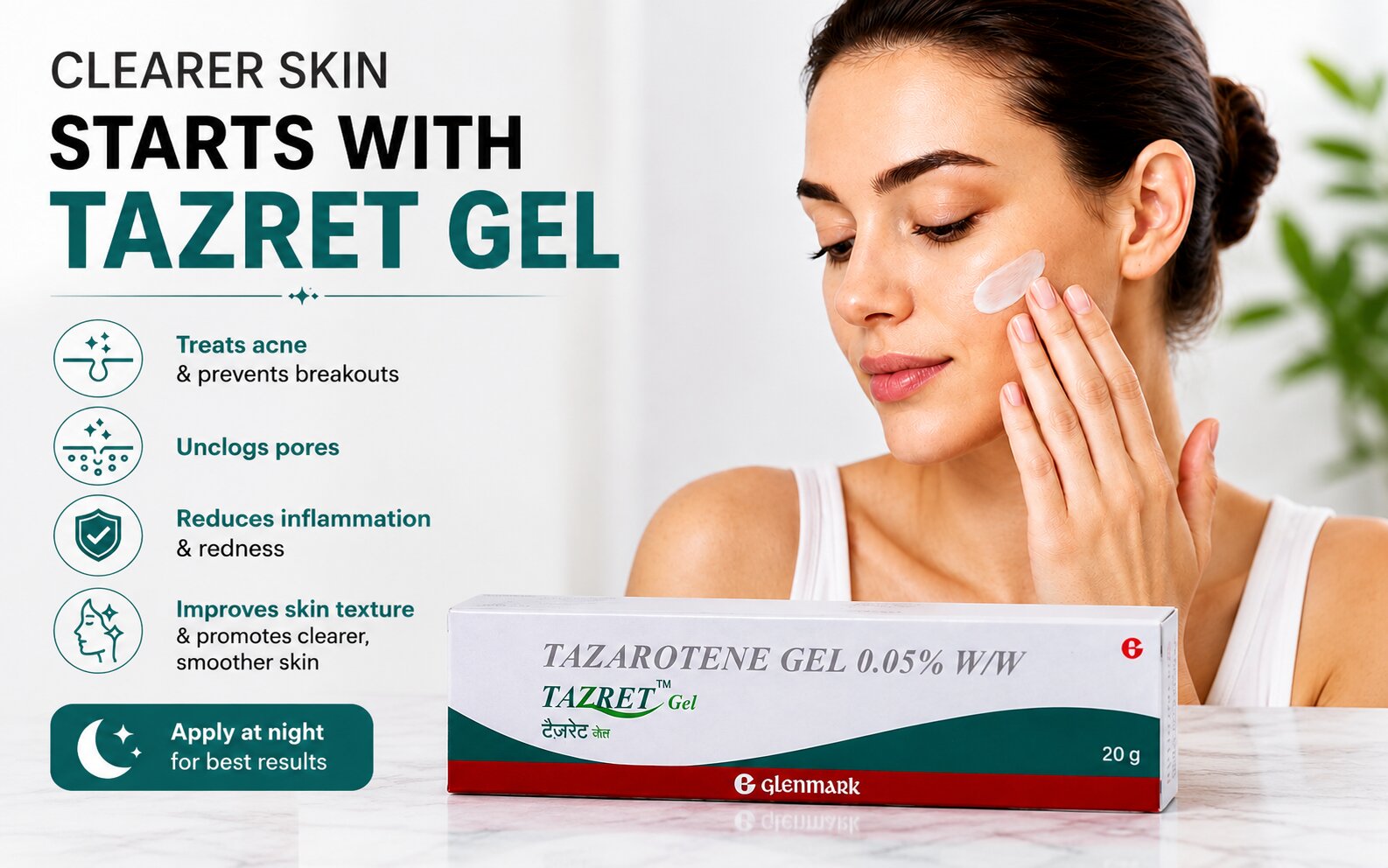
Tazret Gel is a topical retinoid medication built around tazarotene, an active ingredient primarily prescribed for plaque psoriasis and acne vulgaris. It belongs to the same broad family as adapalene and tretinoin — vitamin A derivatives that influence how skin cells grow and shed — but tazarotene is generally considered the most potent of the widely used topical retinoids. That extra strength means real benefits for stubborn skin conditions, but also a higher chance of irritation and a firmer need for medical supervision than milder, over-the-counter options.
Here’s a complete, accurate look at what Tazret Gel treats, how it works, what results to expect, and how to use it as safely as possible under a doctor’s care.
What Is Tazret Gel?
Tazret Gel is a generic formulation of tazarotene, manufactured in markets like India by companies such as Glenmark, and comparable to the original branded product, Tazorac. It’s a retinoid — a compound derived from vitamin A — formulated as a 0.05% topical gel meant for external use only.
It’s classified as a prescription-only medication in essentially every market where it’s sold, unlike some milder retinoids that are available over the counter at lower strengths. This isn’t a product to self-select off a pharmacy shelf.
How Tazarotene Works
Once applied, tazarotene converts into its active form inside the skin, where it binds to retinoic acid receptors found in skin cells. This interaction changes how those cells behave at a genetic level, and produces several downstream effects:
- Normalizing skin cell turnover. The medication slows the rapid, excessive skin cell production that drives plaque buildup in psoriasis, and it prevents dead skin cells from accumulating and clogging pores in acne-prone skin.
- Reducing inflammation. Tazarotene interferes with some of the inflammatory signals responsible for the redness and swelling seen in both conditions.
- Limiting cell overgrowth. Its antiproliferative properties directly reduce how quickly skin cells multiply, which is central to managing both psoriasis plaques and acne lesions.
Together, these mechanisms allow skin to gradually normalise rather than simply masking visible symptoms.
What Tazret Gel Treats
Plaque Psoriasis
Plaque psoriasis causes raised, scaly, often itchy and uncomfortable patches of skin. Tazarotene helps by reducing scaling, redness, and plaque thickness over consistent use. It works progressively — clearing affected skin gradually rather than delivering an immediate fix — and results generally build over several weeks.
Acne Vulgaris
For acne, tazarotene reduces existing lesions and helps prevent new ones by keeping pores clear of the dead skin cells and oil that lead to breakouts. It’s often considered for people who haven’t seen adequate improvement with gentler retinoids such as adapalene.
Additional Uses
Beyond its core approved indications, tazarotene is sometimes used, including off-label, for:
- Hyperpigmentation — its cell-turnover effect can help fade dark spots and even out skin tone over time.
- Photoaging and fine lines — some formulations are used to address facial wrinkles and visible skin aging, working through the same underlying mechanism that benefits acne-prone skin.
- Overall skin texture — with sustained use, the ingredient’s effect on cell turnover and collagen production can contribute to smoother, more even-textured skin, even outside its primary indications.
Benefits of Using Tazret Gel
When used correctly and consistently, people using tazarotene Gel can generally expect:
- Progressively clearer skin, as both psoriasis plaques and acne lesions resolve over time
- Less redness and scaling in psoriasis-affected areas
- Fewer new breakouts, since the mechanism helps prevent clogged pores rather than only addressing existing blemishes
- Improved skin texture as a secondary benefit of long-term, consistent use
- A relatively early initial response for some people — acne improvements are often noticeable within about four weeks, and psoriasis scaling and thickness can begin improving within one to four weeks of steady use
It’s worth setting realistic expectations: tazarotene works gradually and cumulatively rather than as a quick spot treatment. Skipping applications or stopping early tends to slow progress rather than speed anything up.
How to Use Tazret Gel Safely
Because tazarotene is a potent retinoid, correct technique matters both for how well it works and for keeping irritation manageable.
- Cleanse and dry the area first. Skin should be clean and completely dry before application, and hands should be washed both before and after.
- Apply a thin layer only. More product doesn’t speed up results — it typically just increases irritation.
- Treat only the affected areas. Avoid applying it to healthy, unaffected skin, since retinoids can unnecessarily irritate skin that doesn’t need treatment.
- Keep it away from sensitive areas. Avoid the eyes, nose, and mouth, and rinse thoroughly with water if accidental contact occurs.
- Stick to your prescriber’s exact schedule. Retinoid dosing is often started at a lower frequency — for example, every other night — and gradually increased as your skin builds tolerance.
- Apply in the evening. Like most topical retinoids, tazarotene can break down in sunlight and increases photosensitivity, so nighttime application is typically recommended.
- Support your skin barrier. Pairing treatment with a gentle, fragrance-free moisturizer and daily sunscreen helps manage the dryness and sun sensitivity that come with retinoid use.
Common Side Effects
Tazarotene is generally well tolerated once skin adjusts, but some irritation during the first several weeks is common and expected. Reported effects include:
- Itching, burning, redness, dryness, and mild peeling of the treated skin
- Temporary skin discoloration in some cases
- Occasional short-term worsening of psoriasis symptoms before improvement sets in
Most of these effects are mild and resolve on their own as the skin adjusts. However, seek prompt medical attention if you notice more serious signs of an allergic reaction — facial or throat swelling, hives, or difficulty breathing require immediate care.
Who Should Avoid Tazret Gel or Use It With Caution
Certain groups need extra caution with tazarotene, and some should avoid it altogether:
- Pregnant individuals. This is one of the more serious safety considerations with retinoid medications broadly, as tazarotene may pose a risk to fetal development and generally shouldn’t be used during pregnancy.
- Breastfeeding individuals. Use isn’t generally recommended unless a doctor determines it’s necessary, given limited safety data.
- People with eczema or sunburned skin. Applying a strong retinoid to already-compromised skin barriers can worsen irritation significantly.
- Anyone with a known sensitivity or allergy to tazarotene or other ingredients in the formulation.
- Children and younger teens. Safety and effectiveness haven’t been well established in children and younger adolescents, and use in anyone under 18 should only happen under direct medical guidance.
- People with liver, kidney, or heart conditions, or existing skin conditions — these should be discussed with a prescriber before starting treatment.
- Anyone expecting significant sun exposure, since tazarotene meaningfully increases photosensitivity and sunburn risk.
Tazarotene vs. Other Retinoids: How It Compares
Since tazarotene is often mentioned alongside other retinoids, it helps to understand where it fits in terms of strength and typical use:
- Tazarotene (Tazret/Tazorac) — Considered the most potent topical retinoid in common dermatological use. Effective for both acne and psoriasis, but carries the highest likelihood of irritation among commonly prescribed retinoids. Prescription-only in virtually all markets.
- Adapalene — A third-generation retinoid generally considered gentler than tazarotene, with a lower irritation profile. Available over the counter at 0.1% strength in several countries, making it a common starting point before escalating to something stronger.
- Tretinoin Gel — Falls between adapalene and tazarotene in potency for most people, widely used for acne and photoaging, and prescription-only in most markets.
Dermatologists often start patients on a gentler option like adapalene and move to tazarotene only if results are insufficient, since tazarotene’s added potency comes with a real trade-off in tolerability. This step-up approach is one reason a prescriber’s involvement matters — jumping straight to the strongest retinoid without medical guidance increases the odds of significant irritation without necessarily improving outcomes.
What to Expect During the Adjustment Period
Most people experience a period of increased irritation during the first two to four weeks of tazarotene use, sometimes informally called “retinization” or a “purge” phase. This isn’t a sign that the medication is failing — it typically reflects the skin adjusting to a faster cell turnover rate. During this window:
- Redness, flaking, and tightness are common and usually temporary
- Reducing application frequency (for example, every third night instead of nightly) can help skin adjust more comfortably
- A bland, fragrance-free moisturizer applied after the retinoid — or even before, in a technique sometimes called “buffering” — can reduce irritation without significantly reducing effectiveness
- Symptoms that worsen substantially, spread beyond the treated area, or don’t improve after several weeks are worth flagging to your prescriber, since dosing or frequency may need adjustment
Most people find that irritation eases meaningfully after the first month, even as the medication’s benefits continue to build with ongoing use.
Storage and Handling
Tazret Gel should be stored at room temperature, away from direct heat and sunlight, and kept out of reach of children. As with most topical medications, it shouldn’t be used past its labeled expiration date, since the active ingredient’s potency and safety profile aren’t guaranteed beyond that point. If a course of treatment is discontinued or completed, unused product should be disposed of according to local pharmacy guidelines rather than kept indefinitely.
Frequently Asked Questions
How long does it take to see results with Tazret Gel? Acne improvements are often noticeable within about four weeks of consistent use, while psoriasis scaling and plaque thickness may start improving within one to four weeks. Full results, especially for psoriasis, generally take longer and depend on sticking to the prescribed regimen.
Can Tazret Gel be used for wrinkles or anti-ageing, not just acne or psoriasis? Some formulations and off-label uses do extend to facial wrinkles and general skin aging, and long-term use may improve overall skin texture through its effect on cell turnover. This should still be discussed with a dermatologist rather than pursued independently, since the right concentration and application approach vary by goal.
Is it safe to drive or operate machinery while using it? There isn’t clear data either way on this, so it’s reasonable to be cautious — particularly if you experience any visual irritation from accidental contact with the eyes.
Can I use Tazret Gel alongside other acne or psoriasis treatments? Combination regimens are common in dermatology, but tazarotene is a strong retinoid on its own. Layering it with other active ingredients, like benzoyl peroxide or additional retinoids, without medical guidance raises the risk of significant irritation. Always check with your prescriber before combining treatments.
What should I do if I forget a dose? Simply resume your normal schedule at the next planned application rather than doubling up — applying extra to “catch up” only increases irritation risk without speeding up results.
Why does this require a prescription instead of being available over the counter? Tazarotene is one of the most potent topical retinoids available, with real considerations around pregnancy safety, skin barrier disruption, and interactions with other treatments. A prescriber can evaluate whether it fits your specific skin condition, screen for contraindications like pregnancy or eczema, and monitor your progress — oversight that matters more with a strong retinoid like this than with milder over-the-counter options such as adapalene or benzoyl peroxide.
The Bottom Line
Tazret Gel (tazarotene) is an effective, well-studied treatment for plaque psoriasis and acne vulgaris, working by normalizing skin cell turnover and calming inflammation at a cellular level. Its potency makes it a valuable option for people who haven’t responded to gentler treatments, but that same potency is exactly why it remains prescription-only: pregnancy risk, the potential for significant irritation, and the need for a tailored application schedule all call for a dermatologist’s involvement rather than self-directed use.
This article is for general informational purposes and isn’t a substitute for professional medical advice. Talk to your dermatologist before starting Tazret Gel, and follow their guidance on dosing, frequency, and duration of use.


