
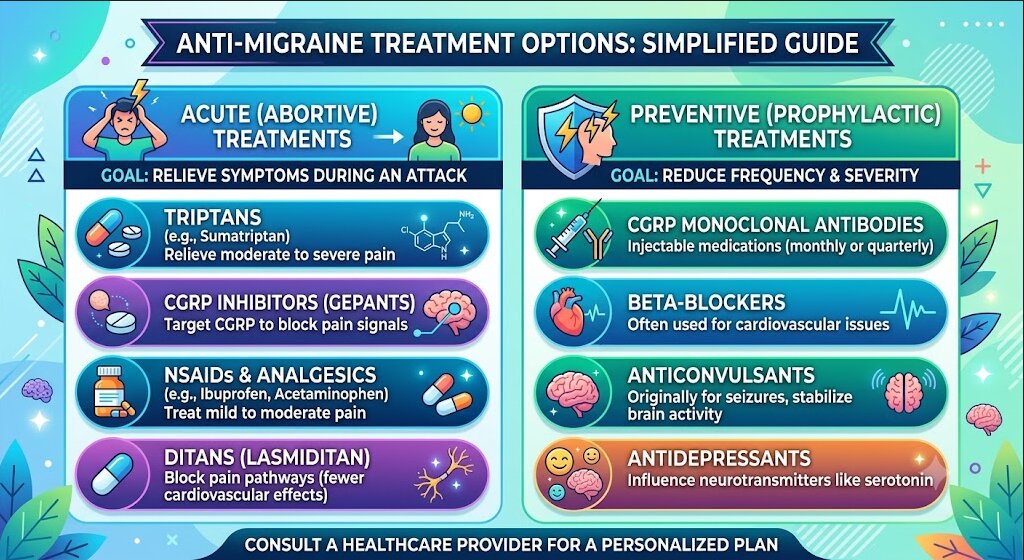
Migraines affect roughly one in four women and one in twelve men at some point in their lives, making it one of the most common neurological conditions worldwide. Yet despite how widespread it is, migraine is still frequently misunderstood as “just a bad headache.” In reality, it’s a complex neurological disease involving changes in brain activity, blood vessels, and pain-signalling pathways — and the medications used to treat it reflect that complexity.
This guide walks through the major categories of anti-migraine medications, how they work, and how doctors typically decide which approach is best for a given patient.
Understanding Migraine Before Treating It
Before diving into medications, it helps to understand what’s actually happening during an attack. Migraines typically progress through four stages: a prodrome phase (subtle warning signs like fatigue or irritability), an aura phase in some patients (visual disturbances or sensory changes), the attack itself (throbbing pain, nausea, light and sound sensitivity), and a postdrome phase (a “migraine hangover” of grogginess afterwards).
Because migraine involves several biological mechanisms — blood vessel dilation, inflammation, and abnormal activity of the trigeminal nerve system, along with a neuropeptide called CGRP (calcitonin gene-related peptide) — treatments target different points in that process. This is why no single medication works for everyone, and why treatment is usually split into two broad categories: acute (abortive) treatment, taken to stop an attack once it starts, and preventive treatment, taken regularly to reduce the frequency of attacks in the first place.
Acute Treatments: Stopping an Attack in Progress
Over-the-Counter Pain Relievers
For mild-to-moderate migraines, many people start with standard pain relievers: NSAIDs like ibuprofen or naproxen, or acetaminophen. These are often effective when taken early in an attack, before pain becomes severe. Some formulations combine a pain reliever with caffeine, which can enhance absorption and effectiveness.
The main limitation is that OTC medications frequently aren’t strong enough for moderate-to-severe migraines, and using them too frequently (generally more than 10–15 days a month, depending on the drug) can actually trigger a separate condition called medication-overuse headache, where the treatment itself becomes part of the problem.
Triptans
Triptans are considered the first migraine-specific drug class and remain a mainstay of acute treatment nearly three decades after their introduction. They work by activating serotonin (5-HT1) receptors, which cause constriction of dilated blood vessels in the brain and interrupt the transmission of pain signals along the trigeminal nerve pathway.
Commonly used triptans include:
- Sumatriptan — the original triptan, available as a tablet, nasal spray, and injectable. The injection and nasal spray act fastest, often within 10–15 minutes, making them useful for attacks that escalate quickly or come with vomiting.
- Rizatriptan — known for rapid absorption and available as an orally disintegrating tablet, which dissolves on the tongue without water — is a practical option when nausea makes swallowing pills difficult.
- Eletriptan — a later-generation triptan with strong oral bioavailability and generally good tolerability.
- Zolmitriptan, naratriptan, almotriptan, and frovatriptan — additional options that differ mainly in onset speed and duration of action, giving doctors flexibility to match a triptan to a patient’s attack pattern.
Triptans are most effective when taken at the earliest sign of an attack, rather than waiting for pain to peak. They aren’t appropriate for everyone, though — they’re generally avoided in people with uncontrolled high blood pressure, coronary artery disease, or a history of stroke, since their vessel-constricting action can pose risks in those conditions.
Gepants: A Newer Acute Option
Gepants are a newer class of oral medications that block the CGRP receptor directly, interrupting one of the key pathways involved in migraine pain, without the vessel-constricting effect of triptans. This makes them a valuable option for people who can’t safely take triptans due to cardiovascular risk factors.
- Ubrogepant is approved specifically for acute treatment.
- Rimegepant is notable for dual approval — it can be used both to stop an attack in progress and, taken every other day, as a preventive treatment, which simplifies treatment for some patients.
Ergotamines
Ergotamine-based medications were among the earliest migraine-specific treatments, predating triptans by decades. They still have a role for some patients with attacks that don’t respond well to triptans, though they’ve largely been supplanted due to a narrower safety margin and more pronounced side effects like nausea.
Anti-Nausea Medications
Because nausea and vomiting are core migraine symptoms — not just side effects of treatment — anti-nausea medications (antiemetics) like metoclopramide or prochlorperazine are frequently prescribed alongside a primary treatment, particularly for attacks severe enough to cause vomiting.
Preventive Treatments: Reducing Attack Frequency
Preventive treatment is generally considered when migraines occur four or more days a month, significantly disrupt daily life, or don’t respond adequately to acute treatment alone. The goal isn’t to eliminate migraines entirely but to reduce their frequency, severity, and duration.
Established Preventive Options
For decades, migraine prevention relied on medications originally developed for other conditions:
- Beta-blockers (like propranolol), originally developed for high blood pressure
- Certain antidepressants (like amitriptyline) are used at lower doses than for depression
- Anti-seizure medications (like topiramate or divalproex), which calm overactive nerve signalling
These remain valid, well-studied options, particularly because of their long track record and lower cost, though they come with class-specific side effects (such as fatigue with beta-blockers or cognitive effects with topiramate) that don’t suit every patient.
CGRP-Targeting Therapies
The most significant shift in migraine prevention over the past several years has been the arrival of CGRP-targeting therapies, which directly address a mechanism now understood to be central to migraine biology.
Two forms exist:
- Monoclonal antibodies — erenumab, fremanezumab, galcanezumab, and eptinezumab — given by injection (self-administered monthly for most, or quarterly for some) or infusion
- Gepants used preventively — atogepant, and rimegepant taken every other day
What makes this shift notable is that the American Headache Society updated its clinical guidance to recognise CGRP-targeting therapies as a first-line preventive option — meaning patients no longer need to try and fail older medications first before qualifying for them. This reflects a strong and growing body of evidence on their effectiveness and, notably, their tolerability, which tends to be better than some older preventive drug classes.
OnabotulinumtoxinA (Botox)
For chronic migraine — defined as 15 or more headache days a month, with at least 8 being migrainous — onabotulinumtoxin A injections administered by a specialist every 12 weeks are an established and effective preventive option, generally reserved for this more severe pattern rather than episodic migraine.
Lifestyle Measures That Support Medication
No medication works in isolation from lifestyle factors, and doctors typically pair any drug regimen with:
- Trigger identification — using a headache diary to spot patterns around food, sleep, stress, or hormonal changes
- Consistent sleep and meal schedules — irregularity is one of the most common and modifiable triggers
- Hydration and moderate caffeine intake — both dehydration and caffeine withdrawal can provoke attacks
- Stress management — through exercise, mindfulness, or relaxation techniques
- Resting in a dark, quiet room at the first sign of an attack, which can shorten its course
How Doctors Choose a Treatment Plan
There’s no universal “best” anti-migraine medication — the right choice depends on several factors a doctor weighs together:
- Attack frequency and severity — occasional mild attacks may only need OTC treatment, while frequent or disabling attacks warrant preventive therapy
- Cardiovascular history — ruling out conditions that make triptans or ergotamines risky
- Presence of aura — which can affect treatment choice, particularly around certain birth control formulations in patients who also need contraception
- Medication-overuse risk — tracking how often acute medications are used to avoid triggering rebound headaches
- Coexisting conditions — for instance, propranolol may be attractive for a patient who also has high blood pressure, while topiramate might be avoided in someone prone to kidney stones
This is also why self-diagnosing and self-treating migraine with medications obtained without medical oversight carries real risk — the same triptan that works well for one patient could be contraindicated for another due to an underlying heart condition they may not even be aware of.
When to See a Doctor
Most migraine can be managed effectively with the right combination of acute and, when needed, preventive treatment. But certain symptoms warrant prompt medical attention rather than self-management:
- A sudden, severe headache unlike any previous one (“worst headache of your life”)
- Headache accompanied by fever, stiff neck, confusion, or vision loss
- A new headache pattern emerging after age 50
- Headache following a head injury
These can signal something other than migraine and should be evaluated urgently.
The Bottom Line
Anti-migraine treatment has evolved considerably — from the introduction of triptans decades ago to today’s CGRP-targeting therapies, which represent the first drug class designed specifically around a core mechanism of migraine biology. Between acute treatments to stop an attack and preventive options to reduce how often attacks occur, most people with migraine have real, effective options available.
The key is that these are prescription medications whose safety depends heavily on individual medical history — cardiovascular status, coexisting conditions, and other medications all factor into which option is appropriate. A conversation with a doctor or headache specialist remains the safest and most effective starting point for building a treatment plan that actually fits.
This article is for general educational purposes only and isn’t a substitute for personalised medical advice. Always consult a licensed healthcare provider before starting, stopping, or changing any medication.


Max Jones
Latest posts by Max Jones (see all)
- How to Revive Your Sex Life - October 27, 2023
- Smoking and Asthma - October 20, 2023
- 10 Causes Of Erectile Dysfunction You Probably Didn’t Know About! - June 29, 2023


